IP69 is an enclosure protection rating under IEC 60529. The first digit, 6, means dust-tight; the second digit, 9, identifies protection against high-pressure, high-temperature water jets under specified test conditions. IP69 does not by itself establish protection against immersion.
For equipment buyers, the rating is the starting point. The test standard, assembly dimensions and operating requirements determine the chamber, fixtures and measurements needed.
IP69 Meaning and the Limits of the Rating
The IP code describes protection provided by an enclosure against access to hazardous parts, solid foreign objects and water. In everyday product discussions, it is often called an ingress protection rating.
| Code element | Meaning | What to check in the supporting documentation |
|---|---|---|
| IP | Enclosure protection classification | Applicable standard and edition |
| 6 | Dust-tight protection | Evidence covering the dust requirement, not only water testing |
| 9 | Resistance to high-pressure, high-temperature water jets | Specimen setup, test method and acceptance results |
IPX9 describes water protection only. The X means that the designation does not specify protection against solid particles; it does not indicate a failed dust test. A water-test result alone therefore cannot support an IP69 claim.
The IP69 rating applies to the enclosure configuration tested, including its seals and cable connections.
IEC 60529 and ISO 20653 Define Different Test Requirements
IEC 60529 for IP69
IEC 60529 is the general enclosure protection standard. Its consolidated Edition 2.2 combines the 1989 publication with the 1999 and 2013 amendments. Amendment 2 introduced the water characteristic 9. Use the applicable consolidated text and corrigenda when preparing a test procedure.
ISO 20653 for automotive requirements
ISO 20653 addresses electrical equipment in road vehicles. Its K codes describe particular automotive requirements. ISO 20653:2023 is the published third edition checked for this article; the ISO catalogue also lists a successor under development. A working draft is not a published replacement.
Product literature often uses the term IP69K. When writing a specification, separate the water requirement IPX9K from the dust requirement, such as IP6KX, and use the complete designation from the test report, which may be IP6K9K. An automotive test report does not automatically support an IEC IP69 claim.
The 2023 ISO revision expanded IPX9K test conditions and added detail on impact-force measurement and tolerances. An equipment specification referring only to an unspecified ISO 20653 edition therefore needs further review.
DIN 40050-9 in older specifications
DIN 40050-9 appears in many older IP69K explanations and equipment descriptions. DIN Media lists DIN 40050-9:1993-05 as withdrawn. For a new automotive project, confirm the required ISO 20653 edition and any OEM requirements; retain an older method only where the contract calls for it.
IP69 vs IP68 and IP69K — Match the Rating to the Exposure
An enclosure that needs pressure washing and one that may remain submerged have different test requirements. A larger number alone does not tell the buyer which exposure was assessed.
| Rating or designation | Main water exposure | Practical implication |
|---|---|---|
| IP66 | Powerful water jets | Relevant to hose exposure; obtain separate evidence for hot, close-range cleaning |
| IP67 | Temporary immersion | Relevant where brief submersion is specified |
| IP68 | Continuous immersion under specified conditions | Check the declared depth, duration and other agreed conditions |
| IP69 | High-pressure, high-temperature water jets under IEC 60529 | Relevant to defined washdown exposure |
| IP69K / IP6K9K as documented | Automotive hot-water jet protection with the documented dust characteristic | Check ISO 20653, its edition and the exact designation |
IP69 is not a universal upgrade to IP68. Immersion and jet cleaning apply water differently. Products exposed to both need evidence for both. Likewise, IPX9 does not automatically establish compliance with IPX5 or IPX6. Multiple designations should reflect the tests actually completed.
IP69 Testing Procedures — Critical Dust and Water Parameters
Before loading the specimen, record its sealing configuration: covers, glands, mating plugs, vents and fastener settings. These details allow another engineer to reproduce the setup.
An IP69 assessment needs evidence for both dust and water protection, plus applicable access-protection requirements. Agree sample quantities, sequence, preconditioning, operating state and acceptance criteria. The procedure does not necessarily use one specimen in a fixed dust-then-water sequence.
Dust testing for the first digit 6
For IEC 60529 dust testing, the test medium is talcum powder meeting the specified sieve requirements. The nominal sieve opening is 75 μm with 50 μm wire diameter. The powder charge is 2 kg per cubic metre of chamber volume; this is not a measured airborne dust concentration.
The IP6X procedure uses air extraction from the specimen enclosure. The method controls pressure difference and extracted air volume; the maximum depression is 2 kPa.
Test duration depends on the extraction conditions and the applicable procedure. Dust-tight acceptance requires no dust ingress.
In equipment selection, assess how the sample connects to the extraction system, how pressure is measured and how dust is kept circulating. A chamber’s maximum vacuum capability is a hardware limit, not the test setpoint.
For automotive dust testing, select the dust medium, circulation or pulse sequence and specimen connections required by ISO 20653. A chamber used for both IEC and ISO methods also needs a suitable dust-change and cleaning procedure.
Water testing for the second digit 9
The enclosure’s size determines the IEC IPX9 arrangement. Check the largest dimension before programming a four-position cycle; larger enclosures require a different coverage and timing approach. Use the values below with the standard’s apparatus drawings and full procedure.
| Item | IEC 60529 IPX9 planning value |
|---|---|
| Water temperature | 80 ± 5°C |
| Flow | 15 ± 1 L/min |
| Small enclosure | Largest dimension below 250 mm |
| Small-enclosure arrangement | Rotating specimen; 0°, 30°, 60° and 90° positions |
| Rotation | 5 ± 1 r/min |
| Small-enclosure exposure | 30 seconds per position |
| Large enclosure | Largest dimension at least 250 mm; mounted as intended for use |
| Large-enclosure nozzle distance | 175 ± 25 mm |
| Large-enclosure exposure | 1 min/m² of calculated exposed area, excluding mounting surface; minimum 3 minutes |
For small enclosures, the IEC arrangement uses a nozzle-to-surface distance of 125 ± 25 mm. For large enclosures, the distance is 175 ± 25 mm. Measure to the surface being sprayed, not to the turntable centre.
A correct pressure reading does not prove that the nozzle produces the required jet. Check the specified impact-force distribution using the prescribed measurement arrangement; the 0.9–1.2 N criterion refers to that arrangement, not the total force acting on the enclosure.
BONAD’s listed water-test equipment operates at 8,000–10,000 kPa (80–100 bar). Pressure is one part of the setup: nozzle geometry, flow, temperature, spray distance and impact-force verification must also match the selected method.
For ISO IPX9K work, prepare a separate recipe and verification plan for the specified edition. Similar four-angle arrangements do not make the standards interchangeable.

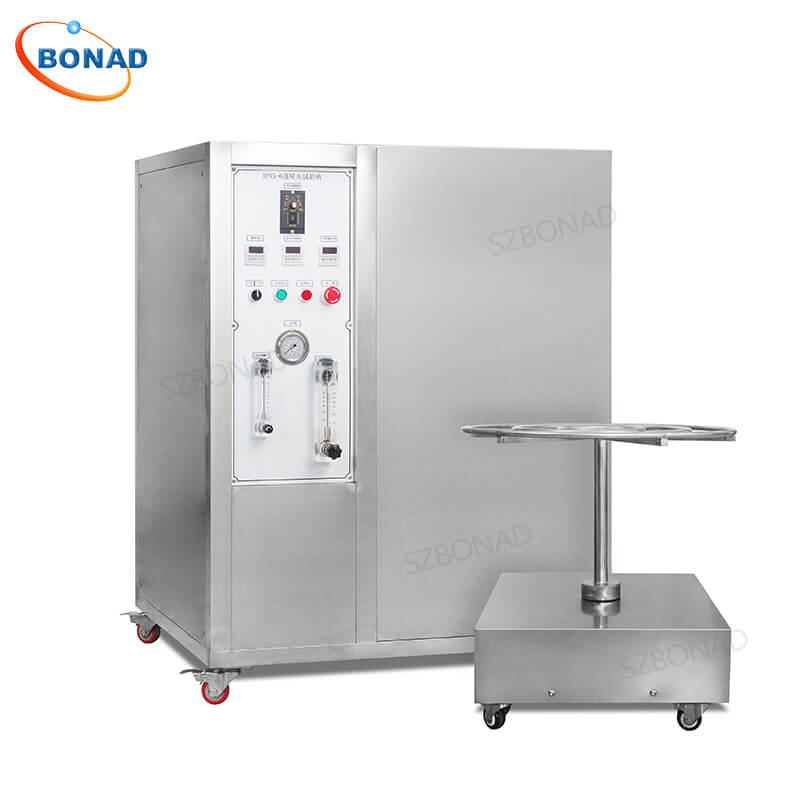
BONAD IPX9K test chamber showing four spray nozzles positioned at 0°, 30°, 60° and 90°, from bottom to top, around the specimen turntable.
Inspection and acceptance
Define the inspection method and any functional or electrical checks before testing. Water-ingress acceptance depends on the harmful effects defined by the applicable requirements; a universal zero-droplet rule does not apply to every product. Product standards or customer specifications may impose stricter conditions.
The report should identify the sample, sealing configuration, mounting, standard edition, equipment, recorded conditions, inspection findings and deviations. Photographs of cable entries and closure details make the result easier to interpret later.
Applications Where Washdown Reaches Seals and Connectors
Choose the rating around the cleaning routine: water temperature, nozzle distance and the joints or connectors exposed to the spray. The following applications often bring those details into the test plan.
| Application | Why hot-water jet testing may matter | Additional question for the test plan |
|---|---|---|
| Food and beverage machinery | Electrical housings may be exposed during washdown | Which detergents, disinfectants and cleaning cycles are used? |
| Vehicle cameras and sensors | External modules can encounter close-range pressure washing | Which automotive specification and connector condition apply? |
| Mobile robots | Camera, sensor and control housings may need cleaning after dusty operation | Does the complete assembly have exposed vents, joints or cable entries? |
| Agricultural and construction equipment | Mud removal can direct jets onto seals and interfaces | Is additional vibration, impact or corrosion testing required? |
| Industrial control equipment | Local washdown may reach displays, buttons and enclosure doors | Is the installed orientation represented in the test? |
Outdoor location alone does not establish a need for IP69. An enclosure exposed to rain, one temporarily flooded, and one cleaned with hot pressure jets need different exposure assessments.
IP69 also does not establish food-contact approval, hygienic design, disinfectant resistance or sterilisation capability. Those properties need their own evidence.
Selecting IP69 Test Equipment — Fixtures, Calibration and Cable Access
A specimen can fit through the door and still be impossible to test correctly. Its bracket may shield a seam, its harness may foul the turntable, or the nozzle may not reach the required distance. Review the complete assembly drawing before choosing a chamber volume.
Check the fixture and spray path first
Include the specimen, bracket, connectors and cable bend radius in the working envelope. Check their combined weight, mounting points and centre of gravity against the fixture and turntable capacity.
For automotive components and heavy industrial enclosures, compare open and enclosed systems using this complete setup. Allow space for the required nozzle distance and access to exposed surfaces. A fixture should secure the sample without shielding areas that the method requires to be sprayed.
Check the spray distance at the specimen surface throughout the required movement. Use the distance specified for the selected standard, edition and enclosure size.
Open or enclosed water-test equipment
An enclosed chamber is practical when the assembly fits its usable workspace and loading arrangement. Check door access, observation, drainage and cable routing as well as nominal volume.
An open system provides access around larger or awkwardly shaped assemblies. Its installation needs space for spray coverage, guarding and water collection.
| BONAD equipment | Listed configuration | What to check with the specimen drawing |
|---|---|---|
| Open-Type IPX9K Waterproof Test Chamber | BND-OPX9; 800 mm turntable; 100 kg listed capacity | Fixture footprint, total load, access around the assembly and achievable spray path |
| ISO 20653 IPX9K High Pressure Waterproof Test Chamber | 512 L and 1000 L models; 400 mm turntable; 50 kg listed capacity | Door opening, rotating envelope, harness routing and nozzle clearance |
On the BND-OPX9 open-type system, the spray lance can be adjusted vertically over a travel of 350 mm. Set the nozzle-to-specimen distance separately for the selected test method.
Both BONAD configurations use test water at 80 ± 5°C, a range of 75–85°C. Confirm the final working envelope, load capacity and method-specific configuration in the equipment proposal. Turntable diameter is a model specification, not a universal requirement of the IP standard.
Dust chambers need room for circulation and specimen connections
A wiring harness can take more space than the automotive module it serves. For ISO 20653 IP5KX/IP6KX work, check how the complete assembly will be mounted and how power, monitoring or specimen connections will enter the chamber.
| Test requirement | BONAD equipment or solution | Selection focus |
|---|---|---|
| IEC IP6X testing for larger specimens | IEC 60529 2000L Sand and Dust Test Chamber | Loading access, dust circulation and specimen extraction |
| ISO automotive dust testing | ISO 20653 IP5KX / IP6KX Automotive Dust Chamber | Dust medium, exposure sequence, mounting and harness connections |
| Comparing standard and custom configurations | BONAD Dust Chamber Solutions | Cabinet, 2000 L or walk-in layout and project-specific options |
Leave enough space around the specimen for dust circulation. When loading several samples, check whether neighbouring products, fixtures or cables obstruct the exposure.
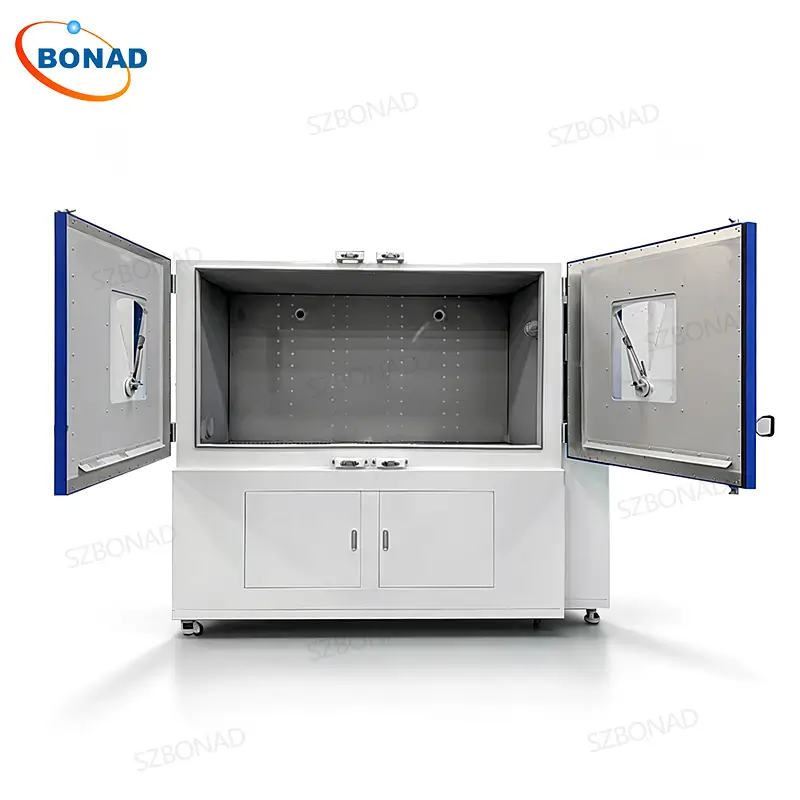
BONAD IP5X/IP6X dust chamber showing the test workspace and chamber access ports. Cable entry arrangements for powered specimen testing are configured to suit the test requirements.
Confirm that the equipment documentation covers the selected model. Equipment conformity documents, calibration certificates and specimen ingress-protection test reports serve different purposes.
Calibration access and ISO/IEC 17025 laboratory requirements
For laboratories working to ISO/IEC 17025, calibration access belongs in the equipment specification. Depending on the design, this can include pressure connection points, access for reference temperature probes, a flow-check arrangement and space for a jet-force measurement fixture.
If accredited calibration is required, check that the provider’s scope covers the quantities, ranges and measurement uncertainties needed. Request records identifying the instruments, calibration points, results, uncertainty and metrological traceability. ISO/IEC 17025 accreditation applies to laboratory competence; it is not a certification of the chamber.
Instrument calibration and nozzle verification serve different purposes. Calibrating a force sensor establishes its measurement performance. Verifying the nozzle checks the jet’s force distribution under the prescribed conditions. Specify the nozzle identification, measurement arrangement and verification record as part of the equipment acceptance requirements.
BONAD can provide third-party calibration certificates for its IPX9 test equipment. State the required measurement parameters, ranges and any accreditation requirements in your enquiry so the documentation can be matched to the selected configuration.
Factory Certificates, Calibration and CE Documentation
All BONAD test equipment is supplied with a factory certificate. Third-party calibration certificates and CE conformity documentation can also be arranged on request for the selected model and configuration. Include these requirements when requesting a quotation.
IPX9 Test Equipment — Third-Party Calibration Certificate
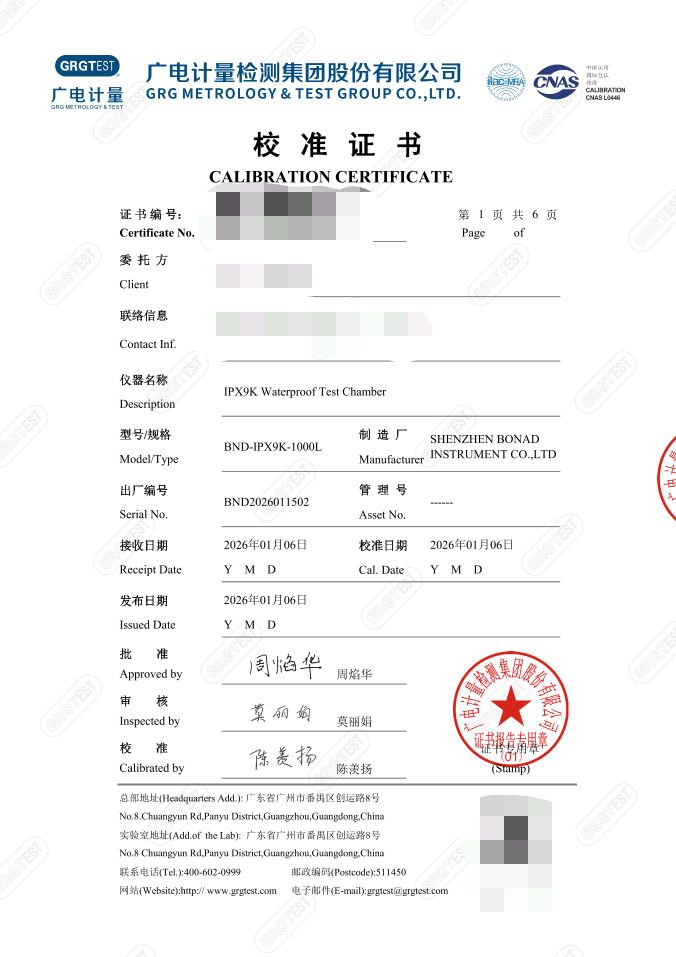
Temporary image placeholder: the CE conformity document is shown here. Replace it with the IPX9 third-party calibration certificate when the certificate image is available.
IP5X/IP6X Dust Chamber — CE Conformity Documentation
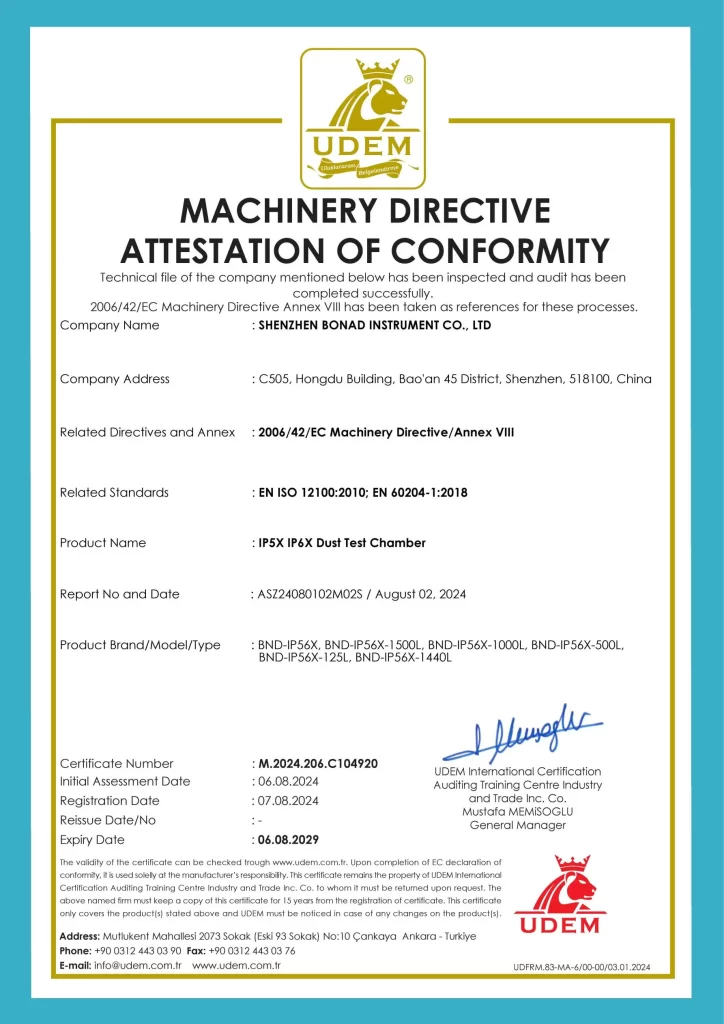
Machinery Directive Attestation of Conformity for the BONAD IP5X/IP6X dust chamber models listed in the document.
Powered testing and cable entry protection
BONAD’s dust chambers and the open-type and enclosed IPX9K systems support powered specimen testing. The specimen test voltage and current can be customized to the test requirements, and the equipment power supply can be configured for the customer’s local supply voltage.
Specify the specimen test supply and the equipment power supply separately. Include the specimen’s operating mode and monitoring connections, and agree whether operation is required during exposure, between stages or only before and after the test.
The chamber cable feedthrough contains the test environment around the wiring. The specimen’s own cable gland or connector must remain in its intended installation configuration, with any required exposure unobstructed. Record changes to the specimen’s seals or connections in the test setup.
Select sealed feedthroughs and cable restraints for the operating conditions. For rotating tests, agree how the wiring will accommodate the required movement and twist limits. Where a slip ring is needed, include it in the equipment specification.
Keep external power supplies and measurement equipment outside the exposure area. Review the electrical design for the actual load, isolation, protective earthing where applicable, leakage protection and emergency shutdown.
Record actual conditions and agree acceptance checks
Ask which measured values are logged and exported. A saved recipe shows the intended settings; the test record should show the conditions actually achieved. Confirm how timing, temperature stability and nozzle verification will be demonstrated during acceptance.
Use a representative assembly for the agreed factory acceptance checks. Confirm site electricity, water supply, drainage, ventilation, floor loading and maintenance access, plus compressed air where required by the selected equipment.
IP69 Specification and Test Setup Pitfalls
Treating IP69 as unlimited waterproofing. Keep use instructions tied to the assessed exposure. Extra immersion, chemicals or unusual cleaning conditions need separate evaluation.
Confusing the setpoint with the recorded water temperature. Verify that the system maintains 80 ± 5°C during the required exposure. A heater rating or an idle tank reading alone does not demonstrate this.
Checking pressure but overlooking the nozzle. Worn, blocked or substituted nozzles can change the jet. Include nozzle identification, maintenance and verification in laboratory practice.
Checking fit without checking exposure. A clamp can hide a seal even when the specimen fits comfortably in the chamber. Review spray coverage and dust circulation after the fixture is installed.
Changing the tested assembly. Replacement seals, different cable diameters, unmated connectors or altered fastener torque can change the enclosure configuration. Review whether further testing is needed.
Using one initial test to claim lifetime durability. Where service conditions justify it, define additional ageing, thermal cycling, vibration or repeated-cleaning work. Keep those results separate from the basic ingress-protection claim.
Confusing test equipment with product certification. Owning a chamber does not certify the products placed inside it. If an independent or accredited report is required, agree the laboratory, method, scope and reporting requirements before starting.
Frequently asked questions about IP69
Is IP69 better than IP68?
IP69 addresses high-pressure hot-water jets; IP68 addresses immersion under specified conditions. Products exposed to both need evidence for both.
Can an IP69 product be used underwater?
IP69 alone does not establish suitability for underwater use. Check the product’s separate immersion rating and its stated depth, duration and operating conditions.
Are IP69 and IP69K identical?
No. Check the standard, edition and complete designation in the test report. Similar equipment and spray arrangements do not make the documented claims interchangeable.
Does passing IPX9 alone establish IP69?
No. IP69 also requires dust-tight protection for the first digit, 6, along with the other applicable assessment requirements.
Does IP69 permit steam sterilisation or chemical cleaning?
It does not establish either capability. Obtain cleaning instructions and material-compatibility evidence for the actual process.
Can one test system support both IEC and ISO methods?
One system can support both when its hardware, controls and verification arrangements meet the specified methods. Request separate documented test settings and procedures for each standard and edition.
What information is needed for an equipment quotation?
Send the standard and edition, required ratings, specimen dimensions and weight, mounting arrangement, test quantity, powered-operation needs, available utilities and required reporting documents.
Plan Your IP69 Test Setup with BONAD
As a manufacturer, BONAD provides standard and customized dust and water ingress testing solutions. We can review your specimen dimensions, test methods and laboratory requirements to help select suitable equipment.