Product reliability depends not only on design and manufacturing quality but also on how products perform under environmental stress. Temperature extremes, humidity exposure, and climate variation can significantly affect electrical, electronic, and industrial products throughout transportation, storage, and operation.
To evaluate these conditions in a controlled and repeatable way, manufacturers and laboratories widely adopt IEC 60068, an internationally recognized environmental testing framework.
Rather than representing a single test, IEC 60068 provides standardized methods for assessing product durability under environmental conditions such as cold, heat, humidity, and temperature change. These methods help manufacturers identify potential failure risks, improve reliability, and support product qualification.
This guide explains IEC 60068 in detail, including its standard structure, common test methods, environmental chambers, industry applications, and future testing trends.
What Is IEC 60068?
IEC 60068 is an international environmental testing standard developed to evaluate how electrical, electronic, and electromechanical products perform when exposed to environmental stresses.
The standard does not certify a product by itself. Instead, it defines repeatable and internationally recognized test methods that manufacturers and laboratories can use to assess product durability, reliability, and environmental resistance.
The primary objective of IEC 60068 is to reproduce environmental conditions that products may encounter during:
- Transportation
- Storage
- Installation
- Operation
- Long-term service exposure
These conditions may include:
- Extreme cold
- Dry heat
- Temperature transitions
- High humidity
- Condensation
- Combined environmental stress
By using standardized testing procedures, manufacturers can compare results consistently across different laboratories and markets.
IEC 60068 is maintained by the International Electrotechnical Commission (IEC), an organization responsible for developing globally recognized electrotechnical standards. Because IEC standards are widely accepted internationally, IEC 60068 testing is frequently referenced in OEM specifications, laboratory procedures, and procurement requirements.
Why IEC 60068 Matters in Product Reliability
Environmental stress is one of the leading causes of product degradation and premature failure.
Even when products pass electrical and functional verification, environmental conditions can still trigger hidden reliability problems.
Typical failure mechanisms include:
- Moisture penetration
- Corrosion of conductive materials
- Seal deterioration
- PCB delamination
- Solder joint fatigue
- Material expansion and contraction
- Condensation-related short circuits
- Mechanical deformation caused by thermal cycling
These failures may not appear immediately during manufacturing inspection. Instead, they often emerge after shipping, storage, or field deployment.
IEC 60068 testing helps manufacturers identify these weaknesses before products reach the market.
From a business perspective, environmental testing supports several strategic objectives:
1. Improved Product Reliability
Environmental validation reduces unexpected field failures and improves long-term performance consistency.
2. Reduced Warranty and Service Costs
Early failure detection can significantly lower repair expenses and warranty claims.
3. International Market Acceptance
Many OEMs and buyers reference IEC environmental testing requirements when qualifying suppliers.
4. Faster Product Development
Standardized test procedures help engineering teams validate designs more efficiently and make data-driven design improvements.
For B2B manufacturers, environmental testing is therefore not merely a compliance activity—it is a reliability engineering tool.
IEC 60068 vs Other Environmental Testing Standards
Environmental testing is not governed by a single global standard. Depending on industry and region, manufacturers may encounter IEC, ISO, MIL, or sector-specific requirements.
Understanding the differences helps laboratories and procurement teams choose the appropriate framework.
Environmental Standard Comparison
| Standard System | Main Focus | Typical Industries | Global Use |
|---|---|---|---|
| IEC 60068 | Environmental testing for electrical and electronic products | Electronics, industrial equipment, electrical systems | Global |
| ISO Standards | Quality and management systems | Multi-industry | Global |
| MIL-STD Environmental Tests | Military durability and defense requirements | Defense, aerospace | Primarily military |
| Automotive OEM Standards | Vehicle-specific validation | Automotive and EV | OEM dependent |
IEC 60068 differs from military standards in an important way.
Military specifications often simulate highly severe operating conditions with defense-specific requirements. IEC 60068, by contrast, provides commercially relevant environmental testing methodologies suitable for broader industrial and consumer applications.
This flexibility explains why IEC 60068 is frequently incorporated into:
- CE-related testing frameworks
- Product qualification programs
- Industrial reliability validation
- Supplier acceptance procedures
- Third-party laboratory protocols
IEC 60068 Family Overview
IEC 60068 is not a single test. It is a family of environmental testing standards, with each section addressing a particular environmental condition or testing procedure.
Among the many published parts, several are commonly referenced in environmental chamber applications.
Common IEC 60068 Environmental Tests
| IEC 60068 Standard | Environmental Condition | Purpose | Typical Equipment |
|---|---|---|---|
| IEC 60068-2-1 | Cold | Evaluate low-temperature resistance | Temperature chamber |
| IEC 60068-2-2 | Dry heat | Assess high-temperature durability | High-temperature chamber |
| IEC 60068-2-14 | Temperature change | Simulate thermal cycling and transition stress | Thermal cycling chamber |
| IEC 60068-2-30 | Damp heat cyclic | Reproduce cyclic humidity conditions | Temperature and humidity chamber |
| IEC 60068-2-78 | Damp heat steady state | Verify long-term humidity resistance | Climate chamber |
Each test method addresses a different failure risk.
For example:
- Cold testing may reveal brittle material behavior.
- Dry heat testing evaluates thermal aging.
- Humidity testing examines moisture-related degradation.
- Thermal cycling identifies expansion and contraction stress.
Because real-world operating environments rarely involve a single stress factor, manufacturers often combine multiple IEC 60068 methods during product validation.
Global Adoption of IEC 60068
IEC 60068 has become increasingly important as manufacturing and supply chains globalize.
Products designed in one region may be assembled in another and ultimately deployed across multiple climate zones.
For example:
- Consumer electronics shipped to Northern Europe may experience sub-zero logistics conditions.
- Industrial equipment installed in Southeast Asia may face prolonged high humidity exposure.
- Automotive electronics may encounter rapid thermal cycling and condensation.
IEC 60068 provides a common environmental testing language that helps manufacturers and buyers communicate reliability expectations clearly.
The standard is widely used in:
Electronics and Electrical Equipment
Used to validate PCB assemblies, connectors, power supplies, sensors, and control systems.
Automotive and EV Components
Applied to electronic modules, battery-related assemblies, charging systems, and thermal management components.
Telecommunications Infrastructure
Important for outdoor communication equipment exposed to temperature and humidity variation.
Aerospace and Transportation
Supports environmental durability assessment for electronic subsystems and support equipment.
Medical and Laboratory Equipment
Helps verify storage stability and operational reliability under controlled environmental conditions.
Because of this broad adoption, IEC 60068 testing often serves as both a technical requirement and a commercial credibility indicator.
Understanding the IEC 60068 framework is only the first step. Effective environmental validation depends on selecting the appropriate test method and reproducing environmental stress under controlled laboratory conditions.
Among the various IEC 60068 procedures, temperature and humidity testing are the most widely implemented and form the foundation of environmental reliability assessment.
The following sections examine how these methods work and what types of product failures they are designed to reveal.
Why Environmental Chambers Matter
IEC 60068 test methods rely on one essential principle: environmental conditions must be controlled, repeatable, and measurable.
This is why environmental chambers play a central role in reliability validation.
An environmental chamber is designed to reproduce controlled temperature and humidity conditions so that laboratories and manufacturers can evaluate product performance under predefined stress profiles. Unlike uncontrolled field exposure, chamber-based testing allows engineers to repeat identical test conditions, compare results, and identify failure mechanisms with greater accuracy.
For IEC 60068 testing, chamber performance directly affects:
- Test repeatability
- Measurement accuracy
- Compliance confidence
- Data reliability
- Product qualification consistency
A poorly controlled chamber may introduce temperature overshoot, unstable humidity levels, or uneven airflow, potentially affecting test validity.
As environmental testing becomes increasingly important across international supply chains, chamber selection is no longer viewed simply as laboratory equipment procurement—it has become part of reliability engineering strategy.
Types of Environmental Chambers Used for IEC 60068
Different IEC 60068 procedures require different environmental simulation capabilities.
Although chamber configurations vary by industry and specimen size, several categories are commonly used.
Environmental Chamber Categories
| Chamber Type | Environmental Capability | Typical IEC Test | Common Applications |
|---|---|---|---|
| Temperature Chamber | Heating and cooling | IEC 60068-2-1 / 2-2 | Cold and dry heat testing |
| Temperature & Humidity Chamber | Combined temperature and humidity | IEC 60068-2-30 / 2-78 | Electronics and material testing |
| Thermal Cycling Chamber | Rapid temperature transition | IEC 60068-2-14 | Reliability stress testing |
| Walk-In Chamber | Large-volume testing | Multi-standard | Industrial assemblies |
| Customized Environmental Chamber | Application-specific | Project dependent | OEM validation |
The choice depends on:
- Product size
- Required temperature range
- Humidity control requirements
- Test duration
- Production or laboratory throughput
- Industry standards and qualification specifications
Among these categories, temperature and humidity chambers are among the most frequently used because they support multiple IEC 60068 procedures.
Chamber Performance Parameters That Matter
Many buyers focus only on chamber size or temperature range. However, reliable IEC 60068 testing depends on several technical performance indicators.
Key parameters include:
Temperature Range
The chamber must reproduce required low and high temperature conditions.
Typical laboratory requirements include:
- Sub-zero cold exposure
- High-temperature aging
- Cyclic thermal stress
A broader operating range generally offers greater test flexibility.
Temperature Uniformity
Uniformity describes temperature consistency throughout the working space.
Poor uniformity may expose specimens to uneven stress, resulting in inconsistent outcomes.
Temperature Stability
Stability measures the chamber’s ability to maintain set conditions over time.
Stable control is particularly important during long-duration IEC humidity tests.
Humidity Control Capability
Humidity testing requires:
- Accurate moisture generation
- Stable RH control
- Controlled condensation behavior
- Reliable sensor performance
Humidity instability may compromise repeatability and lead to questionable data.
Programmable Control
Modern laboratories increasingly prefer programmable systems capable of:
- Multi-step profiles
- Automatic cycling
- Data logging
- Alarm systems
- Remote monitoring
These functions support repeatable and traceable environmental validation.
Selecting the Right Chamber for IEC 60068 Testing
Choosing an environmental chamber should begin with testing objectives rather than equipment cost alone.
A practical selection process generally considers:
Chamber Selection Guide
| Selection Factor | Consideration | Impact |
|---|---|---|
| Product Size | Small component or full assembly | Determines chamber volume |
| Temperature Range | Low and high limits | Determines refrigeration and heating system |
| Humidity Requirement | Steady or cyclic humidity | Determines humidity system |
| Test Standard | IEC method used | Determines chamber capability |
| Test Volume | R&D or production validation | Influences chamber capacity |
For example:
- Small electronic components may use compact laboratory chambers.
- Automotive modules may require medium-capacity systems.
- Industrial equipment or assembled products may require walk-in chambers.
Selecting excess capacity may increase operating cost, while undersized systems can limit testing flexibility.
Therefore, matching chamber capability with application requirements remains the most cost-effective strategy.
Environmental Chamber Solutions for IEC 60068 Testing
Temperature and humidity chambers are widely used for IEC 60068 compliance testing because they support both steady-state and cyclic environmental conditions.
Manufacturers and laboratories commonly use environmental test chamber systems for:
- Humidity resistance evaluation
- Thermal aging
- Storage simulation
- Reliability screening
- Product qualification
A well-designed environmental chamber typically provides:
- Precise temperature control
- Stable humidity regulation
- Uniform airflow distribution
- Programmable operation
- Reliable safety protection
These features help maintain repeatable conditions across long-duration environmental tests.
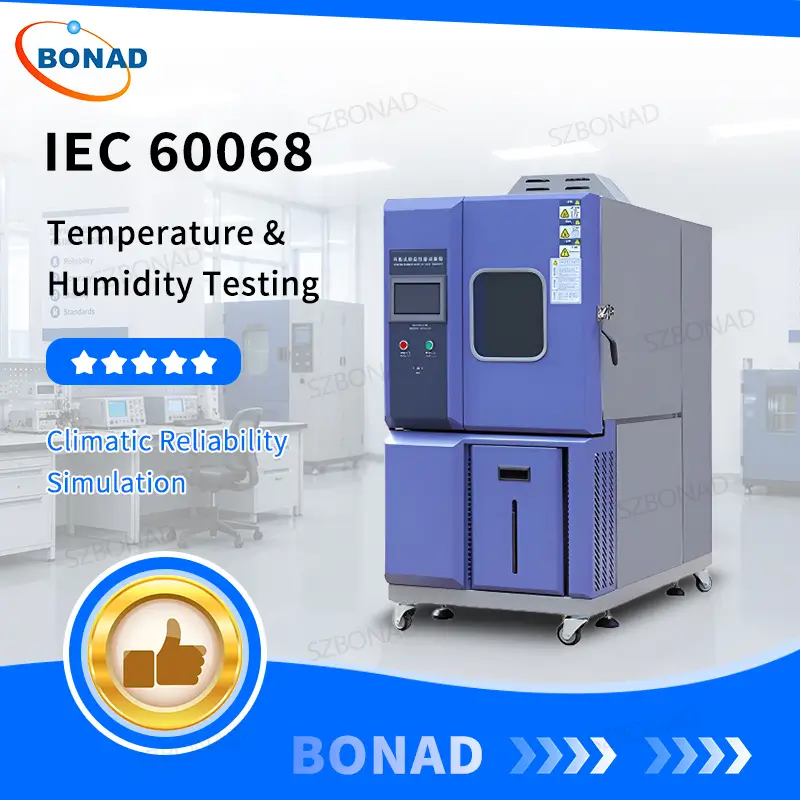
Example: 150L Constant Temperature and Humidity Test Chamber
For laboratories performing IEC 60068 temperature and humidity validation, medium-capacity chambers often provide a balance between flexibility and laboratory efficiency.
A 150L constant temperature and humidity chamber is commonly used for:
- Electronic components
- PCB assemblies
- Consumer products
- Industrial control devices
- Reliability verification testing
Typical chamber specifications may include:
Typical 150L Chamber Specifications
| Parameter | Typical Capability |
|---|---|
| Chamber Capacity | 150L |
| Temperature Range | Up to high-temperature and sub-zero conditions |
| Humidity Range | Broad RH control |
| Control Accuracy | High precision |
| Controller | Programmable touch-screen system |
| Applications | IEC environmental testing |
Compared with oversized systems, mid-capacity chambers often provide:
- Faster stabilization
- Improved laboratory utilization
- Lower energy consumption
- Flexible specimen testing
For many IEC 60068 applications, this configuration supports both development testing and routine quality verification.
Advantages of Working with an Environmental Chamber Manufacturer
Environmental testing projects increasingly involve customized requirements.
These may include:
- Special specimen fixtures
- Non-standard dimensions
- Additional observation windows
- Remote communication functions
- Custom safety systems
- Project-specific test profiles
As a result, many laboratories prefer manufacturers capable of providing:
Manufacturer Capability Comparison
| Capability | Standard Supplier | Engineering-Oriented Manufacturer |
|---|---|---|
| Standard Chamber Supply | Yes | Yes |
| Technical Consultation | Limited | Extensive |
| Customization | Limited | Flexible |
| Application Guidance | Basic | Professional |
| After-Sales Support | Variable | Long-term |
For B2B buyers, supplier capability can influence:
- Commissioning speed
- Maintenance efficiency
- Testing continuity
- Long-term operating cost
Environmental chambers are typically long-life laboratory assets, making technical support and reliability important evaluation factors.
IEC 60068 Applications Across Industries
Environmental testing is rarely performed for compliance alone.
In most industries, IEC 60068 testing supports broader reliability and risk-management objectives.
Because products operate in different climates and environments, testing requirements vary by sector.
Electronics and Consumer Products
Electronics are particularly sensitive to environmental stress.
Common failure mechanisms include:
- Moisture ingress
- Corrosion
- PCB degradation
- Connector oxidation
- Thermal fatigue
IEC humidity and temperature tests help manufacturers validate:
- Smartphones
- Sensors
- Smart devices
- Power supplies
- Consumer appliances
Temperature-humidity cycling is frequently used to identify latent reliability weaknesses.
Automotive and EV Industry
Automotive electronics operate in highly dynamic environments.
Components may encounter:
- Engine heat
- Outdoor humidity
- Cold starts
- Seasonal temperature variation
- Thermal shock
IEC 60068 methods are widely used for:
- Vehicle electronics
- Control modules
- Charging systems
- EV electronics
- Thermal management assemblies
As electric mobility expands globally, environmental validation requirements continue to grow.
Industrial and Electrical Equipment
Industrial systems often operate continuously under demanding conditions.
Examples include:
- Control cabinets
- Switchgear
- Sensors
- Electrical panels
- Factory automation systems
Environmental testing helps evaluate:
- Long-term stability
- Material durability
- Moisture resistance
- Operational reliability
This is particularly relevant in tropical and coastal regions where humidity exposure may be severe.
Medical and Laboratory Devices
Medical and laboratory equipment must maintain performance stability throughout storage and operation.
IEC testing helps assess:
- Transport exposure
- Storage reliability
- Climate sensitivity
- Packaging performance
Because medical products may cross multiple climate zones before use, environmental qualification is increasingly important.
Industry Application Matrix
| Industry | Main Environmental Risk | Common IEC 60068 Tests |
|---|---|---|
| Electronics | Moisture and corrosion | 2-30 / 2-78 |
| Automotive | Thermal cycling | 2-14 |
| EV Systems | Heat and humidity | 2-2 / 2-78 |
| Industrial Equipment | Condensation | 2-30 |
| Medical Devices | Storage conditions | 2-1 / 2-30 |
Future Trends in IEC Environmental Testing
Environmental testing continues to evolve alongside manufacturing technology.
Modern reliability validation increasingly focuses on data-driven, intelligent, and multi-stress testing methods.
Several trends are shaping the future of IEC 60068 testing.
Smart Environmental Chambers
Digital control systems are transforming laboratory operation.
Modern chambers increasingly support:
- Touch-screen interfaces
- Real-time monitoring
- Automatic diagnostics
- Remote management
- Cloud connectivity
These features improve both operational efficiency and data traceability.
Remote Monitoring and IoT Integration
Laboratories are moving toward connected infrastructure.
IoT-enabled chambers may provide:
- Remote status viewing
- Alarm notification
- Historical data access
- Predictive maintenance alerts
This reduces downtime and improves laboratory productivity.
Multi-Stress Testing
Products increasingly face multiple environmental stresses simultaneously.
Future testing trends include:
- Temperature + humidity
- Thermal cycling + vibration
- Environmental + electrical loading
Combined stress testing can better simulate real operating environments.
AI and Data-Based Reliability Analysis
Environmental testing is generating larger datasets than ever before.
AI-assisted analysis may support:
- Failure prediction
- Trend recognition
- Test optimization
- Maintenance planning
Rather than reviewing data manually, laboratories increasingly rely on software-driven evaluation.
Sustainability and Product Durability
Global sustainability initiatives are encouraging longer product life cycles.
Environmental testing supports this trend by helping manufacturers:
- Improve durability
- Reduce early replacement
- Lower material waste
- Enhance reliability engineering
As durability becomes a purchasing consideration, environmental testing may increasingly influence market competitiveness.
Future Testing Trend Comparison
| Trend | Industry Impact |
|---|---|
| Smart Chambers | Higher automation |
| Remote Monitoring | Improved efficiency |
| Multi-Stress Testing | Better field simulation |
| AI Data Analysis | Faster reliability insight |
| Sustainability Focus | Longer product life |
Conclusion
IEC 60068 remains one of the most important environmental testing frameworks for modern manufacturing.
Rather than representing a single test, the standard provides a comprehensive methodology for evaluating how products respond to environmental stress—including temperature variation, humidity exposure, and thermal transition.
For manufacturers serving international markets, IEC 60068 testing supports:
- Product reliability
- Engineering validation
- Procurement qualification
- Market confidence
Equally important, reliable testing depends on selecting suitable environmental chambers capable of delivering stable and repeatable conditions.
As environmental requirements continue evolving through digitalization, AI-assisted analysis, and sustainability-driven product development, IEC 60068 testing will remain central to reliability engineering and product quality assurance.
Looking for Environmental Chambers for IEC 60068 Testing?
Selecting the right environmental chamber can improve testing efficiency, repeatability, and long-term laboratory performance.
Environmental chamber systems—including temperature, humidity, and programmable climate chambers—can support a wide range of IEC 60068 testing applications, from R&D verification to industrial quality control.
FAQ — IEC 60068 Environmental Testing
1. What is IEC 60068 used for?
IEC 60068 is used to evaluate how products perform under environmental conditions such as temperature, humidity, and thermal change. It helps verify product reliability and durability.
2. Is IEC 60068 a certification?
No. IEC 60068 is a testing standard that defines environmental test methods. Products are tested according to the standard, but IEC 60068 itself is not a product certification.
3. What equipment is required for IEC 60068 testing?
Typical equipment includes temperature chambers, temperature and humidity chambers, and thermal cycling chambers, depending on the specific IEC 60068 test method.
4. What is the difference between IEC 60068-2-30 and IEC 60068-2-78?
IEC 60068-2-30 focuses on cyclic damp heat testing with changing humidity and temperature conditions, while IEC 60068-2-78 evaluates steady-state humidity exposure under constant conditions.
5. Why are environmental chambers important for IEC 60068 testing?
Environmental chambers provide controlled and repeatable test conditions, ensuring reliable results and helping laboratories maintain testing accuracy and consistency.