IEC 62133: From Compliance to Engineering Precision
Lithium-ion batteries are ubiquitous in modern electronics, energy storage, medical devices, and electric mobility. With higher energy density comes higher risk: thermal runaway, internal short circuits, venting, and even explosion.
IEC 62133 has emerged as the global benchmark for safe battery design and laboratory verification. While most labs can conduct basic tests, advanced labs know that compliance is only valid when tests are accurate, repeatable, and safe.
BONAD’s approach targets the hidden technical challenges that affect both operational costs and certification success rates, bridging the gap between standard theory and practical execution.
Understanding IEC 62133 Testing Categories
| Test Category | IEC Clause | Compliance Goal |
|---|---|---|
| Electrical Safety | IEC 62133 Electrical Evaluation | Overcharge, forced discharge, short circuit mitigation |
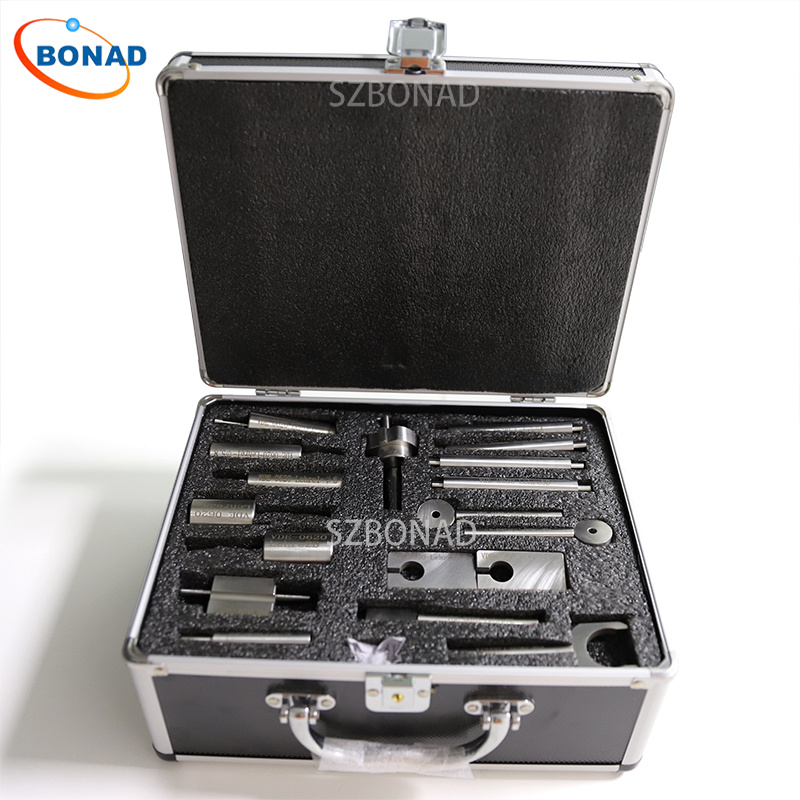
| Mechanical Safety | IEC 62133-1 Clause 7.3.3 | Controlled drops, impact orientation, shock absorption |
| Thermal Safety | IEC 62133-2 Clause 7.2.2 | Linear heating to 130°C ±2°C, avoiding overshoot |
| Protective Circuit Verification | BMS Verification | Ensure correct cut-off, protection triggers |
| Environmental Testing | IEC 62133-2 | Abuse under abnormal operating conditions |
True compliance is achieved only when laboratory hardware can faithfully replicate the test environment without introducing unintended variables.
Thermal Abuse Testing – Eliminating Overshoot and Thermal Inertia
Laboratory Pain Point: Thermal Overshoot
Many low-cost thermal abuse chambers fail to maintain the strict 5°C/min ±2°C ramp rate. When approaching 130°C, controller lag or poor airflow can lead to overshoot, sending the temperature to 135°C or higher, directly violating IEC 62133-2 and invalidating the test.
BONAD Solution: PID-Controlled Precision Thermal Management
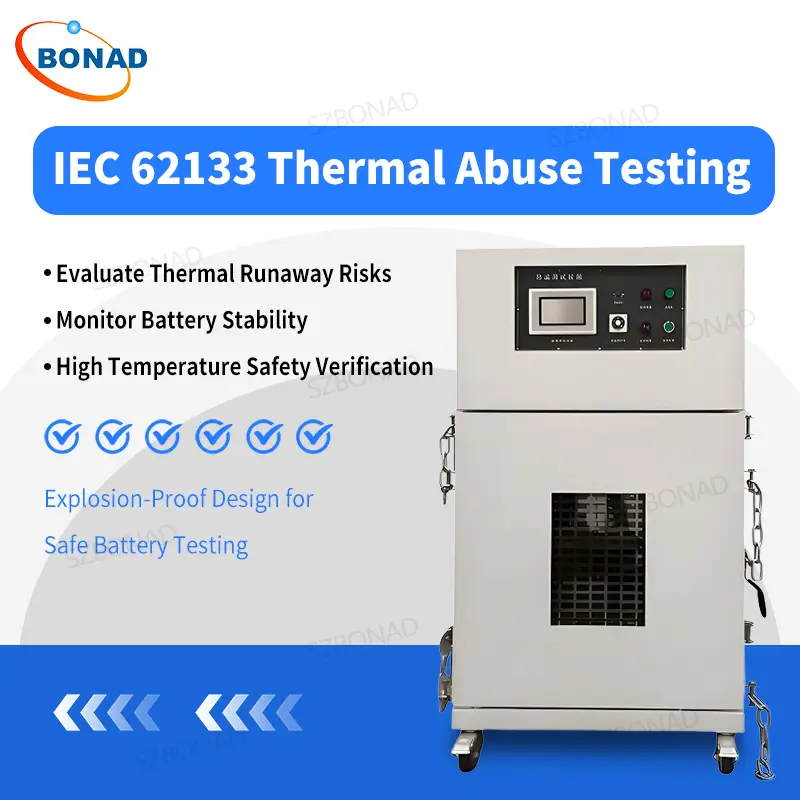
BONAD High-Low Temperature & Thermal Abuse Chamber (BND-BHLT) addresses this with:
- Advanced PID Arithmetic: Prevents overshoot when approaching the 130°C threshold, ensuring the ramp curve flattens precisely within ±2°C.
- Dual 90W Stainless Steel Centrifugal Fans: Eliminate airflow dead zones, maintaining uniform heating.
- 100mm High-Density Polyurethane Insulation: Prevents local hot spots, reducing thermal inertia.
- SSR Non-Contact PWM Heating Control: Real-time adjustment for microsecond-level response.
| Feature | Specification |
|---|---|
| Ramp Rate Accuracy | 5°C/min ±0.2°C/min |
| Temperature Uniformity | ±0.5°C |
| Insulation | 100mm high-density polyurethane |
| Compliance | IEC 62133-2 Thermal Abuse |
For TÜV, SGS, and UL engineers, this precision translates directly into repeatable certification tests and avoids costly reruns.
Charge/Discharge Testing – Mitigating Acid Corrosion and Explosion Risks
Laboratory Pain Point: Acidic Corrosion & Combustible Gas
During overcharge or forced discharge, Li-ion batteries release hydrogen fluoride (HF) and other corrosive gases. Standard stainless steel chambers quickly develop rust, while accumulated flammable gases risk explosion.
BONAD Solution: Engineering the Chamber for Longevity and Safety
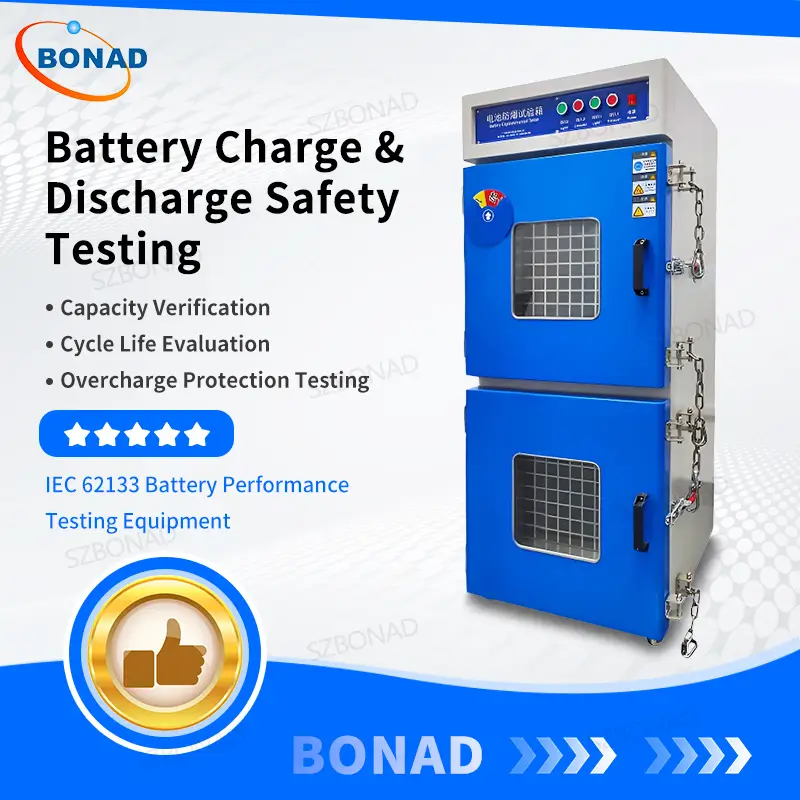
BND-DC003 Charge/Discharge Explosion-Proof Chamber features:
- SUS304 Stainless Steel Interior: Wrapped in 1.2mm Teflon for superior chemical resistance.
- Explosion-Proof Electrical Components: Sealed LED lighting and wiring designed per ATEX-derived principles for hazardous environments.
- Pressure-Relief Safety: 200 × 200mm rear vent and heavy-duty anti-explosion door chains.
- Smoke and Gas Interlock: Immediate activation of high-capacity exhaust fans upon detecting venting.
| Feature | Engineering Advantage |
|---|---|
| Material | SUS304 + Teflon lining for chemical resistance |
| Electrical Safety | Sealed explosion-proof wiring and lighting |
| Pressure Relief | Rear vent + anti-explosion door chains |
| Hazard Mitigation | Smoke/gas interlock triggers fans automatically |
For experienced lab managers, this design ensures longevity of the equipment, reduces maintenance costs, and maintains test validity even under extreme abuse conditions.
Battery Drop Testing – Eliminating Human Error
Laboratory Pain Point: Inconsistent Drop Orientation
Manual drop testing introduces variability:
- Height deviations
- Misaligned impact orientation (face, edge, corner)
- Repeatability issues
This inconsistency can affect certification outcomes.
BONAD Solution: Pneumatic Precision Drop Testing
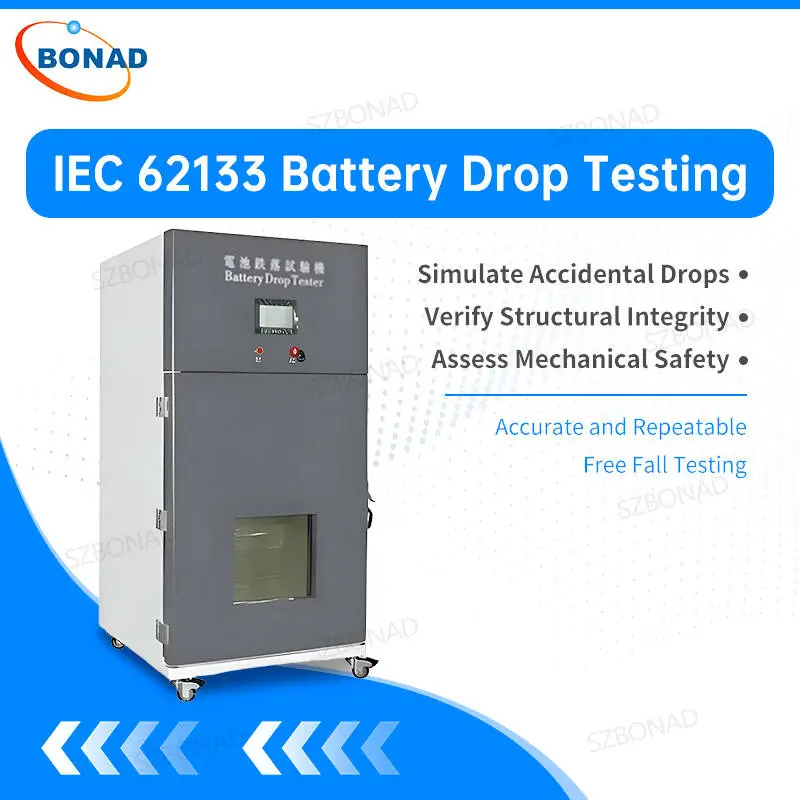
BND-IBDT Battery Drop Tester uses:
- Pneumatic Grippers: Securely hold battery at exact face, edge, or corner orientation.
- PLC Touchscreen Control + Digital Encoder: Ensures drop height accuracy within ±2%.
- Standardized A3 Solid Steel Impact Plate: Guarantees uniform impact surface.
| Feature | Advantage |
|---|---|
| Drop Orientation | Face, edge, corner programmable |
| Height Accuracy | ±2% |
| Repeatability | Fully automated for batch testing |
| Control Interface | PLC touchscreen |
Precision drop testing minimizes data variance, supports repeatable certifications, and reduces human error liability.
Built for Laboratory Safety – Active Hazard Mitigation
BONAD’s design philosophy extends beyond simple containment:
- Automated Smoke & Gas Interlock: Detects early venting, immediately triggers exhaust system.
- Compartmental Isolation: Multi-layer charge/discharge chambers prevent cross-contamination between tests.
- Observation Without Exposure: 400 × 600mm 3-layer vacuum tempered glass windows with anti-condensation heating allow real-time monitoring.
Safety, data integrity, and operational efficiency are built into every aspect of BONAD chambers.
Applications in Real-World Labs
| Industry | Application | BONAD Equipment |
|---|---|---|
| Consumer Electronics | Smartphone and laptop battery validation | Charge/Discharge Chamber + Thermal Abuse Chamber |
| Medical Devices | Portable medical battery testing | Thermal Abuse Chamber + Drop Tester |
| Energy Storage Systems | Residential/commercial ESS | Multi-chamber charge/discharge + thermal testing |
| Electric Mobility | E-bike, light EV batteries | Drop Tester + Thermal Abuse |
| Certification Laboratories | TÜV, SGS, UL testing | All BONAD chambers |
Experienced lab managers know: reducing reruns, preventing equipment corrosion, and controlling thermal overshoot saves thousands in operating costs annually while improving certification throughput.
Future Trends in Battery Safety Testing
- Higher Energy Density Batteries: More rigorous thermal, mechanical, and electrical abuse testing required.
- AI-Enhanced Laboratories: Predictive thermal runaway analysis and automated compliance reporting.
- Global Regulatory Convergence: IEC 62133 harmonization with UN 38.3, UL 1642, UL 2054, and IEC 62619.
Labs investing in precision, durable, and adaptive equipment today are best positioned to handle future certification demands.
Why BONAD is Preferred by Expert Laboratories
BONAD doesn’t just build battery test equipment. We engineer precision instruments that solve the real operational pain points:
- Avoid overshoot in thermal abuse tests
- Protect against corrosive gas in charge/discharge scenarios
- Eliminate human error in drop tests
- Preserve equipment longevity and reduce lab operating costs
- Maintain IEC 62133 compliance with high repeatability
FAQ – IEC 62133 Battery Testing
What is the primary difference between IEC 62133-1 and IEC 62133-2?
The critical distinction lies in battery chemistry: IEC 62133-1 governs nickel-system batteries, whereas IEC 62133-2 applies strictly to secondary lithium-system cells and batteries used in portable applications. Because lithium-ion dominates modern e-mobility and electronics, IEC 62133-2 is the global benchmark that international buyers, OEMs, and compliance laboratories prioritize for market clearance.
Why is precise temperature uniformity critical in IEC 62133-2 Thermal Abuse Testing?
Uneven airflow creates localized hot spots that trigger premature cell venting or thermal runaway before the chamber evenly reaches the required $130^\circ\text{C}$, invalidating the test. BONAD’s Thermal Abuse Chamber resolves this by utilizing dual long-shaft centrifugal fans and SSR pulse width modulation to maintain a tight temperature uniformity of $\le \pm 0.5^\circ\text{C}$ throughout the strict $5^\circ\text{C/min}$ heating ramp.
Why is a manual battery drop test invalid for IEC 62133-2 compliance?
Manual release cannot guarantee the exact impact orientation—such as striking precisely on a specific face, edge, or corner—as strictly mandated by Clause 7.3.3 and Clause 7.3.4. The BONAD BND-IBDT Drop Tester eliminates this human error using an automated pneumatic gripper and PLC touchscreen to ensure 100% repeatable, oriented drops with $\pm2\%$ height accuracy.
How does BONAD’s BND-DC003 chamber protect operators during hazardous electrical testing?
The BND-DC003 utilizes an active hazard mitigation workflow: a 1.2mm Teflon lining prevents acid corrosion from vented hydrogen fluoride (HF) gas, heavy-duty door chains and a $200 \times 200\text{mm}$ rear relief port safely contain sudden blasts, and automated smoke sensors instantly interlock with heavy-duty exhaust fans to evacuate toxic fumes from the lab ecosystem.
Request a Laboratory Configuration Plan
Tell us your battery type, testing standards, and laboratory requirements. Our engineers will recommend a tailored IEC 62133 testing solution.
Contact BONAD.