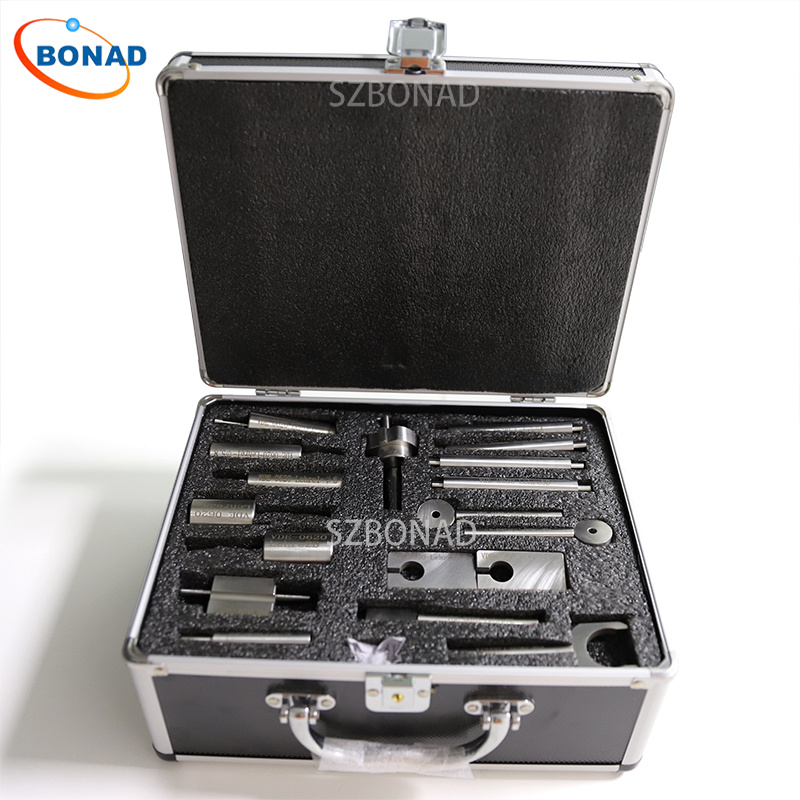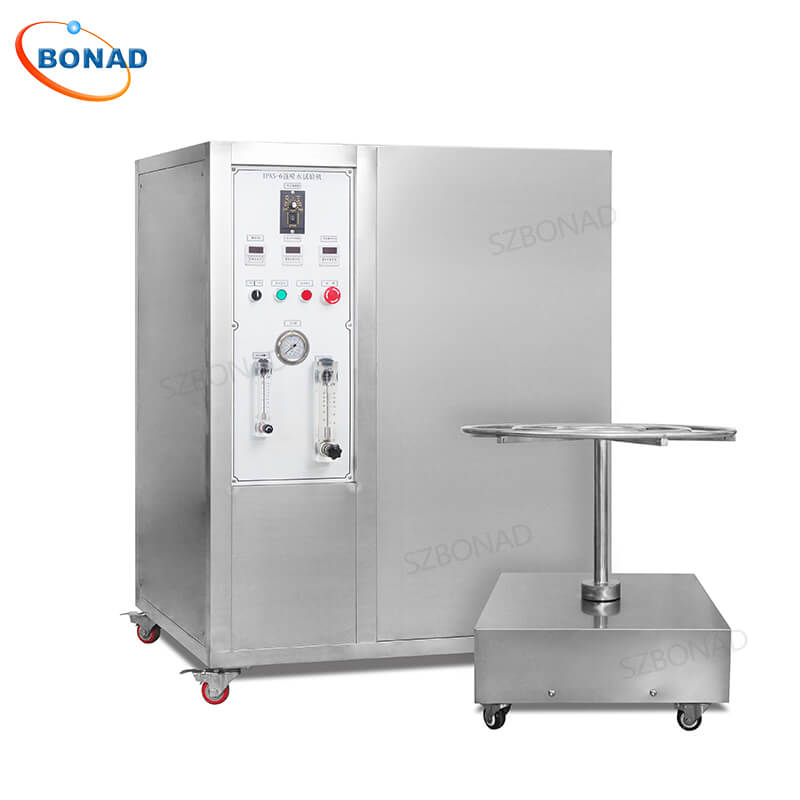
For engineering teams targeting global markets, securing the right enclosure rating is often a critical bottleneck. Mistakes in compliance can lead to redesigns, delayed certifications, or even field failures.
Both IP (Ingress Protection) and NEMA (National Electrical Manufacturers Association) ratings define enclosure protection, but they are built on fundamentally different testing philosophies. Understanding the nuances is essential to avoid costly errors and ensure market acceptance.
1. The Core Limitation of IP Ratings (IEC 60529)
IP ratings, governed by IEC 60529, measure two vectors with precision:
- Solid ingress protection (0–6)
- Liquid penetration protection (0–9K)
| IP Code | Solid Protection | Liquid Protection |
|---|---|---|
| IP54 | Limited dust ingress | Splashing water |
| IP65 | Dust tight | Low-pressure water jets |
| IP66 | Dust tight | High-pressure water jets |
| IP67 | Dust tight | Temporary immersion |
| IP68 | Dust tight | Continuous immersion |
| IP69K | Dust tight | High-temperature, high-pressure water jets, commonly required for food-processing equipment, mining machinery, commercial vehicles, and wash-down industrial environments |
Expert Insight: IP66 or IP67 is sufficient for many electronics, EV battery packs, or automotive components. However, IP testing does not evaluate long-term environmental survival such as UV degradation, corrosion, or ice-loading. For outdoor or harsh industrial environments, achieving a “dust-tight” IP rating is only part of the compliance picture.
Case Example: To verify IPX9K, engineers must deliver water at 80°C and 100 bar, from four spray angles, onto a rotating enclosure. This requires calibrated systems such as BONAD’s IPX9K chamber, rather than improvised setups.
2. Why the North American Market Demands NEMA (NEMA 250-2020) and UL Standards
In the US and Canada, local codes such as the NEC often mandate NEMA 250-2020 compliance. NEMA ratings evaluate not just ingress but also the enclosure’s resistance to long-term environmental hazards. Key evaluation vectors include:
- Corrosion & chemical resistance: Typically verified via 200-hour salt spray testing per ASTM B117
- Physical environmental hazards: Ice formation, prolonged UV exposure, mechanical impacts
- Oil & coolant seepage: Critical for CNC machinery and factory-floor equipment (e.g., NEMA 12)
- Dust ingress: Uses less standardized dust/water ingress methods, making direct equivalence to IEC 60529 unreliable
| NEMA Rating | Protection Highlights |
|---|---|
| NEMA 1 | Indoor, minimal protection |
| NEMA 3 | Rain, sleet, snow, dust |
| NEMA 3R | Rainproof outdoor enclosures |
| NEMA 4 | Splash, hose-directed water, dust-tight |
| NEMA 4X | Splash, dust, corrosion-resistant, 200h salt spray ASTM B117 |
| NEMA 6 | Temporary immersion |
| NEMA 6P | Prolonged immersion, corrosion-resistant |
Additional North American Compliance Layer: UL 50 / UL 50E
For electrical enclosures requiring UL listing, compliance with UL 50 and UL 50E is often evaluated alongside NEMA 250. While NEMA defines enclosure performance categories, UL standards verify construction integrity, safety, and environmental endurance for listed products.
Case Example: For outdoor-rated control panels, engineers must simulate UV exposure and freeze-thaw cycles, which is verified in BONAD Environmental Test Chambers, enabling compliance with both NEMA 4X and UL 50E requirements.
3. The Cross-Over Trap: Why IP66 Does Not Equal NEMA 4X
A common regulatory misstep is assuming that IP66 automatically qualifies as NEMA 4X. While both resist high-pressure water jets, NEMA 4X additionally requires:
- 200-hour salt spray corrosion test (ASTM B117)
- Resistance to outdoor icing and UV exposure
- Material and construction durability verification
An IP66 enclosure made from untreated metal will fail NEMA 4X almost immediately. Misunderstanding this leads to field failures, rejected shipments, and costly re-testing.
| Compliance Feature | IP (IEC 60529) | NEMA (NEMA 250-2020) | UL (UL 50E) |
|---|---|---|---|
| Dust Ingress | Highly standardized | Less standardized, application-based | Verified for listed enclosures |
| Water Ingress | Strict nozzle/flow definitions | Hose-stream, rain/sleet simulation | Environmental verification |
| Corrosion Resistance | Not included | ASTM B117 (typically 200h) | Material durability verification |
| Ice & Freeze-Thaw Testing | Not included | Mandatory for outdoor types | Construction review |
| UV Weathering | Not included | Often required by application | Often reviewed |
4. Building a Bulletproof Global Testing Matrix
For manufacturers targeting both IEC-driven and NEMA/UL-driven markets, running isolated tests is costly and inefficient. A unified environmental validation protocol is the most effective approach.
Workflow (Flowchart Placeholder):
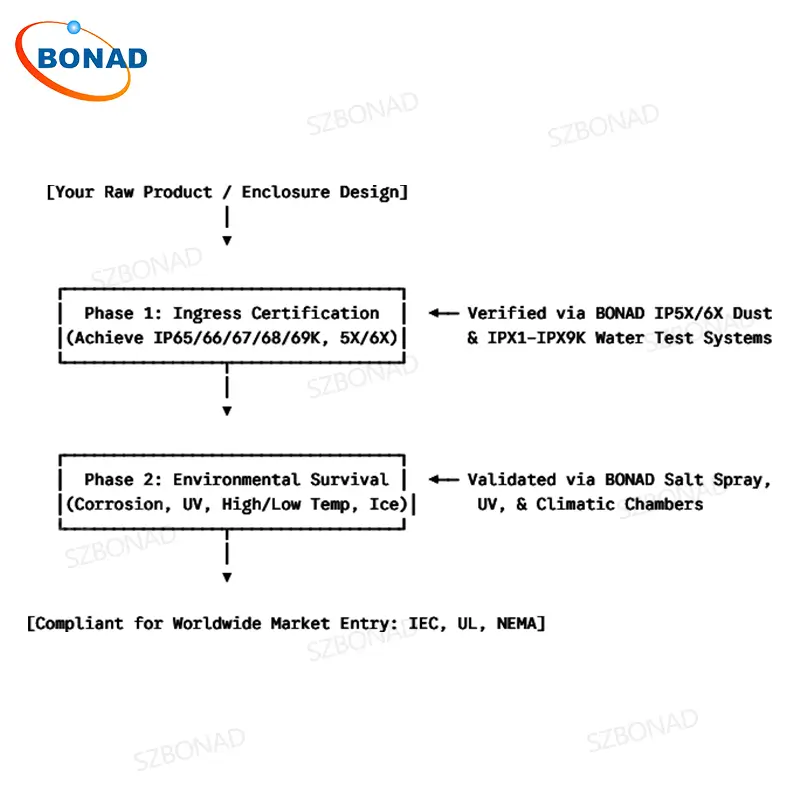
Workflow Insight: By combining ingress testing and environmental survival simulations, engineering teams can leverage IP testing data to cover NEMA ingress portions, leaving only material-degradation tests to be completed in environmental chambers.
5. Conservative Reference Map: IP vs NEMA
| IP Rating | Conservative NEMA Reference |
|---|---|
| IP54 | NEMA 3 |
| IP55 | NEMA 3S |
| IP65 | NEMA 4 |
| IP66 | NEMA 4 |
| IP67 | NEMA 6 |
| IP68 | NEMA 6P |
Important: These mappings are conservative approximations only. Equivalent water and dust ingress performance does not guarantee equivalent resistance to corrosion, UV degradation, icing, or coolant exposure.
6. How BONAD Engineers Complete Enclosure Testing Solutions
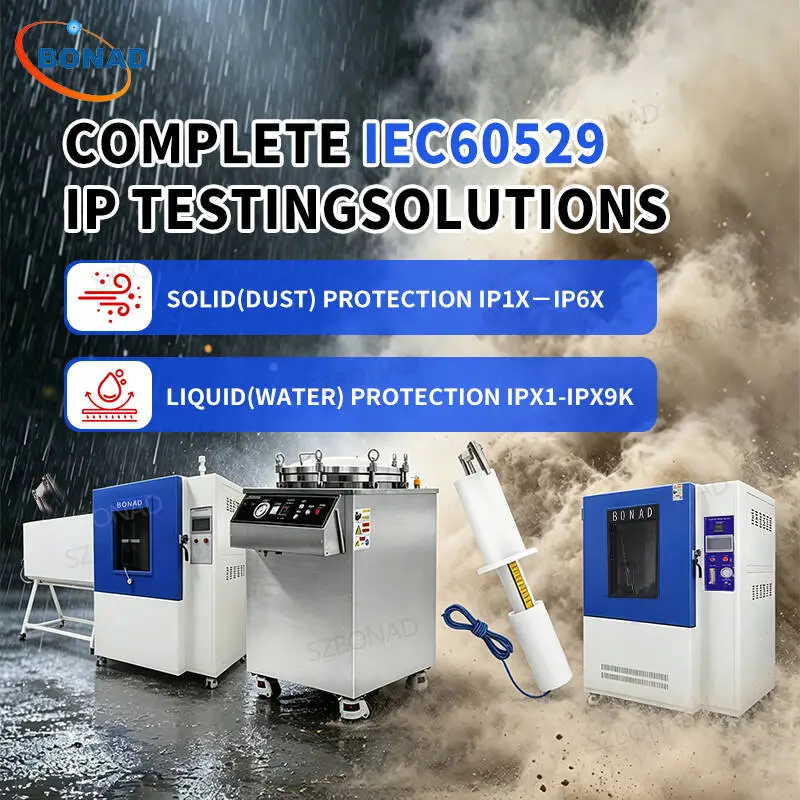
Turnkey IP Ingress Validation Systems
- IPX1 drip boxes to IPX5/6 oscillating tubes
- Specialized IPX9K high-temperature, high-pressure jet chambers
- IP5X/6X dust-tight chambers
Case Example: To certify IP67 immersion, engineers use BONAD IPX7 chambers with controlled immersion depth, water temperature, and timing, ensuring reproducible results.
Environmental & Material Stress Chambers
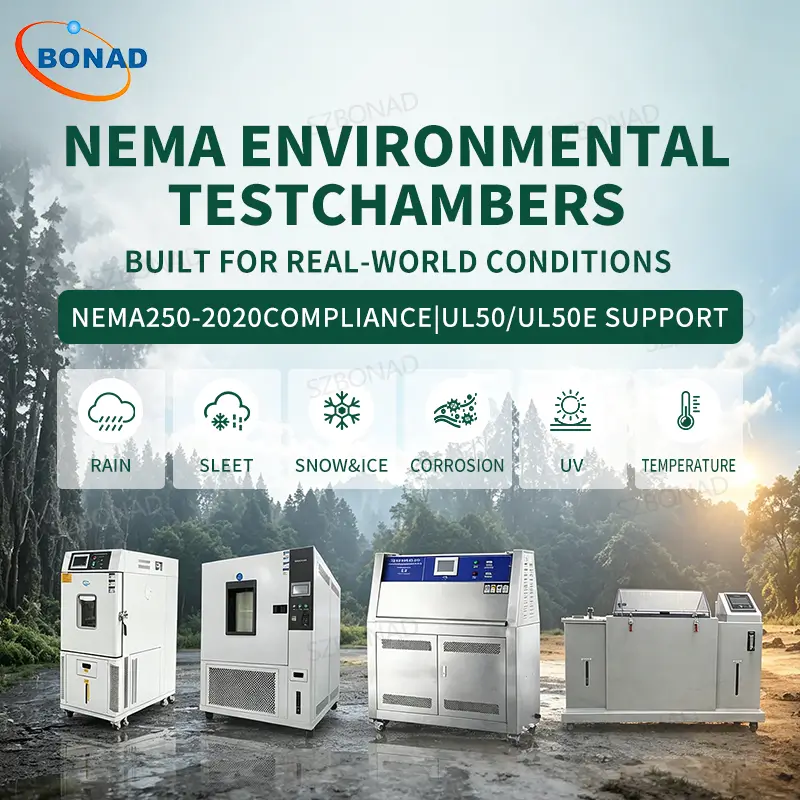
- Salt Spray & Fog Chambers: Validate corrosion resistance for NEMA 4X and 6P
- UV Aging & Xenon Weathering: Test structural integrity of outdoor enclosures
- High/Low-Temperature & Ice Chambers: Observe performance under thermal expansion and ice-loading conditions
BONAD integrates these systems into a turnkey laboratory layout, allowing engineering teams to efficiently achieve IEC 60529, NEMA 250-2020, and UL 50/50E compliance in one workflow.
7. Conclusion: Stop Guessing. Start Validating
Relying on approximate charts or assumptions of equivalence introduces regulatory risk. A modern global compliance strategy requires:
- Ingress certification using calibrated IP test systems
- Environmental survival validation using stress chambers
- Integrated laboratory design aligned with IEC 60529, NEMA 250-2020, and UL 50/50E
Send BONAD your enclosure drawing, installation environment, and export market (EU / US / Southeast Asia), and our engineers will map the required IP, NEMA, and environmental test matrix for your project. This helps reduce redundant testing, accelerate certification, and improve first-pass compliance success. Contact BONAD engineers now for a tailored solution →.
FAQ: IP vs NEMA Compliance Quick Guide
Can an IP68 enclosure bypass the NEMA 6P submersion test?
No. IP68 and NEMA 6P are not interchangeable and cannot be considered equivalent in compliance validation.
IP68 under IEC 60529 is based on manufacturer-defined immersion conditions, including depth, duration, and pressure assumptions validated in controlled hydrostatic systems.
NEMA 6P (NEMA 250-2020) requires fixed and repeatable environmental conditions, including:
- static head pressure-defined immersion testing
- long-term material degradation evaluation
- corrosion resistance validation under ASTM B117 exposure
- oil and thermal cycling resistance assessment
Conclusion: IP68 validates ingress protection only, while NEMA 6P includes environmental durability requirements.
Therefore, direct compliance equivalence cannot be established.
How does the NEMA 250 dust test differ from IEC 60529 IP5X/6X testing?
They are based on fundamentally different testing philosophies and cannot be directly correlated.
IEC 60529 (IP5X/IP6X) uses a fully controlled laboratory method, where:
- talcum powder is continuously circulated
- airflow and vacuum conditions are standardized
- particle exposure is quantifiable and repeatable
NEMA 250 dust evaluation is application-based, often involving:
- directional dust exposure at enclosure joints
- compressed air dust simulation
- wind-blown or field-simulated environmental conditions
Because NEMA does not define a single unified dust methodology equivalent to IEC 60529,
IP and NEMA dust ratings cannot be directly mapped or converted.
What is the relationship between IP66, NEMA 4X, and UL 50E?
IP66 only validates resistance to high-pressure water jets and does not include long-term environmental durability.
NEMA 4X extends beyond IP66 by requiring additional validation, including:
- corrosion resistance testing (commonly ASTM B117 salt spray exposure, typically ~200 hours depending on application)
- resistance to icing and outdoor environmental stress
- long-term sealing and gasket durability evaluation
For North American compliance, UL 50 / UL 50E is often required alongside NEMA 250 to verify:
- enclosure construction integrity
- gasket and sealing reliability under aging conditions
- safety and environmental durability compliance
In real-world certification workflows, IP66 + NEMA 4X + UL 50E are often validated together rather than independently.
What is the difference between IEC 60529 IP ratings and ISO 20653 automotive ratings?
ISO 20653 introduces stricter, automotive-specific environmental test conditions compared to IEC 60529.
The key extension is IP6K9K, which includes:
- higher water jet pressure requirements
- elevated water temperature conditions (typically ~80°C)
- dynamic multi-angle spray exposure
- more aggressive wash-down simulation cycles
These conditions are designed for automotive and heavy-duty environments such as:
- commercial vehicles
- construction machinery
- engine compartment electronics
- high-pressure industrial wash-down systems
Compared to IEC 60529, ISO 20653 applies stricter mechanical and thermal stress conditions.