In our 10+ years working closely with automotive suppliers and electronics manufacturers, nearly every week we hear the same question: “Engineer, is IPX9 the same as IPX9K?” Many QA teams make a costly mistake here. While they sound similar, these two standards differ dramatically in water pressure, temperature, and testing details. Using the wrong equipment can put your products directly at risk of rejection.
In this guide, I’ll walk you through the key differences between IEC 60529 and ISO 20653, share real-world testing pitfalls, and show how one solution—the BONAD IPX5–IPX9K multi-functional test chamber—can simplify lab operations, reduce costs, and save space while covering both standards.
1. Standards Overview
IEC 60529
IEC 60529, also known as the IP Code for enclosures, is the global benchmark for protection against dust and water ingress. It is widely used across:
- Consumer electronics
- Industrial control systems
- Outdoor lighting
- Telecommunications equipment
- Household appliances
- Medical devices
Common ratings include IP54, IP65, IP66, IP67, IP68, and IP69, which define water and dust protection levels for diverse applications.
ISO 20653
ISO 20653 focuses specifically on road vehicles, reflecting extreme automotive conditions:
- High-speed road splash
- Mud and debris thrown by tires
- High-temperature, high-pressure car washes
For electric vehicles, even a standard car wash with an 80°C hot water spray at 100 bar can compromise battery packs or sensors. ISO 20653 ensures automotive components survive these real-world hazards. Key ratings include IPX4K, IPX6K, and IPX9K, which often exceed the scope of IEC 60529.
2. Key Differences Between IEC 60529 and ISO 20653
| Aspect | IEC 60529 | ISO 20653 |
|---|---|---|
| Industry Focus | General electrical products | Automotive components |
| Water Test Levels | IPX1–IPX9 | IPX1–IPX9K |
| Dust Protection | IP0X–IP6X | IP0X–IP6X |
| Extreme Automotive Conditions | Limited | Core requirement |
| High-Pressure Hot Water | Optional | Mandatory for IPX9K |
Industry note: don’t confuse IPX9 with IPX9K. The latter uses higher pressure, elevated temperature, multiple spray angles, and precise sample rotation. Using IPX9 equipment for ISO 20653 can result in QA rejection at car manufacturers like BMW or Volkswagen.
3. Test Methodologies in Real-World Scenarios
IEC 60529 – IPX5 & IPX6
For an outdoor light or consumer electronics enclosure:
- IPX5: 6.3 mm nozzle, 12.5 L/min flow, 2.5–3 m distance, minimum 3 min.
- IPX6: 12.5 mm nozzle, 100 L/min flow, 2.5–3 m distance, minimum 3 min.
Although straightforward, repeated IPX6 testing consumes significant water and operator time.
ISO 20653 – IPX6K & IPX9K
Testing automotive components presents higher stakes:
- IPX6K: Simulates vehicle cleaning with high-pressure water. Incorrect flow or nozzle setup can damage sensitive connectors.
- IPX9K: The ultimate test. Parameters include 8–10 MPa water pressure, up to 80°C, flow 14–16 L/min, spray angles 0°, 30°, 60°, 90°, with precise turntable rotation.
Many labs fail due to unstable pumps, uneven heating, or poor nozzle filtration, leading to invalid test results or equipment damage.
4. Equipment Selection & Industry Pain Points
Previously, labs had to buy multiple chambers to cover IEC and ISO standards:
- One for IPX5/IPX6
- One for IPX9
- Sometimes a third for IPX9K
Consequences:
- Budget ×2–3
- Lab space ×3
- Operator training complexity
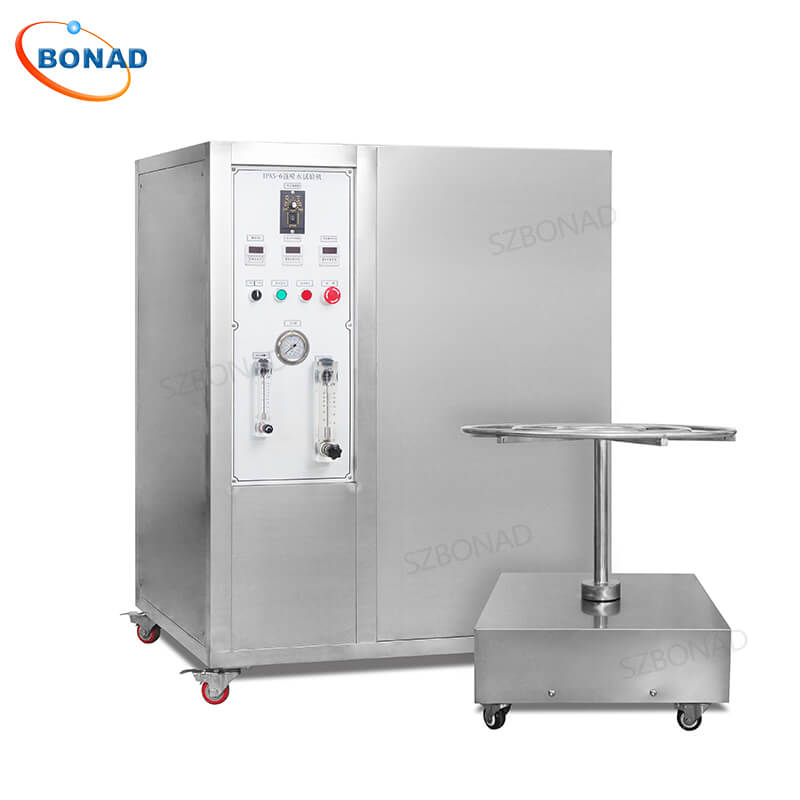
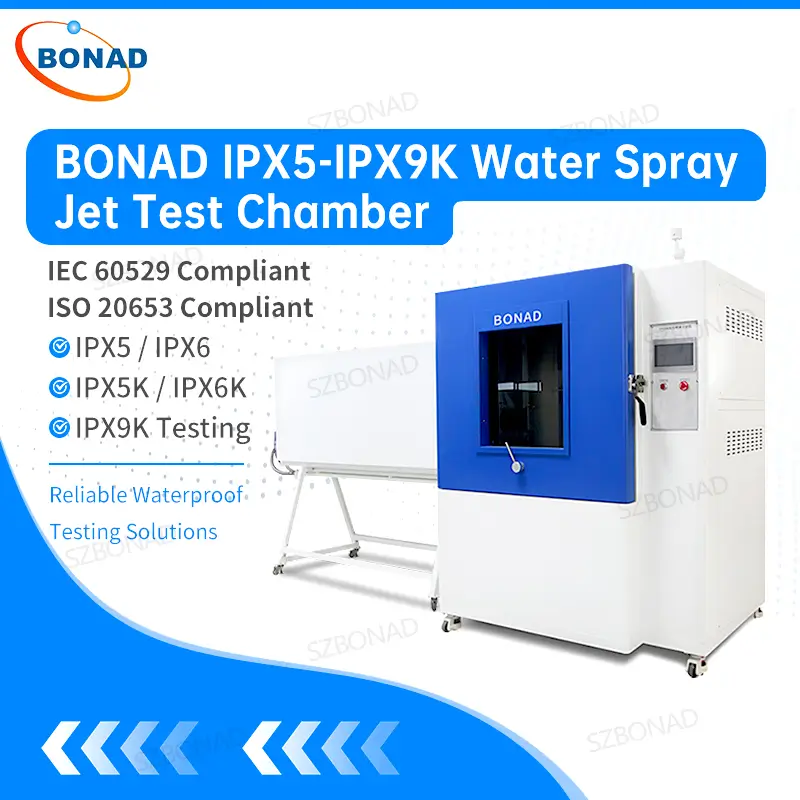
The BONAD IPX5–IPX9K multi-functional test chamber solves these pain points:
- Single Chamber, Full Coverage: IEC IPX5/IPX6 + ISO IPX6K/IPX9K.
- Wide Pressure Range Switching: From gentle 12.5 L/min flow to 8–10 MPa high-temperature jets.
- Integrated Water Recirculation & Filtration: Reduces water usage by 70% and prevents debris from clogging nozzles.
- SUS304 Stainless Steel Pressure Vessel: Corrosion-resistant and withstands prolonged high-temperature, high-pressure testing.
- Intelligent One-Touch Standard Selection: Operators select IEC or ISO on a touchscreen, and the system auto-adjusts water pressure, flow, temperature, and nozzle angles.
This isn’t a simple combination of functions; it’s an all-in-one, high-reliability solution that protects lab efficiency and product compliance.
5. Industry Applications with Real Examples
Automotive
We often test EV battery packs, LIDAR sensors, and automotive lighting. With the BONAD chamber, we can simulate:
- Splash from tires at high speeds
- Mud from off-road tests
- Hot water jet cleaning in QA labs
Ensuring components meet OEM QA standards and regulatory compliance.
Consumer Electronics
For smart watches, earbuds, tablets, and outdoor IoT devices:
- IEC IPX7/IPX8 tests for rain or submersion
- BONAD chamber allows the same lab to run IPX5/IPX6 tests without extra equipment, saving space and water.
Industrial Equipment & Outdoor Lighting
- IP65/IP66 testing for control cabinets, streetlights, and industrial sensors
- Rapid switching between different products without long setup times
- Reliable results under real-world outdoor conditions
6. Future Trends in Waterproof Testing
- EV Expansion: IPX9K testing is increasingly critical for batteries and connectors.
- Smart Outdoor Devices: IoT and smart city infrastructure require higher waterproof ratings.
- Integrated Multi-Standard Testing: Labs prefer chambers capable of IEC, ISO, and DIN 40050-9 to reduce costs and footprint.
7. Conclusion: Expert Advice
For labs serving both consumer electronics and automotive clients, a multi-functional IP testing chamber is no longer optional. It solves:
- Budget constraints: One device replaces multiple chambers
- Space limitations: Occupies far less lab area
- Operational efficiency: One-touch switching reduces human error
The BONAD IPX5–IPX9K multi-functional test chamber has become the go-to solution. Engineered to handle harsh water and temperature scenarios, it safeguards your supply chain, protects your brand, and future-proofs your lab.
Investing in one versatile chamber ensures IEC and ISO compliance, reduces lab complexity, and provides long-term reliability for your QA processes.
FAQ – IEC 60529 vs ISO 20653 IP Testing
Q1: Can one test chamber perform both IEC 60529 and ISO 20653 waterproof tests?
A: Yes. Modern integrated systems, such as the BONAD IPX5–IPX9K Test Chamber, perform IPX5, IPX6, IPX6K, and IPX9K testing within a single platform. This eliminates the need for multiple machines, cutting your equipment costs by up to 60%, saving valuable lab floor space, and simplifying operator training.
Q2: What is the exact difference between IPX9 and IPX9K?
A: Target application and pressure severity. IPX9 (IEC 60529) is for general electrical products, while IPX9K (ISO 20653) is strictly for automotive environments. IPX9K requires higher, more destructive impact forces to simulate heavy-duty vehicle wash stations. Passing a standard IPX9 test does not guarantee compliance with automotive OEM standards (like BMW or Volkswagen).
Q3: Why is IPX9K testing more challenging than standard IP tests?
A: It demands sustained extreme parameters: 8–10 MPa water pressure and 80°C hot water. Maintaining this dual stress without pressure drops or temperature fluctuations is highly destructive to standard pumps. Any minor deviation in the mandatory 0°, 30°, 60°, or 90° spray angles will cause a direct failure during an OEM quality audit.
Q4: How does a water recirculation system benefit an IP testing laboratory?
A: It stops utility bills from skyrocketing. High-flow tests like IPX6 blast an intense 100 Liters of water per minute. BONAD’s integrated multi-layer filtration and recirculation system cuts water consumption by over 70% per cycle, while actively stopping debris from the test samples from clogging the high-precision ultra-high pressure nozzles.
Q5: What should labs consider when selecting an IPX5–IPX9K test chamber?
A: Focus on two core build factors:
Automation Level: Look for intelligent PLC touchscreen control. This allows operators to switch between complex IEC and ISO protocols with one touch, eliminating manual calibration errors and hours of setup time.
Material Integrity: Ensure the chamber uses heavy-duty SUS304 stainless steel to prevent rusting or cabin warping under prolonged 80°C humidity.
Ready to Streamline Your IP Testing Setup?
Whether you’re testing automotive components, EV battery systems, consumer electronics, or industrial products, our engineers can help you choose the right standards and build a reliable testing solution.