When evaluating enclosure safety for electrical and electronic products, one of the most widely used standards is IEC 60529, which defines the IP Code (Ingress Protection Code).
The first characteristic numeral of the IP rating indicates the degree of protection provided by the enclosure against:
- Access to hazardous live or moving parts
- Ingress of solid foreign objects
For manufacturers, laboratories, design engineers, and quality teams, IP1X, IP2X, IP3X, and IP4X testing forms the basic foundation of enclosure compliance verification.
These tests are commonly required for products such as:
- Household appliances
- Power supplies
- Industrial control cabinets
- LED luminaires
- EV charging equipment
- Junction boxes
- Consumer electronics
- Laboratory instruments
This guide explains the technical meaning of each protection level, the official IEC test method, and the required access probes.
Understanding the First Digit of the IP Code
According to IEC 60529, the first digit (0–6) represents protection against contact and solid object ingress.
| First Digit | Protection Level | Typical Hazard Controlled |
|---|---|---|
| 0 | No protection | Open access |
| 1 | Objects ≥50 mm | Back of hand / large object |
| 2 | Objects ≥12.5 mm | Finger access |
| 3 | Objects ≥2.5 mm | Tools / thick wires |
| 4 | Objects ≥1.0 mm | Small tools / wires |
| 5 | Dust-protected | Limited dust ingress |
| 6 | Dust-tight | No dust ingress |
IP1X to IP4X are especially important because they address human safety and mechanical accessibility risks before higher-level dust tests are considered.
Key Test Principles of IP1X to IP4X
Although dimensions differ, these tests share several core principles:
1. Standardized Access Probe Geometry
Each level uses a probe with fixed dimensions defined by IEC 60529 / IEC 61032.
2. Specified Application Force
Some probes require a defined force such as:
- 1 N
- 3 N
- 10 N
- 50 N
- depending on probe type and standard conditions
3. Hazardous Part Accessibility
Passing the test means the probe must not touch dangerous internal parts such as:
- Live conductors
- Moving fan blades
- Sharp energized components
- Mechanisms causing injury
4. Opening Integrity
The enclosure opening must prevent entry beyond the standard allowance.
IP1X Testing – Protection Against Objects Larger Than 50 mm
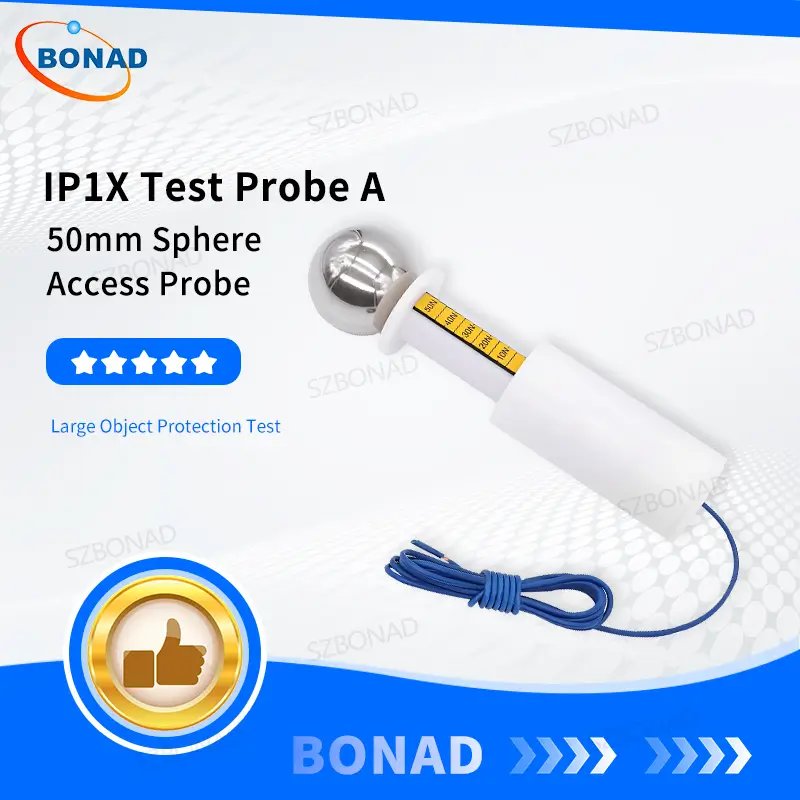
IP1X confirms that a large solid object with a diameter of 50 mm cannot fully enter the enclosure or reach hazardous parts.
This level is intended to simulate accidental contact by a large body surface such as the back of a hand.
Required Probe
Test Probe A – 50 mm Sphere
The rigid sphere is applied to all accessible openings without excessive force.
Typical Applications
- Large electrical cabinets
- Basic covers
- Indoor mechanical housings
- Non-user-serviceable equipment
Engineering Note
IP1X is generally considered a minimum level of basic contact protection, but it does not prevent finger access.
IP2X Testing – Protection Against Finger Contact
IP2X is one of the most common enclosure safety requirements worldwide.
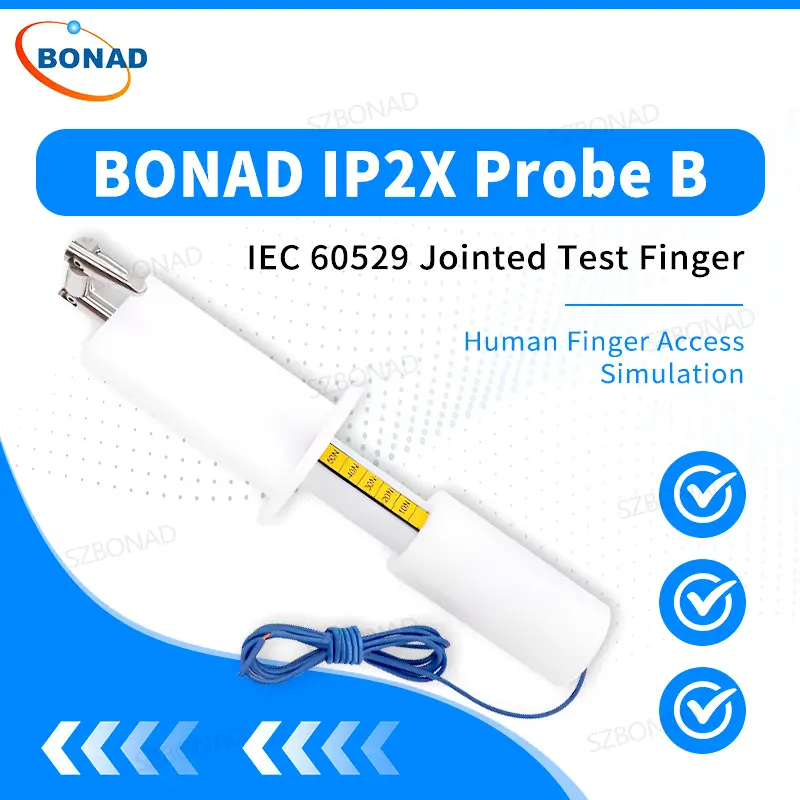
It verifies that a standard finger cannot access hazardous internal parts.
Required Probe
This articulated probe simulates a human finger with:
- Defined diameter
- Defined length
- Joint movement to imitate realistic reach angles
In many applications, this probe is used together with a force gauge.
Typical Applications
- Household appliances
- Wall-mounted devices
- Power strips
- Lighting products
- Chargers
- Consumer electronics
Engineering Importance
IP2X is often the minimum acceptable level where users may directly interact with the product.
IP3X Testing – Protection Against Tools and Thick Wires
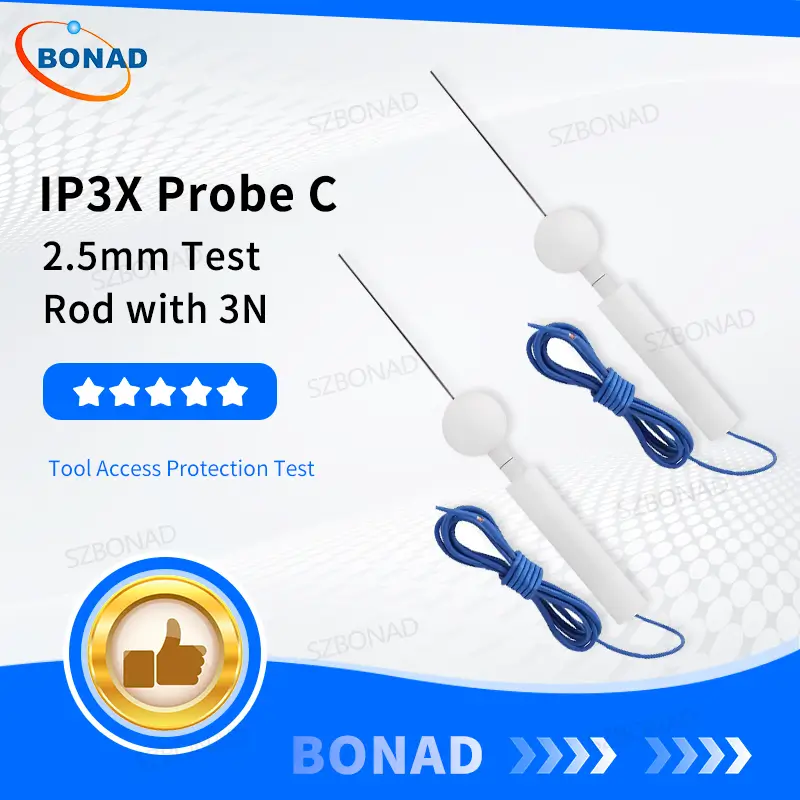
IP3X verifies that objects with a diameter of 2.5 mm or greater cannot enter the enclosure.
This level is designed to simulate:
- Screwdrivers
- Thick wires
- Installation tools
- Maintenance objects
Required Probe
Probe C – 2.5 mm Test Rod with 3N Force
The rod is inserted into openings using specified force and orientation.
Typical Applications
- Industrial control panels
- Machinery enclosures
- EV charging stations
- Distribution boxes
- HVAC control units
Engineering Benefit
IP3X significantly improves protection compared with IP2X because many tools and cables can no longer enter accessible gaps.
IP4X Testing – Protection Against Small Tools and Wires
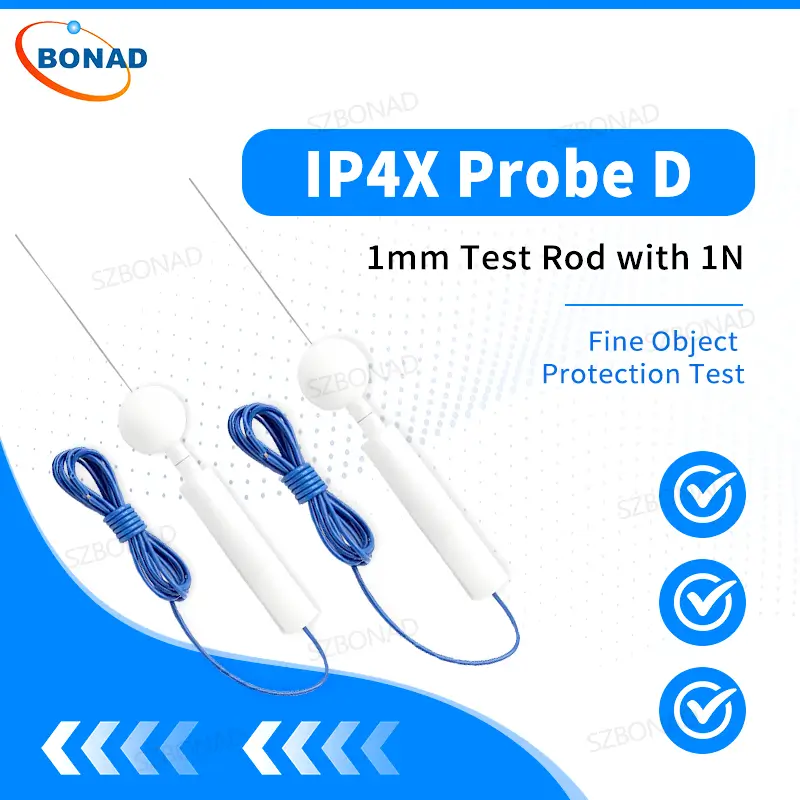
IP4X prevents access by solid objects 1.0 mm or larger.
This is an important upgrade for products installed in harsher environments or where finer openings are required.
Required Probe
Probe D – 1 mm Test Rod with 1N Force
Used to assess narrow slots, ventilation openings, seams, and assembly gaps.
Typical Applications
- LED luminaires
- Switchgear
- Junction boxes
- Automotive electronic housings
- Precision control equipment
Engineering Benefit
IP4X reduces risk from:
- Small wire insertion
- Thin metal objects
- Narrow maintenance tools
- Accidental bridging of live parts
Technical Comparison of IP1X to IP4X
| Rating | Probe Type | Test Object Size | Main Protection Goal |
|---|---|---|---|
| IP1X | Sphere A | 50 mm | Large accidental contact |
| IP2X | Finger B | 12.5 mm | Finger access prevention |
| IP3X | Rod C | 2.5 mm | Tool ingress prevention |
| IP4X | Rod D | 1 mm | Fine object ingress prevention |
Common Design Issues Found During Testing
Many products fail not because of materials, but because of enclosure design details.
Frequent Non-Conformities
- Oversized ventilation slots
- Uneven assembly gaps
- Missing internal barriers
- Poor hinge alignment
- Cable entry openings too large
- Deformation after fastening torque
Practical Advice
Perform probe evaluation during prototype stage rather than after tooling completion.
Relationship with Other Standards
Although IEC 60529 is the main IP code standard, similar access probe requirements may also appear in:
- IEC 61032 (protection of persons and equipment)
- IEC 60335 (household appliances)
- IEC 62368 (audio/video and ICT equipment)
- UL product safety standards
Many laboratories therefore maintain complete probe sets.
How to Select the Correct Test Probe
When purchasing probes, engineers usually consider:
Dimensional Accuracy
Probe diameter, tolerance, articulation angle, and rod straightness must meet standard requirements.
Surface Finish
Smooth machined surfaces reduce measurement uncertainty.
Material Strength
Stainless steel is preferred for repeated laboratory use.
Force Verification
Some tests require accurate force application.
Calibration Traceability
Important for third-party labs and regulated industries.
Complete IEC 60529 Probe Solution from BONAD
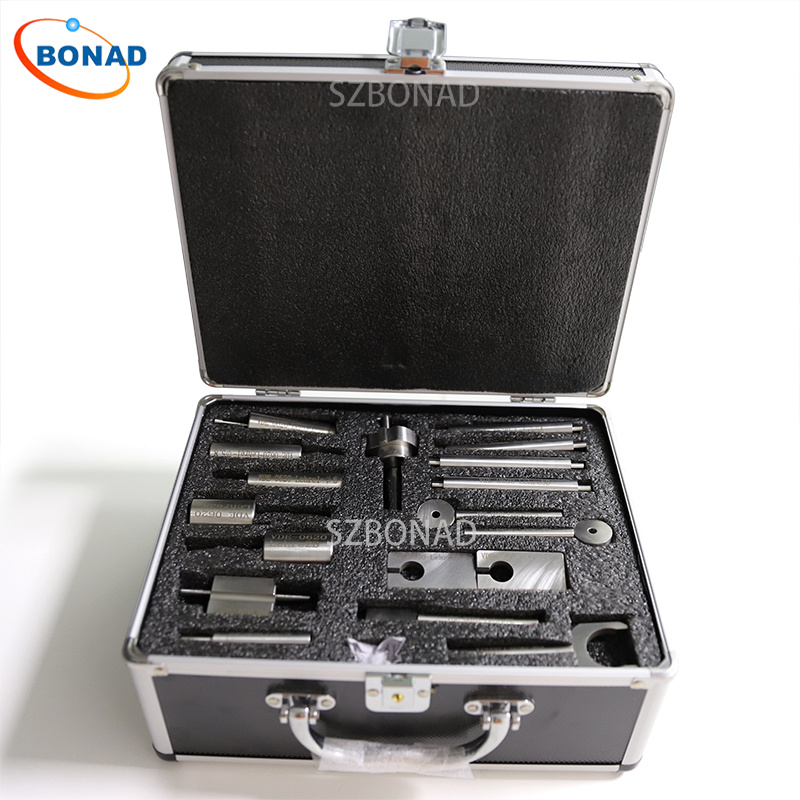
BONAD supplies professional ingress protection testing tools including:
- Probe A
- Probe B
- Probe C
- Probe D
- Full IP1X–IP4X kits
- IEC / UL custom probes
- Force gauge integration options
- Calibration support
For laboratories and manufacturers performing multiple product certifications, complete probe sets improve efficiency and consistency.
Conclusion
IP1X to IP4X testing is more than a formal compliance step—it directly affects user safety, enclosure reliability, and market acceptance.
By using precise IEC 60529 probes and evaluating enclosure openings early in development, manufacturers can reduce redesign costs and improve certification success rates.
For professional ingress protection test probes and complete compliance solutions, BONAD supports laboratories and manufacturers worldwide.
Frequently Asked Questions:
1. Is IP2X enough for consumer products?
For many indoor products, IP2X is a common baseline, but the final requirement depends on product category and applicable standard.
2. What is the main difference between IP3X and IP4X?
IP3X blocks objects ≥2.5 mm, while IP4X blocks objects ≥1 mm, providing finer protection.
3. Are these tests only for electrical products?
No. Any enclosure requiring access protection may use these evaluations.
4. Why do some probes specify force values?
Force ensures repeatable and standardized test conditions across laboratories.
5. Should probes be recalibrated?
Yes, especially in accredited labs or high-frequency use environments.
6. Can BONAD provide customized probe kits?
Yes. Standard and custom compliance solutions are available.