Why IEC Standards Matter in Modern Product Compliance
In today’s global manufacturing environment, product compliance is no longer optional. Electrical appliances, consumer electronics, industrial equipment, and automotive components must meet strict international standards to ensure safety, reliability, and environmental adaptability.
Among the most widely applied IEC (International Electrotechnical Commission) standards, three frameworks are particularly critical:
- IEC 60335 – Household and similar electrical appliance safety
- IEC 60068 – Environmental testing for electrical and electronic products
- IEC 60529 – Ingress Protection (IP code) classification
Although these standards serve different purposes, they are often used together in product qualification, certification, and quality assurance workflows.
Understanding their differences and interconnections is essential for manufacturers, laboratories, and testing equipment providers.
1. IEC 60335: Electrical Safety Standard for Household Appliances
1.1 Overview of IEC 60335
IEC 60335 is the international safety standard for household and similar electrical appliances. It ensures that products operate safely under normal use and abnormal conditions, minimizing risks such as electric shock, fire, and mechanical hazards.
It consists of:
- IEC 60335-1: General requirements
- Part 2 series: Specific requirements for different appliances (e.g., ovens, washing machines, heaters)
1.2 Scope of Application
IEC 60335 applies to a wide range of products, including:
- Kitchen appliances
- Cleaning equipment
- Heating devices
- Portable electrical tools
- Similar consumer electrical equipment
1.3 Key Safety Test Categories
IEC 60335 focuses on electrical safety and hazard prevention, including:
Electrical Shock Protection
Ensures that live parts are not accessible under normal operation.
Typical test methods include:
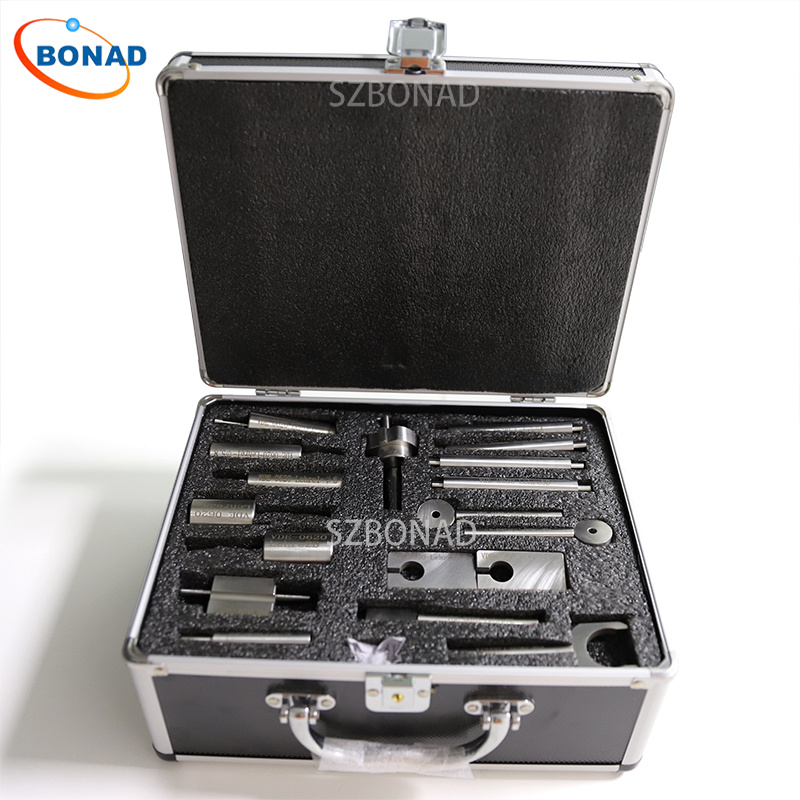
- Test finger probe accessibility checks
- Dielectric strength testing
- Leakage current measurement
Temperature Rise Test
Evaluates whether components exceed safe operating temperatures during normal use.
Abnormal Operation Test
Simulates fault conditions such as:
- Motor blockage
- Voltage fluctuation
- Component failure
Mechanical Strength and Stability
Ensures structural integrity under stress conditions.
Thermal and Fire Resistance
Evaluates insulation materials and fire risk behavior.
1.4 Test Equipment Used for IEC 60335
Typical testing systems include:
- Electrical safety analyzers
- Test finger probe systems
- Dielectric strength testers
- Leakage current testers
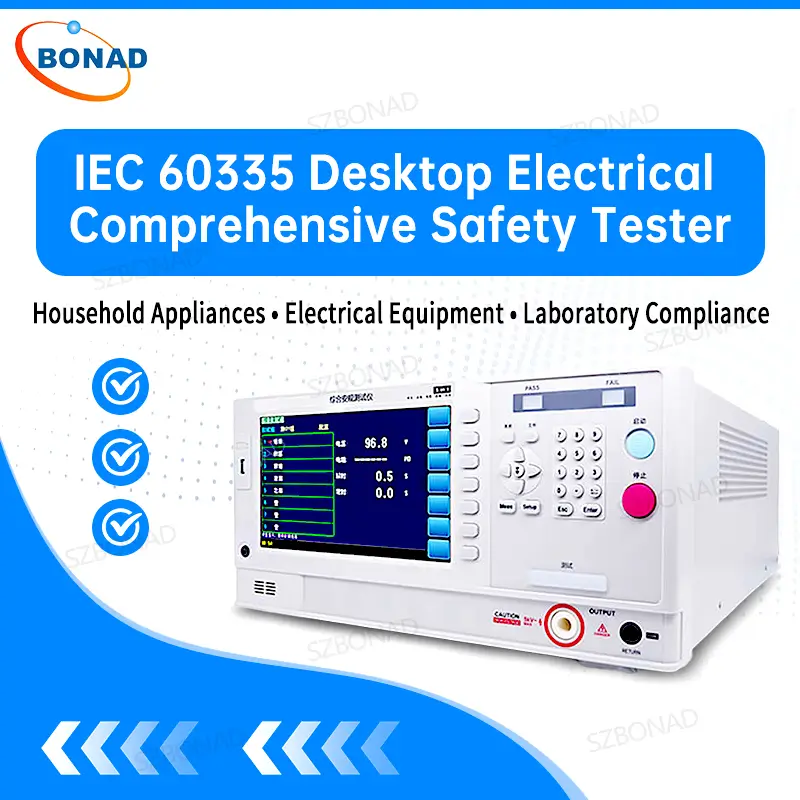
A representative solution is the Desktop Electrical Comprehensive Safety Tester, designed for integrated electrical safety evaluation in compliance with IEC 60335 requirements.
This type of equipment allows manufacturers to perform:
- Multi-parameter safety testing in one system
- Rapid verification during production
- Pre-certification validation in R&D labs
2. IEC 60068: Environmental Testing for Reliability Validation
2.1 Overview of IEC 60068
IEC 60068 defines a series of environmental testing methods used to evaluate how products perform under environmental stress conditions.
Unlike IEC 60335, which focuses on safety, IEC 60068 focuses on durability, reliability, and environmental adaptability.
It is widely used in:
- Electronics manufacturing
- Automotive electronics
- Aerospace components
- Industrial control systems
2.2 Structure of IEC 60068
IEC 60068 is not a single test but a test family standard, including:
- IEC 60068-1: General and guidance
- IEC 60068-2 series: Individual environmental tests
- IEC 60068-3: Supporting procedures
Each part defines specific environmental stress conditions.
2.3 Major Environmental Test Types
High and Low Temperature Testing
Assesses product performance under extreme thermal conditions.
Products are exposed to:
- High temperature aging
- Low temperature storage
- Temperature cycling
This helps identify:
- Material expansion issues
- Component failure under thermal stress
- Long-term degradation trends
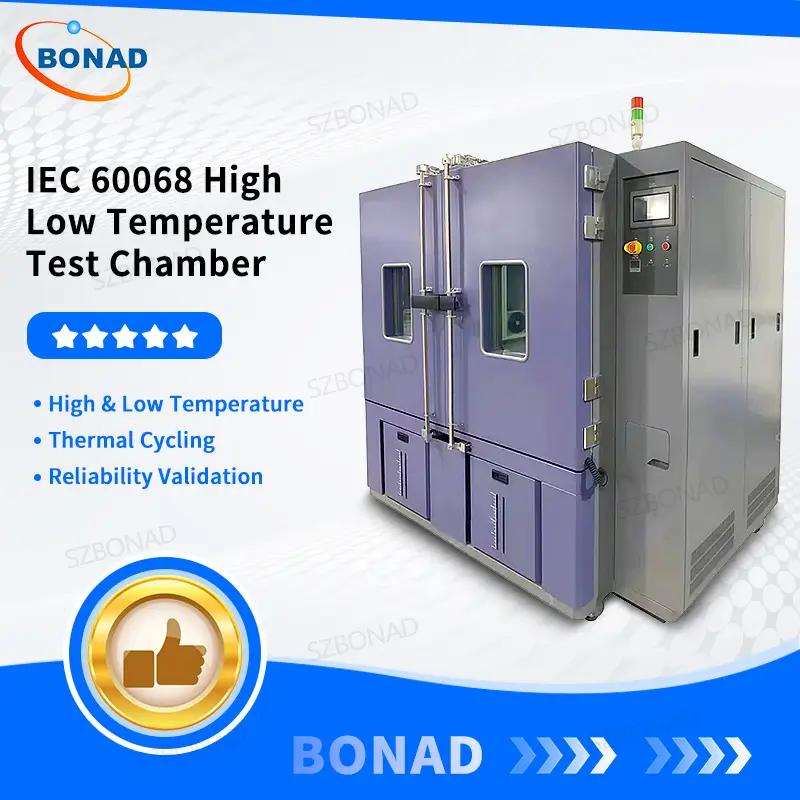
In practical laboratory environments, this is typically performed using a high-low temperature test chamber compliant with IEC 60068 requirements, such as the BONAD environmental test chamber designed for stable thermal cycling and precision control.
Humidity and Damp Heat Testing
Evaluates resistance to moisture penetration and condensation.
Common test conditions include:
- Steady damp heat
- Cyclic humidity exposure
Vibration Testing
Simulates transportation and operational mechanical stress.
Shock Testing
Evaluates resistance to sudden mechanical impact.
Salt Spray and Corrosion Testing
Used for evaluating corrosion resistance in harsh environments.
2.4 Importance of Environmental Reliability Testing
IEC 60068 is critical for ensuring:
- Long-term product stability
- Reduced field failure rates
- Compliance with global export requirements
Manufacturers often integrate environmental testing early in product development to reduce redesign costs and certification risks.
3. IEC 60529: Ingress Protection (IP Code) Standard
3.1 Overview of IEC 60529
IEC 60529 defines the Ingress Protection (IP) rating system, which classifies the degree of protection provided by enclosures of electrical equipment against:
- Solid particles (dust, debris)
- Water ingress (rain, spraying, immersion)
It is one of the most widely recognized protection standards in global trade.
The IP code format is:
IPXY
- X = solid particle protection (0–6)
- Y = liquid ingress protection (0–9K)
3.2 Solid Protection Levels (IP1X–IP6X)
- IP1X–IP4X: protection against large objects and tools
- IP5X: dust-protected
- IP6X: dust-tight (complete protection against dust ingress)
3.3 Water Protection Levels (IPX1–IPX9K)
- IPX1–IPX2: vertical and tilted dripping water
- IPX3–IPX4: spraying water
- IPX5–IPX6: powerful water jets
- IPX7–IPX8: temporary or continuous immersion
- IPX9K: high-pressure, high-temperature water jets (automotive level testing)
3.4 IP Testing in Engineering Practice
IP testing is essential for:
- Outdoor electronics
- Automotive components
- LED lighting systems
- Industrial enclosures
- EV charging equipment
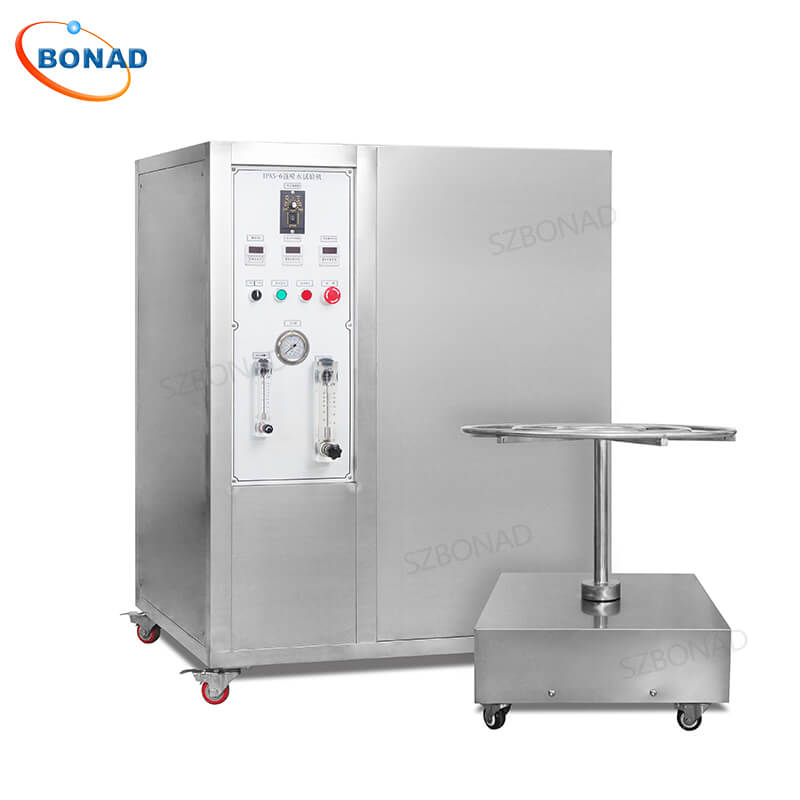
To validate compliance, manufacturers rely on controlled laboratory equipment that simulates real environmental water exposure conditions.
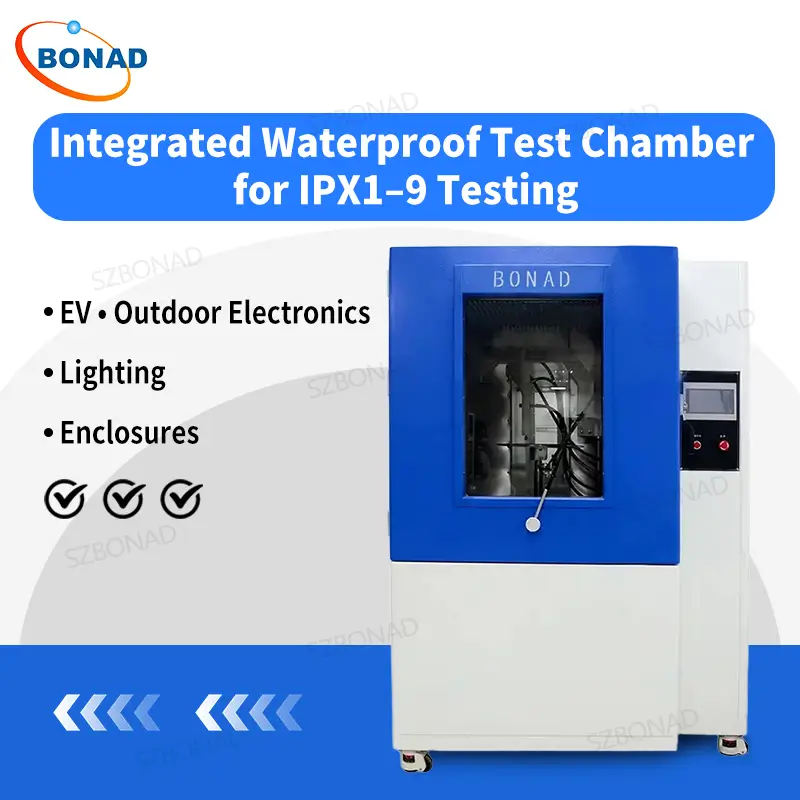
A typical solution is an Integrated Waterproof Test Chamber for IPX1–9 Testing, which allows:
- Multiple IP test levels in one system
- Automated spray and immersion control
- Standardized test repeatability
- Compliance with IEC 60529 requirements
This type of system is widely used in product certification laboratories and OEM quality control departments.
4. IEC 60335 vs IEC 60068 vs IEC 60529: Key Differences
| Category | IEC 60335 | IEC 60068 | IEC 60529 |
|---|---|---|---|
| Main Focus | Electrical safety | Environmental reliability | Ingress protection |
| Test Objective | Prevent hazards | Ensure durability | Evaluate enclosure sealing |
| Typical Tests | Shock, leakage, temperature rise | Temperature, humidity, vibration, shock | Dust & water resistance |
| Application | Household appliances | Industrial & electronics | Enclosure-based products |
| Risk Type | User safety risk | Product failure risk | Environmental exposure risk |
| Test Equipment | Electrical safety testers | Environmental chambers | IP test systems |
| Standard Nature | Product safety standard | Environmental test method | Protection classification system |
5. How These Standards Work Together
In real-world engineering, these three IEC standards are not used independently.
Instead, they form a complete product validation framework:
5.1 Electrical Appliance Development Workflow
- IEC 60335 → Safety Validation
- Prevent electrical hazards
- Ensure safe user operation
- IEC 60068 → Environmental Reliability
- Validate performance under stress conditions
- Simulate lifecycle environment
- IEC 60529 → Protection Rating
- Confirm enclosure sealing capability
- Ensure outdoor/industrial usability
Together, they ensure:
- Safety + durability + environmental protection
6. Industry Applications
Consumer Electronics
- Smartphones
- Home appliances
- Chargers and adapters
Automotive & EV Industry
- Battery systems
- Charging stations
- Control modules (ECU)
Industrial Equipment
- Control panels
- Sensors
- Automation systems
Lighting Industry
- Outdoor LED systems
- Street lighting
- Waterproof fixtures
7. BONAD Testing Solutions for IEC Compliance
To support IEC 60335, IEC 60068, and IEC 60529 compliance, integrated laboratory equipment plays a critical role in product development and certification.
7.1 Environmental Reliability Testing Solution
For IEC 60068 temperature and climate simulation, the IEC 60068 High Low Temperature Test Chamber provides:
- Stable temperature control for thermal cycling
- Wide temperature range simulation
- Long-term aging and reliability testing
- Compliance with environmental test procedures
It is widely used in electronics, automotive, and materials testing laboratories for product lifecycle evaluation.
7.2 IP Waterproof Testing Solution
For IEC 60529 IP rating validation, the Integrated Waterproof Test Chamber for IPX1–9 Testing enables:
- Full IPX1 to IPX9K test coverage in one system
- Automated spray and immersion control
- Repeatable and standardized test conditions
- Suitable for EV, automotive, and outdoor electronics
It is especially important for manufacturers requiring multi-level IP certification in one testing platform.
7.3 Electrical Safety Testing Solution
For IEC 60335 compliance, the Desktop Electrical Comprehensive Safety Tester provides:
- Leakage current testing
- Dielectric strength testing
- Insulation resistance testing
- Multi-function integrated safety evaluation
It is commonly used in appliance manufacturing and laboratory certification workflows.
8. FAQ:
Q1: What is the main difference between IEC 60335 and IEC 60068?
IEC 60335 focuses on electrical safety, while IEC 60068 focuses on environmental reliability testing.
Q2: Is IEC 60529 a safety standard?
No. IEC 60529 defines protection levels (IP codes), not electrical safety requirements.
Q3: Can one product require all three IEC standards?
Yes. Many consumer and industrial products must pass safety, environmental, and IP testing simultaneously.
Q4: What industries use IEC 60068 the most?
Electronics, automotive, aerospace, and industrial control systems.
Q5: What is IPX9K testing used for?
High-pressure, high-temperature water resistance testing, mainly for automotive and heavy-duty outdoor equipment.