Plastic materials are widely used across automotive, electrical, packaging, medical, and industrial sectors due to their lightweight structure, chemical resistance, and versatile mechanical properties. However, selecting the right plastic material requires reliable mechanical performance evaluation. Among various material characterization methods, plastic tensile testing is one of the most fundamental and widely applied mechanical tests.
A tensile test provides valuable information about how a plastic material behaves when subjected to pulling forces. By measuring parameters such as tensile strength, elongation, and modulus, manufacturers and laboratories can assess material quality, compare formulations, verify product performance, and ensure compliance with international standards.
For thermoplastics and thermosetting molding materials, tensile testing is commonly performed according to ISO 527 and ASTM D638 standards. These methods establish consistent procedures for specimen preparation, testing conditions, and result evaluation, allowing laboratories and manufacturers worldwide to achieve repeatable and comparable results.
This guide explains the principles, standards, testing procedures, and applications of plastic tensile testing while introducing suitable tensile testing equipment for reliable material evaluation.
What Is Plastic Tensile Testing?
Plastic tensile testing is a mechanical test used to determine how plastic materials respond to tensile or pulling forces. During the test, a prepared specimen is stretched at a controlled speed until yielding or fracture occurs.
The testing machine continuously records force and displacement data throughout the process. These measurements are converted into stress–strain curves, which reveal the mechanical behavior of the material under load.
Typical plastic tensile testing evaluates:
- Tensile strength
- Tensile modulus
- Yield strength
- Elongation at break
- Breaking force
- Deformation characteristics
The results help engineers and quality control personnel understand whether a material can withstand expected service loads and environmental conditions.
Unlike hardness or impact testing, tensile testing provides a broader picture of mechanical performance because it evaluates both strength and deformation behavior.
Why Plastic Tensile Testing Is Important
Mechanical performance directly influences the reliability and safety of plastic products. Inadequate tensile properties may lead to cracking, deformation, or premature failure during service.
Plastic tensile testing plays an important role in:
Material Development
Polymer manufacturers use tensile testing to compare formulations, additives, fillers, and reinforcement systems during material development.
Quality Control
Production batches can vary due to processing conditions or raw material changes. Tensile testing helps ensure consistent mechanical performance and stable product quality.
Product Design Validation
Engineers use tensile data to confirm whether materials meet structural and functional requirements before mass production.
Compliance With International Standards
Many industries require materials to comply with internationally recognized mechanical testing standards such as ISO 527 and ASTM D638.
Failure Investigation
Tensile testing also assists laboratories in identifying performance degradation caused by aging, environmental exposure, or manufacturing defects.
Plastic Tensile Test Standards
International standards provide unified testing procedures to ensure consistency and repeatability.
The two most widely used standards for plastic tensile testing are ISO 527 and ASTM D638.
ISO 527 Tensile Testing Standard
ISO 527 is an internationally recognized testing standard used to determine tensile properties of plastics.
The ISO 527 series defines testing principles, specimen geometry, conditioning requirements, and testing speeds for various plastic materials.
Important parts include:
ISO 527-1
ISO 527-1 specifies general principles for determining tensile properties of plastics.
It covers:
- Testing concepts
- Equipment requirements
- Data interpretation
- Calculation methods
- Testing conditions
This section serves as the foundation for the entire ISO 527 testing framework.
ISO 527-2
ISO 527-2 applies specifically to molded and extruded plastics.
It defines:
- Specimen shapes
- Grip distance
- Testing speed
- Strain measurement methods
- Property calculations
This section is widely used for thermoplastics and thermosetting molding materials.
ISO 527-3
ISO 527-3 addresses plastic films and sheets.
Because flexible films behave differently from rigid plastics, the standard includes specialized specimen preparation and testing procedures.
ASTM D638 Standard
ASTM D638 is another widely used tensile testing standard, particularly in North America.
It establishes procedures for determining tensile properties of reinforced and unreinforced plastics.
The standard covers:
- Dumbbell specimen geometry
- Testing speeds
- Conditioning requirements
- Calculation methods
- Reporting procedures
ASTM D638 is commonly used in manufacturing, material development, and product qualification.
ISO 527 vs ASTM D638
Although both standards evaluate tensile properties, several differences exist.
| Item | ISO 527 | ASTM D638 |
|---|---|---|
| Primary Region | International | North America |
| Specimen Type | ISO standardized shapes | ASTM dumbbell |
| Modulus Measurement | High precision strain measurement | Standard extensometer methods |
| Test Speed | Standard-defined categories | Material-based selection |
| Application | Broad plastics testing | Industrial and commercial plastics |
Despite procedural differences, both standards aim to generate reliable and repeatable tensile property data.
The selected standard usually depends on customer specifications, regional regulations, and industry requirements.
Key Mechanical Properties Measured in Plastic Tensile Testing
Plastic tensile testing generates several important mechanical parameters.
Understanding these properties helps engineers make informed material selection decisions.
Tensile Strength
Tensile strength represents the maximum stress a material can withstand before fracture or failure.
Higher tensile strength generally indicates greater load-bearing capability.
This property is important for:
- Structural plastic parts
- Automotive components
- Engineering plastics
- Safety-related products
Tensile Modulus (Young’s Modulus)
Tensile modulus measures material stiffness.
It indicates resistance to elastic deformation under load.
Materials with:
- High modulus → stiffer behavior
- Low modulus → more flexibility
Modulus is critical when dimensional stability and rigidity are required.
Yield Strength
Some plastics begin to deform permanently before fracture.
Yield strength represents the stress level at which irreversible deformation starts.
This value is essential for predicting long-term dimensional stability.
Elongation at Break
Elongation at break measures how much a specimen stretches before rupture.
It reflects ductility and flexibility.
Typical observations include:
- High elongation → ductile materials
- Low elongation → brittle materials
Flexible plastics often exhibit significantly higher elongation values.
Breaking Force
Breaking force is the total force applied at fracture.
This parameter is commonly used for comparative evaluation and quality verification.
Stress–Strain Behavior
Perhaps the most valuable output of tensile testing is the stress–strain curve.
The curve illustrates:
- Elastic deformation
- Yield point
- Plastic deformation
- Necking
- Fracture behavior
Different plastic materials display distinct stress–strain characteristics, helping engineers understand real-world mechanical performance.
Plastic Tensile Testing Procedure
Reliable testing results depend on standardized procedures and controlled testing conditions.
A typical plastic tensile test involves several steps.
1. Specimen Preparation
Specimens are prepared according to relevant standards.
Common methods include:
- Injection molding
- Compression molding
- Machining
- Extrusion sample cutting
Poor specimen preparation may significantly influence test accuracy.
Edges, thickness, and dimensions must comply with standard requirements.
2. Specimen Conditioning
Conditioning stabilizes moisture and temperature before testing.
ISO and ASTM standards commonly recommend:
- 23°C ±2°C
- 50% ±5% relative humidity
Conditioning reduces testing variability and improves reproducibility.
3. Specimen Installation
The specimen is mounted between machine grips.
Proper alignment is critical.
Misalignment may produce:
- Uneven stress distribution
- Slippage
- Premature failure
- Measurement error
Grip selection depends on material stiffness and specimen geometry.
4. Extensometer or Strain Measurement
Strain measurement is essential for accurate modulus and elongation calculation.
Common methods include:
- Contact extensometers
- Non-contact optical systems
- Crosshead displacement methods
ISO modulus determination typically requires high-accuracy strain measurement.
5. Controlled Loading
The tensile testing machine stretches the specimen at a specified speed.
Testing speed depends on:
- Standard requirements
- Material type
- Property being measured
Force and displacement are continuously recorded during loading.
6. Data Analysis
Testing software calculates mechanical properties and generates stress–strain curves.
Results are analyzed and compared against:
- Material specifications
- Customer requirements
- Historical data
- Regulatory standards
Test Specimens and Environmental Conditions
Specimen geometry and environmental control significantly affect testing reliability.
ISO 527 Specimen Types
ISO 527 commonly uses several specimen types.
Type 1A is widely used for molded plastics because it provides:
- Stable gripping
- Reliable stress distribution
- Good repeatability
Alternative specimen geometries may be selected based on material thickness or manufacturing process.
Environmental Conditions
Plastic materials are sensitive to environmental factors.
Testing conditions influence:
- Moisture absorption
- Flexibility
- Strength
- Modulus
Maintaining stable laboratory conditions is therefore essential.
Typical controlled conditions include:
- Temperature control
- Humidity regulation
- Standardized conditioning time
- Laboratory calibration procedures
Environmental control ensures comparable and repeatable testing results across laboratories and production facilities.
Tensile Testing Machine for Plastics
Accurate tensile testing requires reliable equipment capable of applying controlled force and measuring deformation with high precision. Modern laboratories typically use computer-controlled tensile testing machines to ensure stable testing conditions and repeatable results.
A plastic tensile testing system generally includes:
- Loading frame
- Servo or motor drive system
- Load cell
- Gripping fixtures
- Extensometer or strain measurement device
- Computer control and analysis software
The overall performance of the system directly influences testing accuracy and repeatability.
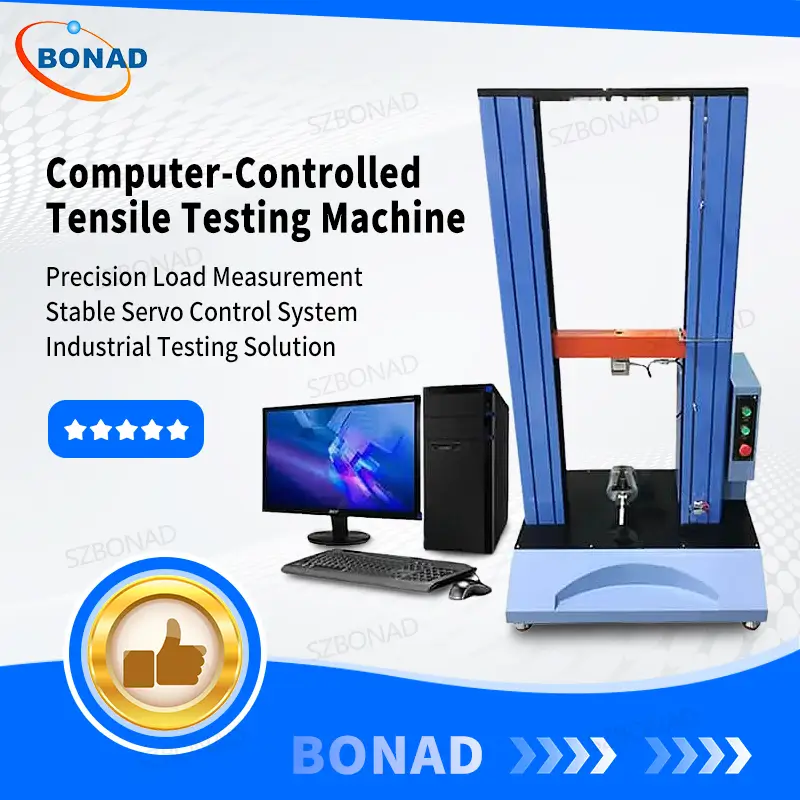
Computer-Controlled Tensile Testing Machine
For plastic material testing, computer-controlled tensile testing machines provide automated operation and precise data acquisition.
These systems are designed to perform:
- Tensile testing
- Compression testing
- Peel testing
- Flexural testing
- Material strength evaluation
Computerized control enables laboratories to standardize testing procedures and reduce operator-related variation.
Load Cell Accuracy and Force Measurement
The load cell is responsible for measuring applied force throughout the test.
High-precision load cells help ensure:
- Stable force measurement
- Reliable strength calculations
- Repeatable test results
- Compliance with testing standards
Appropriate load cell selection depends on the expected testing range and specimen strength.
Using an oversized or undersized sensor may affect measurement sensitivity and accuracy.
Grips and Fixture Selection
Proper gripping is essential for plastic tensile testing.
Incorrect grip selection may cause:
- Slippage
- Edge damage
- Uneven stress distribution
- Premature fracture
Common grip options include:
- Pneumatic grips
- Mechanical wedge grips
- Flat specimen grips
- Specialized polymer fixtures
Fixture design should match the specimen shape and material characteristics.
Extensometer and Strain Measurement
Accurate strain measurement is particularly important for modulus determination.
Depending on the application, laboratories may use:
- Contact extensometers
- Video extensometers
- Optical non-contact systems
- Crosshead displacement methods
For ISO 527 modulus measurement, precise strain measurement is often required to obtain reliable elastic property data.
Testing Software and Data Analysis
Modern tensile testing systems incorporate software capable of automatic data collection and analysis.
Typical software functions include:
- Real-time curve display
- Automatic property calculation
- Test report generation
- Statistical analysis
- Data storage and export
Digital testing software improves efficiency and enhances traceability in laboratory quality systems.
BONAD Computer-Controlled Tensile Testing Machine for Plastic Testing
The BONAD Computer-Controlled Tensile Testing Machine is designed for mechanical property evaluation of plastics, rubber, composite materials, and industrial products.
The system supports standardized testing according to international methods and provides reliable force and deformation measurement for laboratory and industrial applications.
Typical testing capabilities include:
- Plastic tensile testing
- Elongation measurement
- Strength evaluation
- Material comparison
- Quality control testing
Key advantages include:
High Testing Accuracy
The machine adopts precision force measurement and stable control systems to support accurate and repeatable results.
Computerized Control
Automated software control simplifies testing procedures and reduces manual operation variability.
Wide Application Range
The system can be applied to multiple material categories, supporting laboratory testing and industrial quality assurance requirements.
Flexible Fixture Configuration
Different grips and fixtures may be configured according to specimen type and testing standards.
This flexibility supports testing of various plastic products and polymer materials.
Applications of Plastic Tensile Testing
Plastic tensile testing is widely used across numerous industries where mechanical reliability and material verification are critical.
Automotive Industry
Modern vehicles increasingly rely on lightweight plastic components.
Tensile testing helps verify:
- Structural strength
- Durability
- Dimensional stability
- Material consistency
Typical tested materials include:
- Polypropylene (PP)
- Polyamide (PA)
- ABS
- Reinforced engineering plastics
Reliable tensile data supports lightweight design and long-term product performance.
Electrical and Electronics Industry
Plastic materials used in electrical products must maintain mechanical integrity during service.
Testing assists manufacturers in evaluating:
- Connector housings
- Insulating materials
- Cable components
- Consumer electronics plastics
Mechanical verification is particularly important when products experience thermal or environmental stress.
Packaging Industry
Packaging materials require controlled flexibility and adequate mechanical strength.
Tensile testing is commonly used for:
- Plastic films
- Flexible packaging
- Containers
- Protective materials
Mechanical performance influences product protection and processing efficiency.
Medical Plastics
Medical polymers must meet strict quality and reliability requirements.
Tensile testing supports:
- Material qualification
- Device safety verification
- Manufacturing consistency
- Regulatory documentation
Mechanical testing helps ensure safe performance in healthcare applications.
Construction and Industrial Materials
Construction plastics and industrial polymer products often experience sustained loading conditions.
Testing helps evaluate:
- Pipe materials
- Panels
- Structural polymers
- Composite systems
Mechanical data supports product certification and service-life prediction.
Polymer Research and Development
Research laboratories rely heavily on tensile testing when developing new polymer formulations.
Tensile data enables:
- Material comparison
- Filler evaluation
- Additive optimization
- Performance benchmarking
This information accelerates material innovation and product development.
Why Tensile Testing Matters in Plastic Material Development?
Plastic materials are increasingly engineered to satisfy demanding performance requirements.
Mechanical characterization through tensile testing supports informed material selection and reliable product development.
Supporting Quality Control
Routine tensile testing helps manufacturers identify variations in:
- Raw materials
- Processing conditions
- Production consistency
Early detection reduces defects and improves manufacturing stability.
Improving Product Reliability
Mechanical testing confirms whether products can withstand expected service loads.
Reliable tensile data reduces the risk of:
- Premature cracking
- Deformation
- Product failure
- Customer complaints
Verifying Material Changes
Material substitutions, recycled content, and formulation modifications may influence performance.
Tensile testing provides objective data for evaluating these changes.
Meeting Customer and Regulatory Requirements
Many industries require documented mechanical property verification.
Standardized tensile testing helps manufacturers demonstrate compliance and maintain confidence throughout the supply chain.
Why Choose BONAD Tensile Testing Equipment
Selecting suitable testing equipment is essential for obtaining reliable and repeatable results.
BONAD focuses on providing professional laboratory testing equipment for industrial and research applications.
Professional Testing Equipment Manufacturer
BONAD provides testing solutions covering mechanical, environmental, electrical, and safety testing applications.
The company supports laboratories and manufacturers requiring reliable compliance testing equipment.
Standards-Oriented Testing Solutions
BONAD equipment is designed to support internationally recognized testing methods and laboratory practices.
Testing systems may be configured according to application requirements and material standards.
Stable Performance and Repeatability
Reliable mechanical design and computerized control help improve testing consistency and operational efficiency.
Repeatable results support long-term laboratory quality assurance.
Technical Support and Customized Solutions
Different testing applications may require specialized fixtures, force ranges, or software configurations.
BONAD provides technical support and customized testing solutions according to customer requirements.
Conclusion
Plastic tensile testing is one of the most important methods for evaluating mechanical properties and ensuring reliable material performance.
Using internationally recognized standards such as ISO 527 and ASTM D638, manufacturers and laboratories can generate consistent and comparable data for material development, quality control, and product validation.
Accurate tensile testing depends not only on standardized procedures and proper specimen preparation but also on reliable testing equipment and precise measurement systems.
As plastic materials continue to evolve across automotive, electronics, packaging, medical, and industrial applications, tensile testing remains a critical tool for supporting product quality, regulatory compliance, and engineering confidence.
With professional testing equipment and application-focused support, BONAD helps laboratories and manufacturers perform dependable tensile testing and advance material performance evaluation.
FAQ:
What is plastic tensile testing?
Plastic tensile testing is a mechanical test used to determine how plastic materials behave under tensile force. It measures properties such as tensile strength, modulus, and elongation.
What is ISO 527?
ISO 527 is an international standard used for determining tensile properties of plastics, including thermoplastics and thermosetting molding materials.
What is the difference between ISO 527 and ASTM D638?
Both standards evaluate tensile properties, but they differ in specimen geometry, testing procedures, and regional application preferences.
Why is specimen conditioning important?
Conditioning stabilizes temperature and moisture content, helping reduce testing variability and improve repeatability.
What machine is used for plastic tensile testing?
Plastic tensile testing is typically performed using a computer-controlled tensile testing machine equipped with appropriate grips and strain measurement devices.
Why is elongation at break important?
Elongation at break indicates material ductility and flexibility, helping engineers understand deformation behavior before fracture.
Can one tensile testing machine test multiple materials?
Yes. With suitable load cells and fixtures, many tensile testing machines can test plastics, rubber, composites, textiles, and other materials.