What Is Ozone Testing?
Ozone testing is an environmental durability test designed to measure the resistance of materials to ozone-induced cracking and surface degradation.
Ozone (O₃) is a highly reactive oxidizing gas naturally present in the atmosphere and also generated by electrical discharge, motors, transformers, industrial equipment, and urban pollution. Even low ozone concentrations can attack certain elastomers over time.
Materials commonly tested include:
- Natural rubber (NR)
- Styrene-butadiene rubber (SBR)
- Nitrile rubber (NBR)
- EPDM rubber
- Silicone rubber
- Cable sheath materials
- Sealing compounds
- Flexible polymer components
Typical damage may include:
- Fine surface cracks
- Loss of elasticity
- Hardening
- Reduced tensile strength
- Seal leakage
- Premature failure
Why Is Ozone Testing Important?
Many products operate in environments where ozone exposure is possible. Heat, humidity, stress, and stretching can accelerate material failure.
Without ozone resistance testing, manufacturers may face:
| Potential Issue | Possible Result |
|---|---|
| Seal cracking | Air or water leakage |
| Hose degradation | Reduced service life |
| Cable jacket failure | Insulation risk |
| Rubber part aging | Maintenance or replacement costs |
| Material inconsistency | Batch quality variation |
Ozone testing helps reduce field failures and supports better material selection.
How Does Ozone Damage Rubber?
Many elastomers contain double bonds in their molecular structure. Ozone reacts with these bonds and breaks polymer chains at the surface.
This often becomes worse when the sample is under strain. A stretched rubber surface is more vulnerable to cracking than an unstressed sample.
Common factors affecting ozone cracking:
- Higher ozone concentration
- Increased temperature
- Longer exposure time
- Mechanical tension or elongation
- Poor antioxidant formulation
- Low-quality raw materials
How Ozone Testing Works
An Ozone Aging Test Chamber creates a controlled environment where samples are exposed to a specified ozone concentration for a defined time.
Key controlled parameters include:
- Ozone concentration (pphm or ppm)
- Chamber temperature
- Relative humidity (if required)
- Exposure duration
- Static strain or dynamic movement
- Air circulation rate
This allows months or years of natural aging to be simulated in a shorter test cycle.
Real Technical Test Conditions
Actual settings depend on the material type and test standard.
Typical Static Ozone Test Conditions
| Parameter | Common Range |
|---|---|
| Ozone Concentration | 25 to 200 pphm |
| Temperature | 23°C to 40°C |
| Relative Humidity | Below 65% RH |
| Elongation | 10% to 40% |
| Test Duration | 24h / 72h / 168h |
Typical Severe Aging Conditions
| Parameter | Common Range |
|---|---|
| Ozone Concentration | 300 to 1000 pphm |
| Temperature | 40°C to 60°C |
| Exposure Time | 72h to 336h |
Example Test Setup for Rubber Seal
- Standard: ISO 1431-1
- Ozone concentration: 50 pphm
- Temperature: 40°C
- Elongation: 20%
- Duration: 72 hours
After exposure, the sample surface is visually inspected under magnification.
Common International Standards
| Standard | Description |
|---|---|
| ISO 1431-1 | Static and dynamic ozone cracking resistance of rubber |
| ISO 1431-3 | Ozone concentration calibration methods |
| ASTM D1149 | Rubber deterioration by ozone cracking |
| ASTM D1171 | Atmospheric ozone cracking evaluation |
| IEC 60811 | Ozone resistance of cable insulation and sheath |
| GB/T 7762 | Rubber ozone aging testing |
Using recognized standards improves consistency and comparability.
Common Ozone Testing Methods
1. Static Strain Test
Samples are stretched to a specified elongation and held in fixtures during exposure.
Best for:
- Seals
- O-rings
- Gaskets
- Cable jackets
2. Dynamic Ozone Test
Samples are repeatedly flexed or stretched while exposed to ozone.
Best for:
- Hoses
- Flexible boots
- Moving rubber parts
3. Free State Exposure Test
Samples are exposed without strain to evaluate surface stability.
How to Evaluate Ozone Test Results
After testing, samples are inspected visually or with magnification.
Common evaluation criteria include:
| Evaluation Item | Description |
|---|---|
| Crack Presence | Yes / No |
| Crack Density | Number of cracks per area |
| Crack Length | Microscopic or visible crack size |
| Crack Depth | Surface or penetrating |
| Retained Tensile Strength | Mechanical performance after exposure |
| Appearance Change | Color or gloss change |
Typical Rating Example
- Grade 0 = No visible cracks
- Grade 1 = Very slight cracking
- Grade 2 = Moderate cracking
- Grade 3 = Severe cracking
(Actual grading depends on standard or internal quality rules.)
Industries That Use Ozone Testing
Automotive
- Door seals
- Window channels
- Under-hood hoses
- Suspension boots
- EV sealing components
Wire & Cable
- Outdoor cable jackets
- Power cable insulation
- Flexible industrial cables
Industrial Products
- O-rings
- Conveyor parts
- Rubber rollers
- Protective sleeves
Electronics & Appliances
- Flexible covers
- Soft-touch rubber parts
- Appliance seals
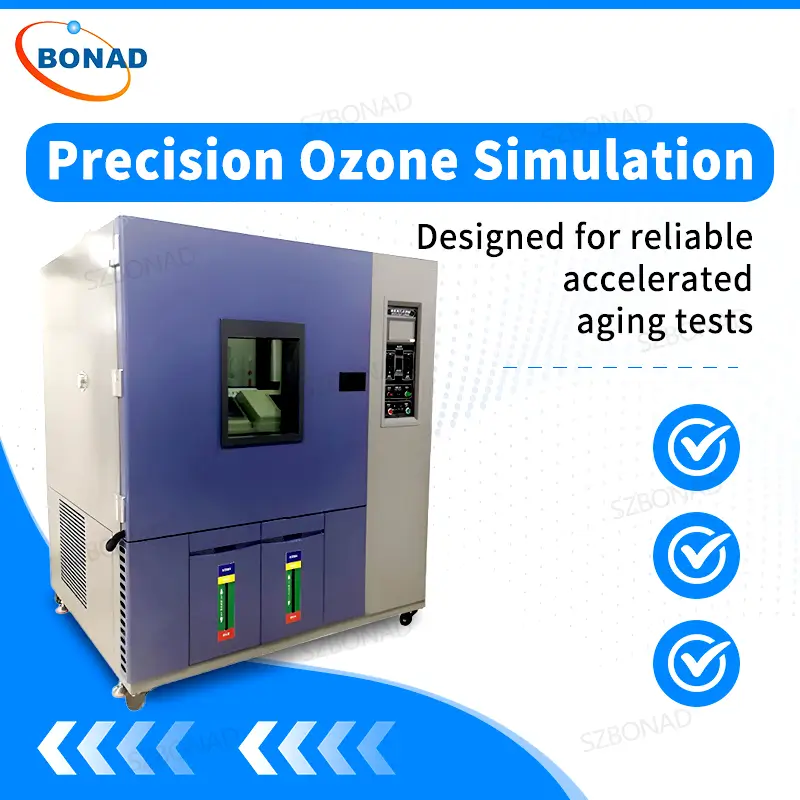
Recommended Equipment: Ozone Aging Test Chamber
The Ozone Aging Test Chamber is designed for stable and repeatable ozone resistance testing.
Key Features
- Accurate ozone generation and control
- Static and dynamic sample fixtures available
- Programmable temperature settings
- Stainless steel chamber interior
- Touchscreen controller
- Safety protection system
- Reliable long-term operation
Typical Specifications
| Item | Specification |
|---|---|
| Temperature Range | Ambient +10°C to 60°C |
| Ozone Concentration | 0 to 1000 pphm |
| Concentration Deviation | ±10% |
| Temperature Fluctuation | ±0.5°C |
| Inner Chamber Material | SUS304 Stainless Steel |
| Power Supply | Customizable |
Ozone Testing vs UV Testing vs Xenon Testing
| Test Type | Simulates | Best For |
|---|---|---|
| Ozone Test | Oxidative cracking | Rubber / Elastomers |
| UV Test | Ultraviolet degradation | Plastics / Coatings |
| Xenon Test | Full weather sunlight exposure | Automotive / Paint / Textile |
For outdoor applications, combined aging programs are often recommended.
How to Choose the Right Ozone Test Chamber
1. Required Test Standards
Check whether ASTM, ISO, IEC, or internal methods must be followed.
2. Chamber Capacity
Select based on sample size and testing volume.
3. Concentration Accuracy
Stable ozone control improves repeatability.
4. Fixture Type
Choose static strain racks or dynamic movement fixtures.
5. Temperature Performance
Higher temperature capability supports accelerated aging.
6. Service & Calibration Support
Regular calibration is important for ozone sensors and concentration accuracy.
Conclusion
Ozone testing is one of the most effective ways to evaluate the durability of rubber and polymer materials under oxidative stress. By using realistic test conditions and recognized standards, manufacturers can improve product quality, compare material formulations, and reduce unexpected failures.
A reliable Ozone Aging Test Chamber provides stable, repeatable, and standards-based results for research, quality control, and production testing.
Frequently Asked Questions:
What is the normal ozone concentration used for testing?
Common values are 25, 50, 100, or 200 pphm depending on the standard.
Why are samples stretched during ozone testing?
Surface tension accelerates cracking and better simulates real service conditions.
How long does an ozone test take?
Typical durations are 24h, 72h, 168h, or longer.
Can EPDM rubber resist ozone well?
Yes. EPDM generally has excellent ozone resistance compared with many unsaturated rubbers.
How often should an ozone chamber be calibrated?
This depends on usage frequency and internal quality systems, but periodic sensor verification is recommended.
Can chamber size be customized?
Yes. Chamber dimensions, fixtures, and control systems are often customizable.