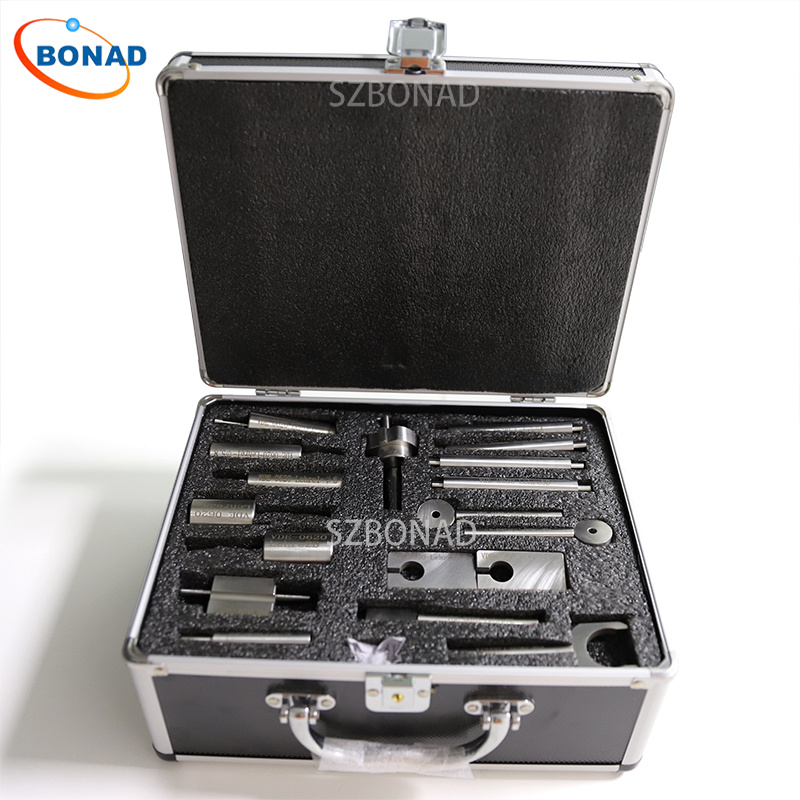
IEC 61032 is a fundamental international standard defining test probes used to verify protection against access to hazardous parts in electrical and electronic equipment enclosures. It is widely applied in product safety certification, IP protection testing, and compliance validation across industries such as appliances, industrial equipment, lighting, and consumer electronics.
This standard is especially important because it simulates human body interaction (fingers, tools, wires) to ensure that end users cannot accidentally touch dangerous live parts or moving components.
1. IEC 61032 Standard Overview
IEC 61032 defines a series of standardized probes that simulate human access and foreign object intrusion.
These probes are used to evaluate:
- Protection against electric shock
- Mechanical enclosure safety
- Access to hazardous live parts
- Ingress protection (IP Code-related verification)
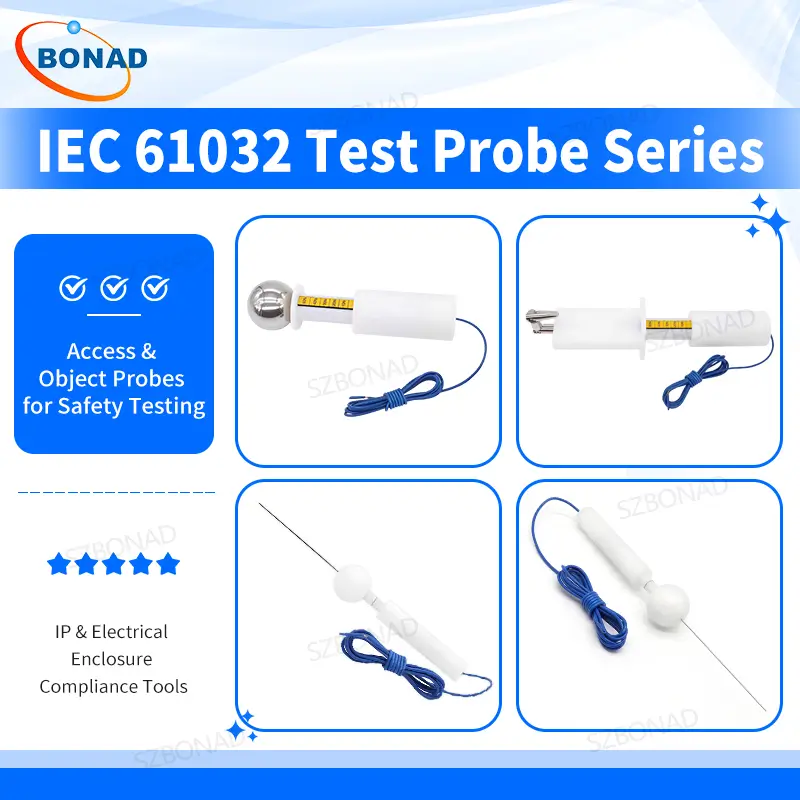
Main Probe Types under IEC 61032
| Probe Type | Description | Application |
|---|---|---|
| Test Probe A | Back-of-hand simulation | Large surface access checks |
| Test Probe B (Finger Probe) | Articulated test finger | Standard human finger simulation |
| Test Probe C | Rigid access tool probe | Tool-like intrusion testing |
| Test Probe D | Wire probe | Small object intrusion |
| Test Pin / Needle Probes | Small diameter access simulation | Fine-gap safety testing |
Among them, Test Probe B (Jointed Test Finger) is the most widely used in global compliance testing.
2. IEC 61032 Test Methods (How Testing is Performed)
IEC 61032 testing focuses on simulating human access under controlled force and motion conditions.
2.1 Basic Test Principle
A test probe is applied to:
- Product openings
- Enclosure joints
- Ventilation holes
- Switch panels
- Internal barriers
The goal is to determine whether: Hazardous parts can be touched under normal or expected use conditions.
2.2 Test Probe B (Jointed Finger) Method
The most important test is Figure 2 – Test Probe B.
Key test parameters:
| Parameter | Typical Specification |
|---|---|
| Finger diameter | 12 mm |
| Finger length | 80 mm |
| Baffle diameter | 50 mm |
| Joint movement | 90° articulation |
| Applied force | ~10N (standard configuration) |
Testing logic:
- Probe is inserted into openings
- Joints simulate finger bending
- A defined force is applied
- Pass/Fail is determined based on access to hazardous parts
2.3 Acceptance Criteria
A product is considered compliant if:
- No live parts are accessible
- No sharp/hazardous components can be touched
- The probe cannot penetrate protective barriers beyond defined limits
2.4 Key Comparison: Probe Functions
| Probe Type | Simulates | Risk Evaluated | Common Standard Use |
|---|---|---|---|
| Test Probe B | Human finger | Electric shock risk | IEC 61032 / IEC 60529 |
| Test Probe A | Hand back | Large surface contact | Appliance safety |
| Test Probe C | Tool | Mechanical penetration | Industrial equipment |
| Wire Probe | Thin object | Small gap intrusion | Electrical enclosures |
3. IEC 61032 Test Equipment (Industrial Solutions)
To perform IEC 61032 testing, laboratories typically use:
- Jointed test finger probes
- Rigid finger probes
- Force-controlled articulated systems
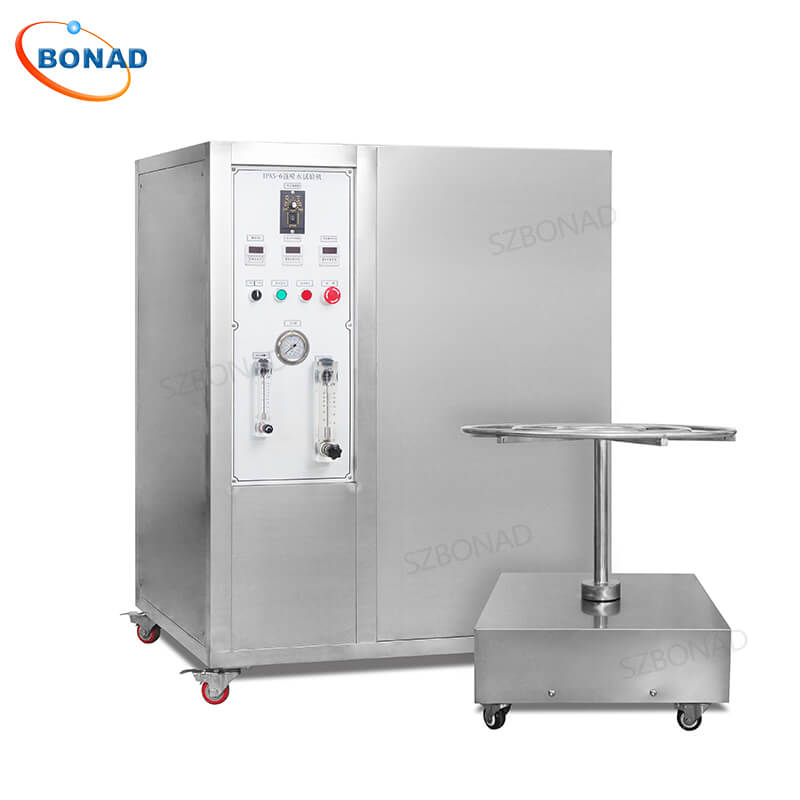
- IP test rigs (combined IEC 60529 setups)
- Calibration-certified probe kits
Technical requirements for compliance-grade equipment:
| Feature | Requirement |
|---|---|
| Material | Stainless steel / insulating handle |
| Calibration | ISO 17025 recommended |
| Force control | 10N–50N depending on probe type |
| Joint articulation | Smooth ±90° movement |
| Standard compliance | IEC 61032 / IEC 60335 / IEC 60529 |
Industrial Product Reference
For full probe systems and testing setups: BONAD Test Probe
These systems are widely used in:
- Third-party testing laboratories
- Appliance manufacturers (OEM/ODM)
- Certification organizations (CE, UL, IEC compliance)
4. Application Areas of IEC 61032 Testing
IEC 61032 is not limited to one industry. It is essential in multiple safety-critical sectors.
4.1 Consumer Electronics
- Power adapters
- Smart home devices
- Chargers
- Audio equipment
4.2 Household Appliances
- Washing machines
- Microwaves
- Air conditioners
- Kitchen appliances
4.3 Industrial Equipment
- Control panels
- PLC cabinets
- Electrical enclosures
- Automation systems
4.4 Lighting Systems
- LED drivers
- Street lighting
- Industrial luminaires
Industry Importance Summary
| Industry | Why IEC 61032 Matters |
|---|---|
| Consumer electronics | Prevent electric shock |
| Home appliances | User safety compliance |
| Industrial systems | Operator protection |
| Lighting | Installation safety |
5. IEC 61032 vs Related Standards (Key Comparison Table)
| Standard | Focus | Relationship to IEC 61032 |
|---|---|---|
| IEC 61032 | Test probes for accessibility | Core standard for physical probes |
| IEC 60529 | IP protection rating | Uses probes defined in IEC 61032 |
| IEC 60335 | Appliance safety | Requires probe-based testing |
| IEC 61010 | Laboratory equipment safety | Uses similar accessibility probes |
👉 IEC 61032 acts as a foundation standard for multiple safety frameworks.
6. Future Trends in IEC 61032 Testing
The evolution of IEC 61032 testing is driven by automation and higher safety requirements.
6.1 Automation in Probe Testing
- Robotic probe insertion systems
- AI-based pass/fail detection
- Automated force control testing
6.2 Higher Precision Calibration
- ISO 17025 traceability requirements
- Digital force measurement integration
- Enhanced material durability standards
6.3 Integration with Smart Testing Systems
- IoT-enabled test rigs
- Digital compliance reporting
- Remote laboratory verification systems
Conclusion
IEC 61032 remains a core global standard for electrical safety verification, ensuring that products prevent accidental human contact with hazardous components.
Its test probe system—especially the jointed test finger (Test Probe B)—is essential for validating enclosure safety across industries from consumer electronics to industrial automation.
For manufacturers and testing laboratories, investing in standard-compliant IEC 61032 test equipment is critical for achieving international certification and ensuring product safety reliability.
FAQ – IEC 61032 Test Finger Standard
1. What is IEC 61032 used for?
IEC 61032 defines standardized test probes used to check whether users can accidentally touch hazardous parts in electrical and electronic equipment.
2. What is the most commonly used probe in IEC 61032?
The most widely used probe is Test Probe B (jointed test finger), which simulates a human finger for accessibility testing.
3. Is IEC 61032 required for IP testing?
Yes. IEC 61032 probes are commonly used in IEC 60529 IP testing to verify protection against access to dangerous parts.
4. What industries use IEC 61032 test probes?
They are used in consumer electronics, household appliances, industrial equipment, and lighting products for safety compliance testing.
5. How do I choose the correct IEC 61032 test probe?
Selection depends on the hazard type being tested—finger access, tool access, or wire intrusion—each requires a different probe type (A, B, C, or D).