In the world of product design, reliability is not just about whether a device turns on; it is about whether it survives the environment it was built for. For industries ranging from automotive manufacturing to consumer electronics, one of the most pervasive threats to sensitive machinery isn’t water or impact—it is dust.
Whether it is fine sand in the desert, construction debris on a job site, or talcum-like particles in a factory, the ability of an enclosure to resist these intrusions is defined by its Ingress Protection (IP) rating. Understanding the critical nuances between IP5X, IP6X, and the automotive-specific IP5KX and IP6KX classifications is essential for manufacturers seeking certification and market access.
This guide breaks down these global standards, the laboratory procedures behind them, and how the right testing equipment—like the advanced chambers from BONAD—can validate your product’s durability and ensure compliance.
What is Ingress Protection (IP) Testing?
Ingress Protection testing, defined primarily by the IEC 60529 standard, evaluates the level of protection an enclosure provides against “ingress,” or entry of foreign elements . These intrusions can mean solids (like dust and dirt) and liquids (water) .
The IP rating is represented by two numbers:
- First Digit (0-6): Protection against solid objects and dust.
- Second Digit (0-9): Protection against liquids .
For dust testing specifically, we focus on the first digit. The most common benchmarks are IP5X and IP6X, which distinguish between “dust-protected” and “dust-tight” enclosures.
IP5X vs. IP6X: Understanding the Critical Difference
While both ratings indicate resistance to dust, the level of tolerance differs significantly. Choosing the wrong rating for your application could lead to product failure or unnecessary manufacturing costs.
IP5X: Dust Protected
An enclosure with an IP5X rating is considered dust-protected. According to IEC 60529, this does not mean the enclosure is completely sealed against fine particles. It allows for the ingress of dust, but only to a very limited extent .
- The Requirement: Dust may enter the enclosure, but it must not deposit in a sufficient quantity to interfere with the satisfactory operation of the equipment or impair safety .
- The Test: After exposure to a circulating dust cloud, the product must be assessed for functionality. If dust ingress causes mechanical seizing, overheating, or electrical shorts, the product fails the IP5X test .
IP6X: Dust Tight
An IP6X rating represents the highest level of protection against solids (dust tight). This classification leaves no room for ambiguity regarding particulate ingress.
- The Requirement: No dust whatsoever is permitted to enter the enclosure. It is a complete barrier .
- The Test: The test procedure is significantly more stringent than IP5X. To simulate real-world pressure changes (such as an electronic component cooling down and sucking in air), a vacuum is often applied to the enclosure during the test. Unlike IP5X, a simple visual inspection for any dust ingress results in a failure, regardless of whether the device still functions.
The Automotive Standards: What are IP5KX and IP6KX?
For the automotive industry, the stakes are even higher. Components like Electronic Control Units (ECUs), sensors, and battery packs are exposed to road dust, high-pressure washing, and vibration. This is where the ISO 20653 standard comes into play, introducing the IP5KX and IP6KX ratings .
The “K” in these ratings signifies a test specific to road vehicles, often involving higher energy and more aggressive conditions.
- Pressure Differential Testing: The primary difference between standard IEC tests (IP5X/IP6X) and ISO tests (IP5KX/IP6KX) is the use of a pressure differential. During the dust circulation test, a vacuum is created inside the enclosure to actively suck dust into the housing if any microscopic gap exists . This simulates real-world conditions where a hot engine part cools down rapidly, creating negative pressure.
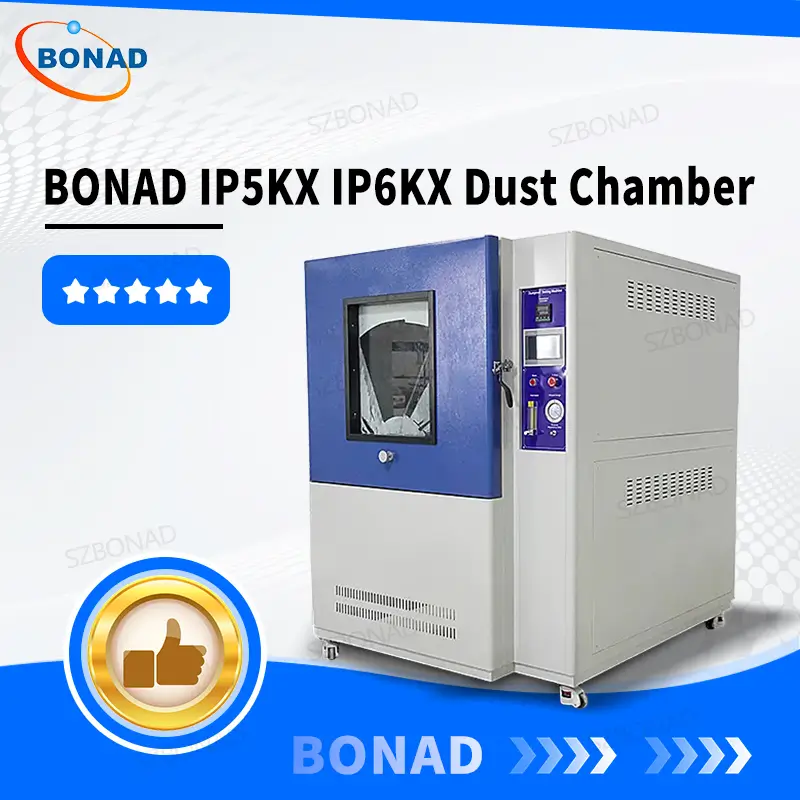
- BONAD addresses this specific need with specialized equipment like the ISO 20653 IP5KX / IP6KX Automotive Dust Chamber (Model: BND-IP56KX) . This chamber is designed to perform these rigorous automotive ingress tests with precision vacuum control, ensuring components can withstand severe particulate environments.
Inside the Lab: How Dust Testing Works
To achieve an accurate and repeatable IP rating, testing must be conducted in a controlled environment using calibrated material and equipment. Whether you are certifying a consumer electronic or a rugged industrial motor, the process follows strict international protocols.
The Testing Medium
Standards dictate the use of specific dust types to ensure global consistency. The most common medium is fine talcum powder.
- Specifications: The powder must be filtered through a square-mesh sieve with a wire diameter of 50µm and a nominal aperture of 75µm to ensure consistent particle size .
- Concentration: For an IP6X test, the dust concentration in the chamber is typically maintained at 2kg per cubic meter .
The Equipment: Dust Test Chambers
Performing these tests requires a robust Dust Test Chamber. A high-quality chamber must simulate natural windblown dust conditions while maintaining strict control over airflow, velocity, and duration.
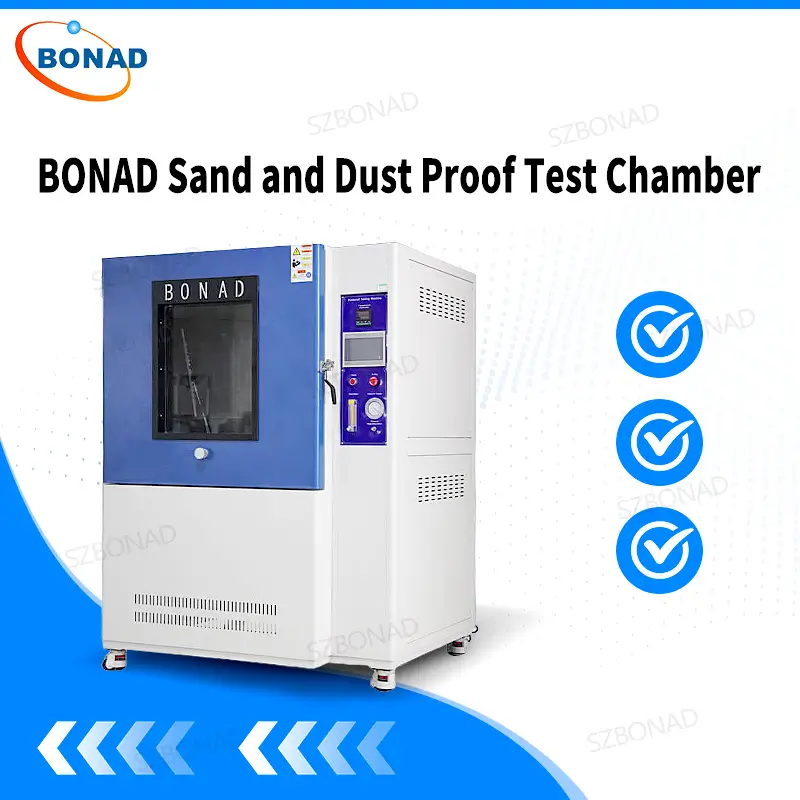
BONAD offers state-of-the-art solutions for these evaluations. The IEC60529 IP5X IP6X Sand and Dust Proof Test Chamber (Model: BND-IP56X) is engineered to create a circulating dust environment that tests the resilience of electronic enclosures, lighting, and electrical cabinets against fine dust penetration. Built with a stainless steel (SUS304) interior and a funnel-shaped bottom with a vibrating motor, it ensures consistent dust recycling through a 50µm filter, guaranteeing test accuracy.
Step-by-Step Test Procedures
IP5X Testing Procedure:
- Setup: The product is placed inside the BONAD dust test chamber.
- Exposure: A dust distributor (often using a centrifugal fan) blows fine dust particles from multiple directions to ensure even exposure, maintaining a dust velocity that prevents settling .
- Duration: The product is exposed to the blowing dust for a specified period (typically 8 hours) .
- Evaluation: Technicians remove the product and check for dust accumulation. They then verify if the dust that did enter compromises the device’s function or safety.
IP6X Testing Procedure:
- Setup: The product is placed inside the chamber. If required by the standard (or for automotive IP6KX tests), a vacuum line is attached to the product’s enclosure to create negative pressure.
- Exposure: A dense cloud of fine dust is raised and maintained within the sealed chamber, completely surrounding the product .
- Duration: The test duration is generally longer than IP5X, often lasting 8 hours with the vacuum running intermittently to simulate breathing cycles.
- Evaluation: The product is inspected internally. For an IP6X rating, the interior must be completely free of dust . This is a strict pass/fail criterion based solely on visual inspection.
Why Products Require Rigorous Dust Testing
Dust isn’t just a cosmetic nuisance; it is a functional killer. Even in seemingly clean environments, the presence of dust can impact operations over time.
- Thermal Insulation: Dust buildup inside a fan or heatsink can insulate components, leading to overheating and premature failure.
- Electrical Failure: Conductive or hygroscopic dust can settle on circuit boards, causing short circuits or corrosion.
- Mechanical Wear: In automotive and industrial applications, sand and dust can act as abrasives, wearing down moving parts, seals, and connectors .
- Hazardous Locations: In industries like grain processing or mining, accumulations of combustible dust pose a severe explosion risk. Verifying the integrity of electrical housings with IP6X ratings is a critical safety measure to mitigate these dangerous situations .
Industries that require stringent dust testing include:
- Automotive: ECUs, sensors, wiring harnesses, and battery management systems (often tested in the BONAD BND-IP56KX).
- Consumer Electronics: Smartphones, wearable tech, and outdoor cameras.
- Industrial Equipment: Motor control centers, outdoor enclosures, and power distribution boxes.
- Medical Devices: Equipment that must remain sterile and functional.
BONAD: Your Partner in Environmental Testing
Choosing the right testing equipment is vital for compliance and product quality. As a direct manufacturer, BONAD (SZBONAD) provides cutting-edge solutions tailored to global standards, ensuring your products meet the required level of ingress protection.
BONAD Product Highlights
- BND-IP56X – General Purpose Dust Chamber
- Standards: IEC60529.
- Application: Ideal for lamps, electrical cabinets, and general electronics requiring IP5X or IP6X certification. This chamber simulates dry sand and dust environments to verify the physical sealing of products against intrusions .
- BND-IP56KX – Automotive Dust Chamber
- Standards: ISO 20653 (IP5KX/IP6KX).
- Application: Specifically designed for the automotive industry. It tests components like battery packs, sensors, and lighting devices under harsh conditions, including pressure differentials, to ensure they are truly dust-tight even under thermal cycling and road vibration stress .
Conclusion: Ensuring Compliance from Development to Delivery
Understanding the difference between “Dust Protected” and “Dust Tight” is the first step in product design. IP5X offers a buffer for non-critical applications where minimal dust is acceptable, while IP6X provides an absolute seal. For the road, IP5KX and IP6KX add an extra layer of rigor demanded by automotive engineers to ensure long-term reliability.
To ensure your products meet these international benchmarks, you need reliable, precise testing equipment. BONAD’s range of dust test chambers are engineered to help you validate your designs, achieve certification, and bring durable, reliable products to market.
Contact BONAD today to find the perfect dust test solution for your engineering challenges.