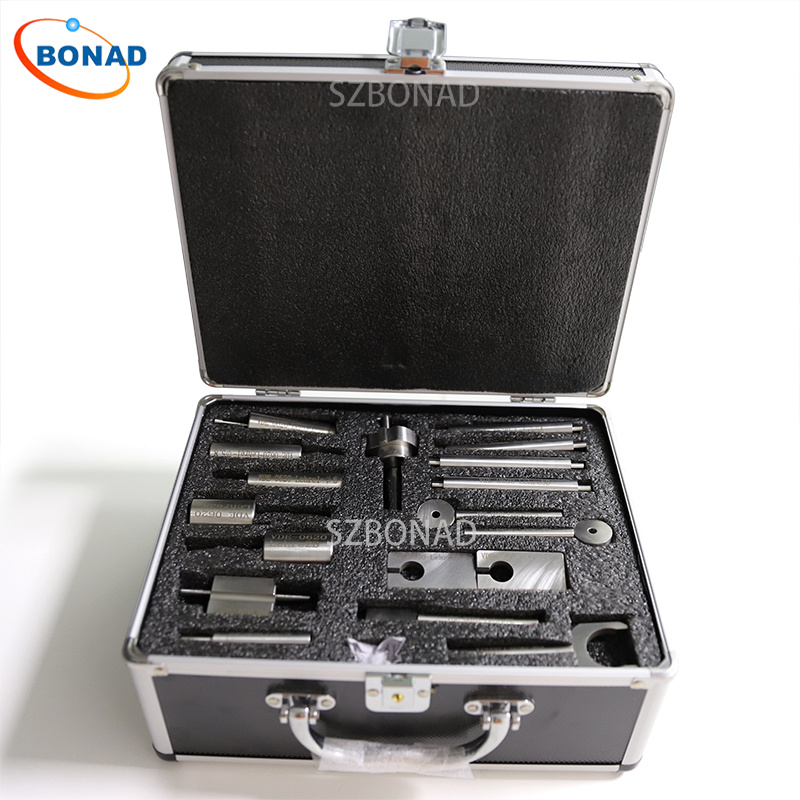
Sharp edges on electrical and electronic equipment are a hidden but serious safety risk. Even minor burrs or unfinished edges can cause cuts and injuries during normal use, handling, or maintenance. To address this issue, UL 1439 – Tests for Sharpness of Edges on Equipment defines a standardized method for evaluating whether accessible edges pose a potential injury hazard.
This article explains the UL 1439 standard, how sharp edge testing works, why calibration matters, and how the BONAD UL 1439 Sharp Edge Tester (BND-RL) helps manufacturers ensure product safety and compliance.
What Is UL 1439?
UL 1439 is a safety testing standard developed by Underwriters Laboratories (UL) in the early 1970s. The standard was created to evaluate the sharpness of accessible edges on appliances, electrical equipment, and consumer products.
UL engineers recognized that products made from metal, glass, and hard plastics often contain edges that may appear harmless but can cause serious injuries if not properly tested. The goal of UL 1439 is to simulate real human contact under controlled force and determine whether an edge presents a cut hazard during normal handling.
The standard states that edges associated with enclosures, frames, guards, knobs, handles, and similar components must be smooth and rounded enough to prevent cut-type injuries.
History of the UL 1439 Sharp Edge Test
Work on the UL 1439 standard began in 1973, when UL assembled a team of engineers to develop a reliable method for detecting dangerous sharp edges. This effort led to the creation of the Sharp Edge Tester, a device designed to reproduce consistent contact pressure similar to that of human touch.
Over time, the testing solution has been refined, but its core purpose remains the same:
to help manufacturers design and produce safer products.
How Does UL 1439 Sharp Edge Testing Work?
UL 1439 sharp edge testing uses a mechanical tester with layered sensing tape to evaluate edge sharpness in a repeatable and objective way.
Test Procedure
- A test probe wrapped with three layers of standardized tape is placed against the edge under test
- A controlled force is applied to simulate human contact
- The probe is slid at least 50 mm (2 inches) along the edge and then returned to the starting point
- The total travel distance is 4 inches (100 mm)
Pass / Fail Criteria
- Fail (Sharp Edge):
If the edge cuts through the two outer layers of sensing tape, exposing the inner (black) layer. - Pass (Acceptable Edge):
If the two outer layers are not cut at the same time.
This method ensures consistent results across different operators and test environments.
What Materials Can Be Tested?
UL 1439 testing is suitable for nearly any accessible hard edge, including:
- Metal edges and fabricated parts.
- Glass edges.
- Hard plastic housings.
- Electrical equipment enclosures and structural components.
The standardized force and motion allow accurate comparisons across different materials and product designs.
Why Is Calibration Important?
Calibration is essential for UL 1439 compliance.
To perform valid tests:
- The tester must be specifically designed for UL 1439 requirements.
- The applied force must match the standard specification.
- The testing device must be calibrated at least once per year.
Proper calibration ensures the tester accurately simulates human contact and produces reliable, compliant results.
Benefits of UL 1439 Sharp Edge Testing
Implementing UL 1439 sharp edge testing provides significant advantages:
Improve Safety
Identify and eliminate sharp edges that could cause user injuries.
Ensure Compliance
Meet UL 1439 and IEC 61010 Clause 7.2 requirements for electrical and consumer products.
Achieve Consistent Quality
Validate product quality through routine testing of components and finished goods.
Reduce Risk
Minimize liability, product recalls, and customer complaints related to cut hazards.
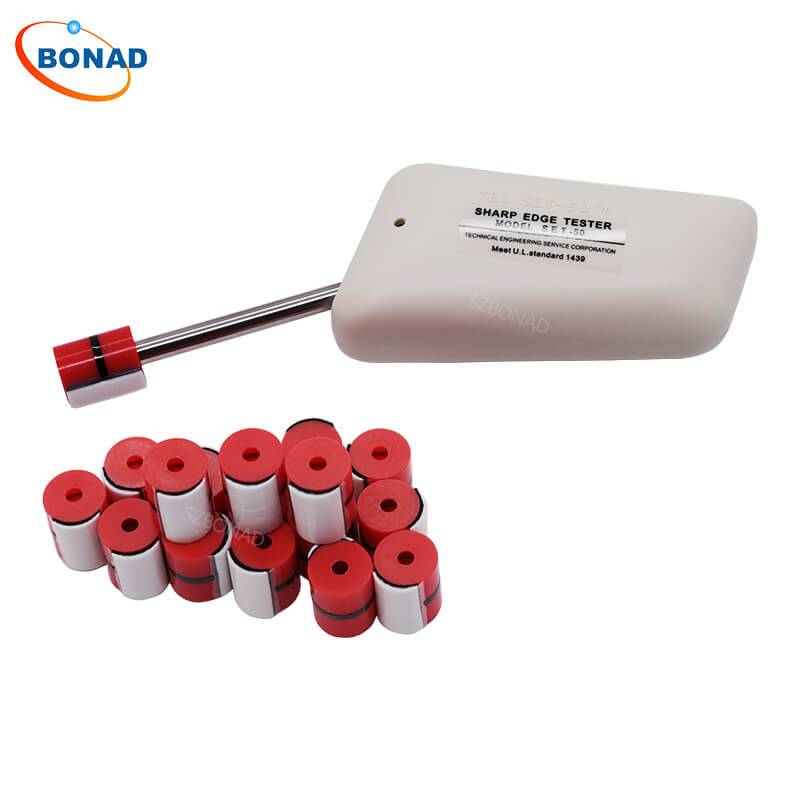
BONAD UL 1439 Sharp Edge Tester (Model BND-RL)
The UL1439 Sharp Edge Tester from SZBONAD is manufactured in strict accordance with the UL 1439 standard and also complies with IEC 61010 Clause 7.2. It is designed to detect dangerous sharp edges on accessible parts of electrical and electronic products.
Test Principle
Three layers of standard sensing tape are wrapped around the probe. The probe is slid over the test edge under a specified force and speed. Edge sharpness is determined by whether the tape layers are cut.
Operating Steps
- Install the test head onto the tester
- Apply a force of 0.68 kg and move the probe 2 inches along the edge, then return to the starting point
- Inspect the sensing tape
- If the two outer layers are cut, the edge is classified as sharp
Technical Specifications
- Probe material: Stainless steel
- Probe diameter: 12.7 mm
- Probe length: 19 mm
- Tester rod diameter: 6.4 mm
- Test head diameter: ≤ 15.9 mm, replaceable
- Overall dimensions: 184 × 35 × 52 mm
- Weight: 132 g
The compact design and simple operation make this tester ideal for manufacturers, quality laboratories, and third-party testing organizations.
Why UL 1439 Matters in Product Design
Seemingly minor edge defects can result in severe injuries and costly legal consequences. UL 1439 provides a structured, objective method for identifying unintended sharp edges before products reach the market.
By using a compliant solution such as the BONAD UL 1439 Sharp Edge Tester, manufacturers can improve safety, enhance product quality, and demonstrate commitment to regulatory compliance.
FAQ
What is the UL 1439 sharp edge test?
The UL 1439 sharp edge test determines whether accessible edges on equipment can cause cut injuries by simulating human contact under controlled force.
How does UL 1439 sharp edge testing work?
A probe wrapped with layered sensing tape is pressed and slid along the edge; if the two outer tape layers are cut, the edge is classified as sharp.
What force and distance are used in the UL 1439 test?
The test uses a 0.68 kg applied force and a 2-inch (50 mm) forward and return stroke, totaling 4 inches.
What products and materials are covered by UL 1439?
UL 1439 applies to metal, glass, and hard plastic edges on electrical, electronic, and consumer products with accessible edges.
What is the BONAD UL 1439 Sharp Edge Tester used for?
The BONAD UL 1439 Sharp Edge Tester is used to evaluate edge sharpness in accordance with UL 1439 and IEC 61010 Clause 7.2 to ensure product safety compliance.