Impact resistance is a critical safety and durability requirement for electrical enclosures, luminaires, industrial control panels, and outdoor equipment. The IK rating system, defined under IEC 62262 and verified through IEC 60068-2-75 impact testing, provides a standardized way to evaluate how products withstand mechanical impacts.
Among all IK testing solutions, Vertical Impact Test Equipment and Pendulum Impact Test Equipment are the two most widely used systems. While both comply with IEC 60068-2-75, they differ significantly in structure, test method, and application scenarios.
This article provides a professional comparison of vertical and pendulum impact test equipment, while also explaining IK impact test principles, test methods, and selection criteria to help manufacturers choose the correct solution.
What Is IK Impact Testing?
IK impact testing evaluates the mechanical strength of enclosures and product housings when subjected to external impacts. The result is expressed as an IK code (IK01–IK10), representing the impact energy in joules that a product can withstand.
Common Applications of IK Testing
IK impact testing is widely used for:
- Electrical enclosures and distribution boxes
- Luminaires and outdoor lighting fixtures
- EV charging equipment
- Industrial control cabinets
- Household and commercial electrical appliances
The test ensures products remain safe, functional, and compliant after mechanical shock.
Relevant Standards for IK Impact Testing
Professional IK testing equipment must comply with multiple international standards:
- IEC 60068-2-75 – Environmental testing: Test Eh (Hammer tests)
- IEC 62262 – IK code classification
- EN 62262 / EN 60068-2-75 – European harmonized standards
Both vertical and pendulum impact testers are designed to meet these requirements when correctly configured.
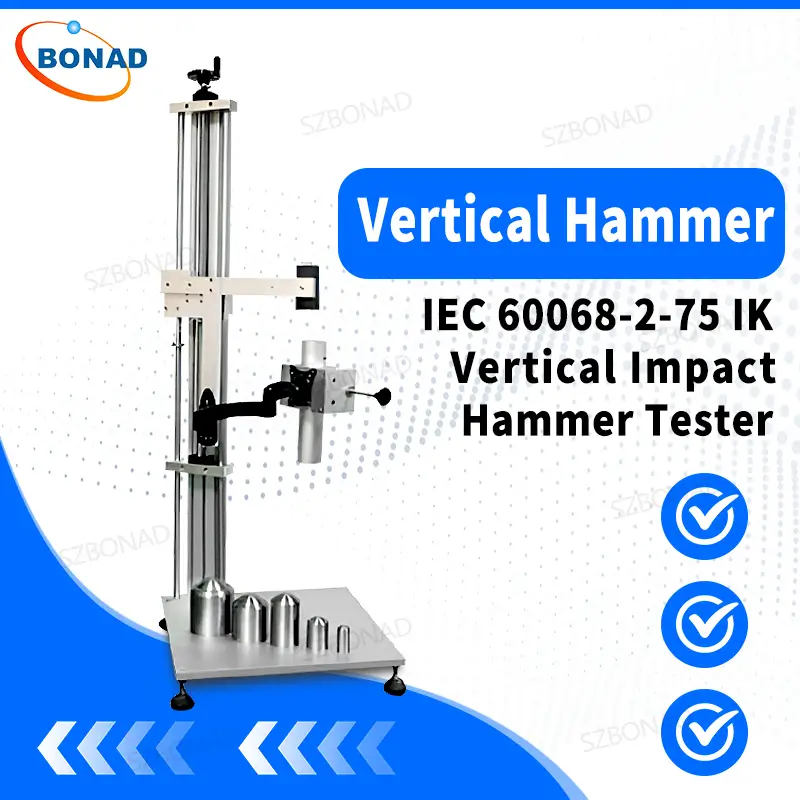
Overview of Vertical Impact Test Equipment
Vertical Impact Test Equipment applies impact energy through a free-falling hammer that strikes the test specimen vertically from a specified height.
Test Principle
- The hammer is released from a defined height
- Impact energy is controlled by hammer mass and drop height
- Gravity provides the impact force
Key Characteristics
- Simple mechanical structure
- Direct simulation of falling object impacts
- Suitable for flat or horizontal test surfaces
Typical Use Cases
- Ceiling-mounted or horizontal enclosures
- Products exposed to vertical falling impacts
- Basic IK verification during design or production
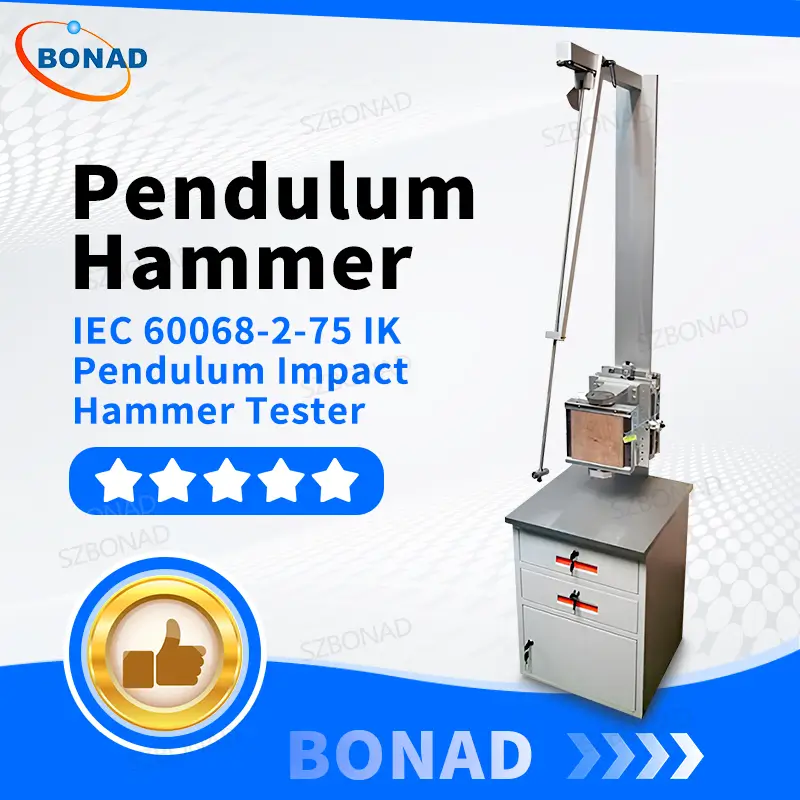
Overview of Pendulum Impact Test Equipment
Pendulum Impact Test Equipment delivers impact energy using a swinging hammer that strikes the specimen along a controlled arc.
Test Principle
- Impact energy is defined by pendulum mass and release angle
- Swing motion ensures consistent impact velocity
- Higher repeatability and control
Key Characteristics
- Highly repeatable impact energy
- Adjustable impact direction
- Better control for high IK levels
Typical Use Cases
- Vertical enclosures and sidewall testing
- High-requirement IK ratings (IK08–IK10)
- Certification and third-party laboratory testing
Vertical vs Pendulum Impact Test Equipment: Key Differences
| Aspect | Vertical Impact Tester | Pendulum Impact Tester |
|---|---|---|
| Impact direction | Vertical (free fall) | Arc / horizontal |
| Energy control | Drop height & mass | Release angle & mass |
| Repeatability | Moderate | High |
| Test complexity | Low | Medium |
| Typical IK range | IK01–IK07 | IK01–IK10 |
| Common applications | Falling object simulation | Enclosure certification testing |
Which Impact Tester Should You Choose?
Choose Vertical Impact Test Equipment if:
- You need basic IK compliance testing
- The product is mainly exposed to vertical impacts
- Budget and operational simplicity are priorities
Choose Pendulum Impact Test Equipment if:
- You require high repeatability and precision
- Testing for IK08, IK09, or IK10
- Certification or compliance testing is required
In many professional laboratories, both systems are used together to cover all testing scenarios defined in IEC 60068-2-75.
Impact Energy Levels and IK Ratings
| IK Code | Impact Energy (J) |
|---|---|
| IK01 | 0.14 J |
| IK05 | 0.70 J |
| IK07 | 2.00 J |
| IK08 | 5.00 J |
| IK09 | 10.00 J |
| IK10 | 20.00 J |
Accurate energy control is essential, which is why pendulum impact systems are often preferred for higher IK levels.
Best Practices for IK Impact Testing
To ensure valid and repeatable test results:
- Secure the test specimen rigidly
- Apply impacts at specified points
- Avoid re-impacting damaged areas unless required
- Record impact energy, location, and results
Proper test execution is as important as the equipment itself.
Conclusion
Both Vertical Impact Test Equipment and Pendulum Impact Test Equipment play essential roles in IEC 60068-2-75 IK impact testing. While vertical systems provide simplicity and practicality, pendulum systems offer superior control and repeatability for high-level compliance testing.
Understanding the differences, applications, and testing principles ensures manufacturers select the right equipment, achieve reliable results, and meet international safety standards.
FAQ:
What is the main difference between vertical and pendulum impact test equipment?
Vertical impact test equipment applies impact energy through a free-falling hammer to simulate falling object impacts. Pendulum impact test equipment uses a swinging hammer with controlled release angle, offering higher repeatability and more precise energy control, especially for enclosure testing.
Which impact test method is recommended for IK08–IK10 testing?
For higher IK ratings such as IK08, IK09, and IK10, pendulum impact test equipment is generally recommended due to its consistent impact energy, repeatability, and suitability for certification and compliance testing under IEC 60068-2-75.
What standards do these impact testers comply with?
Both vertical and pendulum impact test equipment are designed to comply with IEC 60068-2-75 for impact test methods and are used in conjunction with IEC 62262 (IK code) to determine impact resistance ratings.
What types of products typically require IK impact testing?
IK impact testing is commonly required for electrical enclosures, luminaires, outdoor lighting fixtures, EV charging equipment, industrial control cabinets, and electrical appliances to verify mechanical strength and safety.
Do I need both vertical and pendulum impact testers?
Many professional laboratories and manufacturers use both systems. Vertical impact testers are suitable for basic impact simulations and routine testing, while pendulum impact testers are preferred for high-precision and high-IK-level compliance testing. Using both ensures full coverage of IEC 60068-2-75 requirements.