What Is a Salt Spray Test?
The Salt Spray Test, also known as the Salt Fog Test, is an accelerated corrosion test used to evaluate how materials, metal components, and surface coatings withstand corrosive saline environments. By exposing specimens to a controlled salt mist inside a salt spray test chamber, manufacturers can quickly assess corrosion resistance and product durability.
Salt Spray Testing is widely used in automotive, electronics, marine, aerospace, rail transportation, energy storage, and industrial manufacturing industries to verify quality and compliance with international standards.
Purpose of Salt Spray Testing
The Salt Spray Test plays a critical role in product validation and quality control by helping manufacturers:
- Evaluate corrosion resistance of metals and coatings
- Compare different surface treatments such as plating, painting, and anodizing
- Verify compliance with international corrosion test standards
- Support R&D, supplier qualification, and durability assessment
A professional salt spray tester / salt spray chamber ensures repeatable and reliable test results.
How Does a Salt Spray Test Work?
In a Salt Spray Test, specimens are placed inside a sealed salt spray chamber where a fine mist of sodium chloride (NaCl) solution is continuously sprayed. This salt fog simulates harsh marine or coastal environments, accelerating corrosion processes that would normally take months or years in natural conditions.
Common Salt Spray Test Standards
Salt Spray Testing is conducted in accordance with globally recognized standards, including:
- ASTM B117 – Neutral Salt Spray (NSS)
- ISO 9227 – NSS, AASS, CASS
- IEC 60068-2-11
- JIS Z 2371
These standards define test parameters such as salt concentration, temperature, spray rate, pH value, and test duration.
Types of Salt Spray Tests
Neutral Salt Spray (NSS)
- 5% NaCl solution
- pH range: 6.5–7.2
- Test temperature: 35°C
- Most commonly used Salt Spray Test method
Acetic Acid Salt Spray (AASS)
- NaCl solution with added acetic acid
- Higher corrosion acceleration
- Used for plated and coated components
Copper-Accelerated Acetic Acid Salt Spray (CASS)
- Highly aggressive corrosion test
- Suitable for decorative coatings and high-performance surface treatments
Typical Salt Spray Test Conditions
- Temperature: 35°C (NSS)
- Salt concentration: 5% NaCl
- Salt spray deposition rate: 1–3 ml / 80 cm² · h
- Test duration: 24 to 1000+ hours depending on specifications
Applications of Salt Spray Testing
Salt Spray Tests are commonly applied to:
- Automotive parts and fasteners
- Electronic enclosures and connectors
- Hardware, coatings, and electroplated components
- Marine, outdoor, and offshore equipment
- Aerospace, railway, and new energy products
Walk-In Composite Salt Spray Test Chamber by BONAD
Designed for Large-Scale Corrosion Testing
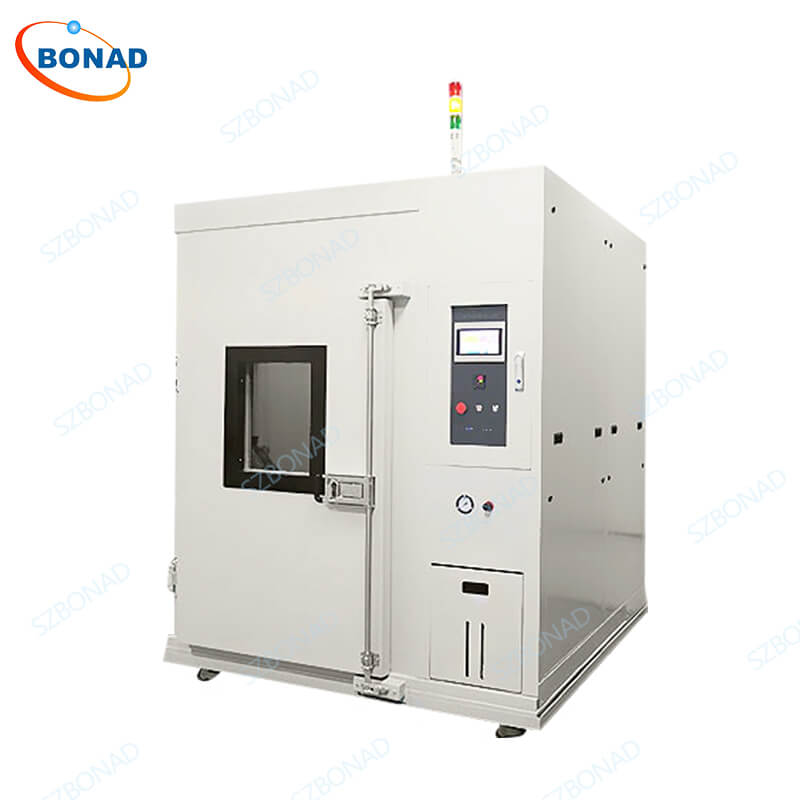
The Walk-In Composite Salt Spray Test Chamber (Model: BND-CSST) from BONAD (SZBONAD) is engineered for large products and heavy workpieces. It supports traditional Salt Spray Tests as well as CCT composite cyclic corrosion testing, making it ideal for advanced durability evaluations.
This industrial-grade salt spray test chamber precisely controls salt spray, temperature, humidity, and condensation to simulate complex marine and outdoor environments.
Compliance with International Standards
- IEC 60068
- ASTM B117
- ISO 9227
- ISO 14993
Key Features of the Walk-In Salt Spray Chamber
- Independent salt spray and refrigeration systems with corrosion-resistant components
- Double-door design for easy loading of large specimens
- Inner chamber constructed entirely from 316 stainless steel
- High-performance, thermally stable salt spray atomizing nozzle
- Accurate salt spray collection and monitoring system
- Self-developed programmable touch-screen controller
- Automatic exhaust system linked to the chamber lid
- Customizable design based on specific test requirements
- Optional explosion-proof door and window for battery and energy storage testing
Technical Specifications Overview
- Working volume: 10 / 15 / 20 m³
- Temperature range: 15–85°C
- Humidity range: 25%–98% RH
- Temperature fluctuation: ±2°C
- Salt spray deposition rate: 1–3 ml / 80 cm² · h (adjustable)
- Maximum load capacity: up to 3 tons
- Spray mode: Continuous or pulse spray
Why Choose BONAD Salt Spray Test Chambers?
BONAD provides professional salt spray test chambers and salt spray testers that combine:
- Full compliance with international standards
- Stable long-term performance
- Large-scale testing capability
- Industrial-grade corrosion protection and safety design
These solutions help manufacturers improve product reliability, ensure compliance, and accelerate time-to-market.
FAQ: Salt Spray Test & Salt Spray Test Chamber
1. What is a Salt Spray Test used for?
A Salt Spray Test is used to evaluate the corrosion resistance of metals, coatings, and surface treatments by exposing them to a controlled salt fog inside a salt spray test chamber. It helps manufacturers verify durability, quality, and compliance with international standards.
2. What standards are used for Salt Spray Testing?
The most common Salt Spray Test standards include ASTM B117, ISO 9227, IEC 60068-2-11, and JIS Z 2371. These standards define test conditions such as salt concentration, temperature, spray rate, and test duration.
3. What is the difference between NSS, AASS, and CASS tests?
- NSS (Neutral Salt Spray): Uses a 5% NaCl solution at neutral pH and is the most widely used method.
- AASS (Acetic Acid Salt Spray): Adds acetic acid to accelerate corrosion.
- CASS (Copper-Accelerated Acetic Acid Salt Spray): A highly aggressive test for decorative and high-performance coatings.
4. What is a walk-in salt spray test chamber used for?
A walk-in salt spray test chamber is designed for large, heavy, or oversized products such as automotive parts, battery packs, rail components, and aerospace structures. It allows full-scale Salt Spray Tests and composite cyclic corrosion testing under controlled environmental conditions.
5. How long does a Salt Spray Test take?
A Salt Spray Test can last from 24 hours to over 1000 hours, depending on the product requirements and test standard. Longer test durations generally indicate higher corrosion resistance.