Waterproof performance is a critical quality and compliance requirement for many electrical and electronic products. Among the ingress protection ratings defined by IEC 60529, IPX7 is widely used to verify resistance to temporary water immersion.
This guide explains the IPX7 waterproof test standard, outlines the test principles, and introduces IPX7 water immersion test equipment, including both manual and electric lifting solutions, to support informed technical and procurement decisions.
What Is IPX7 Waterproof Testing?
IPX7 is a water ingress protection level specified in IEC 60529 – Degrees of Protection Provided by Enclosures (IP Code).
IPX7 testing verifies that a product can withstand:
- Temporary immersion in water
- A water depth of up to 1 meter
- A test duration of 30 minutes
- No harmful water ingress affecting safety or normal operation
IPX7 focuses on enclosure sealing performance under static immersion conditions, making it a key benchmark for product reliability.
IEC 60529 IPX7 Test Conditions Explained
According to IEC 60529, IPX7 testing must meet the following conditions:
- The test sample is fully immersed in clean water
- Test duration: 30 minutes
- The lowest point of the enclosure is at least 1 m below the water surface
- The highest point of the enclosure is at least 0.15 m below the surface
After immersion, the product is inspected to confirm that no water ingress has occurred that could impair insulation, safety, or functionality.
Typical Applications of IPX7 Testing
IPX7 testing is commonly required for products that may be exposed to accidental or temporary immersion, including:
- Consumer electronics and electrical devices
- Automotive electrical and electronic components
- Luminaires and outdoor lighting products
- Industrial sensors, controllers, and enclosures
- Portable and outdoor equipment
For many manufacturers, IPX7 testing is part of type approval, certification, customer audits, and internal quality validation.
IPX7 Water Immersion Test Equipment Overview
To perform IPX7 testing in compliance with IEC 60529, dedicated water immersion test equipment is required. These systems provide controlled immersion depth, stable conditions, and repeatable test results.
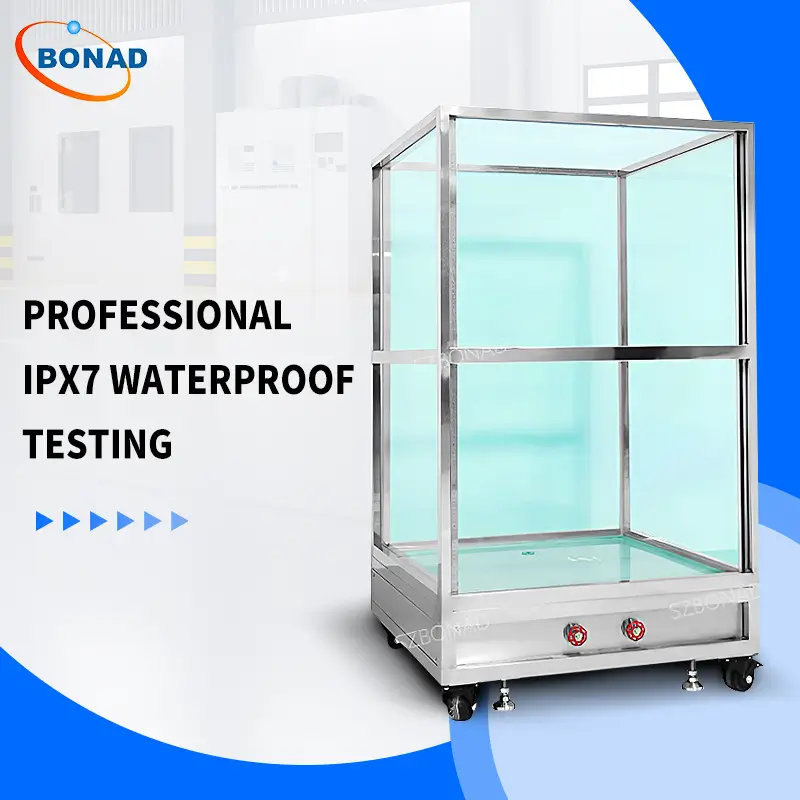
Standard IPX7 Water Immersion Test Equipment (Manual Type)
Manual IPX7 immersion systems are designed for routine compliance testing of small to medium-sized products.
Key characteristics:
- Fully compliant with IEC 60529 IPX7 requirements
- Stainless steel tank and structural frame for corrosion resistance
- Transparent viewing window for real-time observation
- Clear water level scale for accurate depth control
- Manual positioning of the test sample
This solution is suitable for laboratories, R&D departments, and quality inspection teams performing standard IPX7 tests.
Related product:
IEC 60529 IPX7 Water Immersion Test Equipment
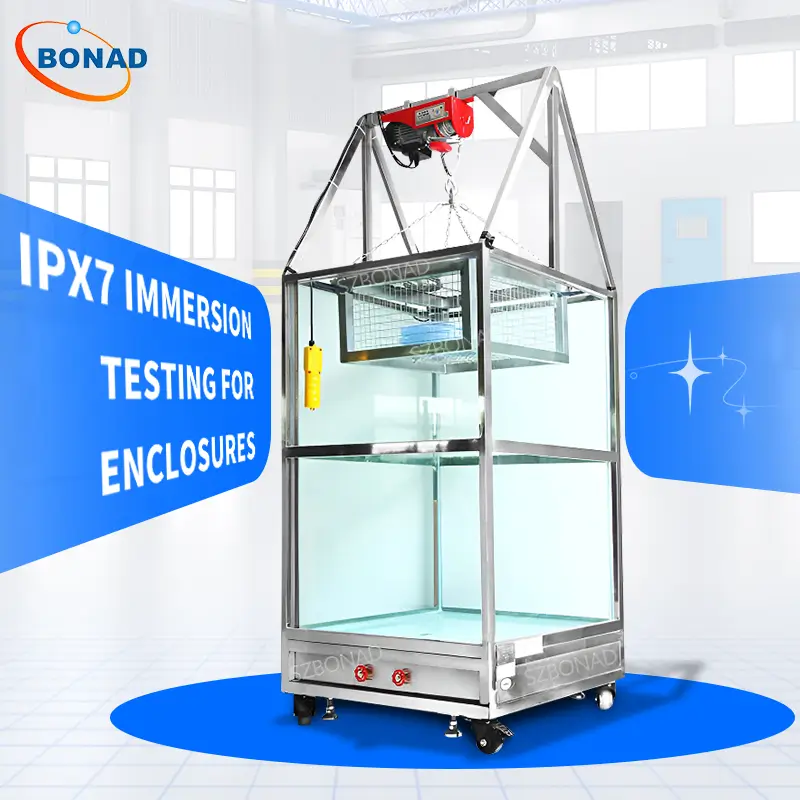
IPX7 Water Immersion Test Equipment with Electric Lifting System
Electric lifting IPX7 immersion systems are designed for higher efficiency and improved operational safety.
Key advantages:
- Motorized lifting mechanism for automatic sample immersion and retrieval
- Reduced manual handling and operator risk
- Improved positioning accuracy and test repeatability
- Suitable for large, heavy, or multiple samples
- Customizable lifting baskets and tank dimensions
These systems are widely used in automotive testing, industrial product testing, and third-party laboratories.
Related product:
IEC 60529 IPX7 Water Immersion Electric Lifting Test Equipment
How to Select the Right IPX7 Test Equipment
When selecting IPX7 water immersion test equipment, procurement and technical teams should consider:
- Compliance: Full alignment with IEC 60529 IPX7 conditions
- Sample size and weight: Electric lifting systems are recommended for large or heavy products
- Test frequency: Automated lifting improves efficiency in high-volume testing
- Customization: Tank dimensions and fixtures should match real product requirements
Proper equipment selection ensures consistent test results and long-term testing reliability.
Conclusion
IPX7 waterproof testing is a critical part of product validation for applications involving temporary water immersion. By using IEC 60529-compliant IPX7 water immersion test equipment, manufacturers and testing laboratories can ensure reliable, repeatable, and auditable test results.
Whether using a manual immersion system or an electric lifting solution, selecting the right equipment supports product quality, regulatory compliance, and long-term market success.
FAQS:
What is IPX7 waterproof testing?
IPX7 testing verifies that a product can withstand temporary immersion in water up to 1 meter for 30 minutes, as defined by IEC 60529.
Why is IPX7 testing important for product compliance?
It provides standardized evidence of waterproof performance and is often required for certification, audits, and market access.
What industries typically require IPX7 testing?
Electronics, automotive components, lighting, industrial equipment, and outdoor products commonly require IPX7 testing.
How do I choose between manual and electric lifting IPX7 test equipment?
Manual systems suit small samples, while electric lifting systems are preferred for large, heavy, or frequent testing to improve safety and efficiency.
Can IPX7 test equipment be customized?
Yes. Tank size, lifting capacity, and sample fixtures can be customized to meet specific testing needs.
What are the IEC 60529 IPX7 test conditions?
Full immersion for 30 minutes, with the lowest point at least 1 m below the surface and the highest point at least 0.15 m below.
Does IPX7 testing involve water pressure or flow?
No. IPX7 testing uses static water immersion without pressure or water jets.
What is considered a failure in IPX7 testing?
Any harmful water ingress affecting safety, insulation, or normal operation is considered a failure.
When is electric lifting IPX7 equipment technically necessary?
It is recommended when precise positioning, repeatability, or safe handling of heavy samples is required.
Does IPX7 testing replace IPX5 or IPX6 testing?
No. IPX7 evaluates immersion resistance, while IPX5 and IPX6 evaluate resistance to water jets.