Automotive interior flammability testing is a fundamental safety evaluation used to assess how vehicle interior materials behave when exposed to ignition sources. By measuring flame spread, burning rate, and self-extinguishing behavior, manufacturers and testing laboratories can reduce fire-related risks, ensure regulatory compliance, and improve occupant protection.
This article provides a comprehensive and professional overview of FMVSS 302 automotive interior flammability testing, covering regulatory requirements, test methods, performance indicators, best practices, and certified test equipment used by automotive manufacturers and laboratories worldwide.
1. Why Automotive Interior Flammability Testing Is Essential
Modern vehicle interiors contain a wide range of polymer-based materials, including plastics, foams, textiles, synthetic leather, and composites. In the event of an electrical fault, external heat source, or accidental ignition, these materials can contribute to flame propagation within the passenger compartment.
Flammability testing helps the automotive industry to:
- Limit flame spread inside the vehicle
- Increase evacuation time for occupants
- Reduce secondary fire risks caused by molten dripping
- Meet mandatory safety regulations
- Support vehicle homologation and market access
As a result, interior flammability testing is a core requirement in automotive safety engineering and quality assurance.
2. FMVSS 302 and Global Automotive Flammability Standards
FMVSS 302 – Federal Motor Vehicle Safety Standard (USA)
FMVSS 302 specifies flammability resistance requirements for materials used in the occupant compartment of motor vehicles, including passenger cars, multipurpose vehicles, trucks, and buses.
Materials covered include:
- Seat upholstery and cushions
- Headliners, carpets, and floor coverings
- Door panels and interior trims
- Instrument panels and dashboard components
- Sun visors, armrests, and padding materials
Acceptance criteria:
The horizontal burning rate must not exceed 102 mm/min, or the material must self-extinguish before the flame reaches the specified measurement mark.
Equivalent International Standards
FMVSS 302 is technically aligned with several international standards, enabling global material qualification:
- ISO 3795 – Road vehicles: Burning behavior of interior materials
- ASTM D5132 – Horizontal burning test method
- DIN 75200 – Automotive interior flammability (Germany)
- GB 8410 – Automotive interior burning test (China)
- JIS D 1201 – Vehicle interior flammability (Japan)
This alignment allows manufacturers and laboratories to perform multi-standard testing using a single test system.
3. Automotive Interior Burning Test Method (FMVSS 302)
Test Principle
The FMVSS 302 test evaluates flame propagation along a horizontally mounted specimen after exposure to a small, controlled ignition flame.
Typical Test Procedure
- A specimen (usually 356 mm × 100 mm) is conditioned at specified temperature and humidity.
- The sample is mounted horizontally inside a flammability test chamber.
- A calibrated flame (~38 mm height) is applied for 15 seconds.
- After ignition, flame spread distance and burning time are measured.
- The burning rate is calculated and compared against the standard limit.
This method ensures repeatable and comparable results across laboratories and production environments.
4. Key Performance Indicators Measured
FMVSS 302 flammability testing evaluates multiple fire-related behaviors:
- Burning Rate (mm/min): Primary compliance indicator
- Flame Spread Length: Distance traveled by the flame
- Self-Extinguishing Behavior: Ability to stop burning after flame removal
- Molten Dripping Observation: Assessment of secondary ignition risk
Together, these parameters provide a realistic assessment of interior fire safety.
5. Automotive Interior Materials Commonly Tested
FMVSS 302 applies to a wide range of materials, including:
- Polyurethane foams and seat cushions
- ABS, PP, PVC, PC interior plastics
- Textile fabrics and synthetic leather
- Rubber and elastomeric components
- Laminated and coated composite materials
Testing supports material selection, formulation optimization, and supplier qualification.
6. FMVSS 302 Flammability Test Equipment Overview
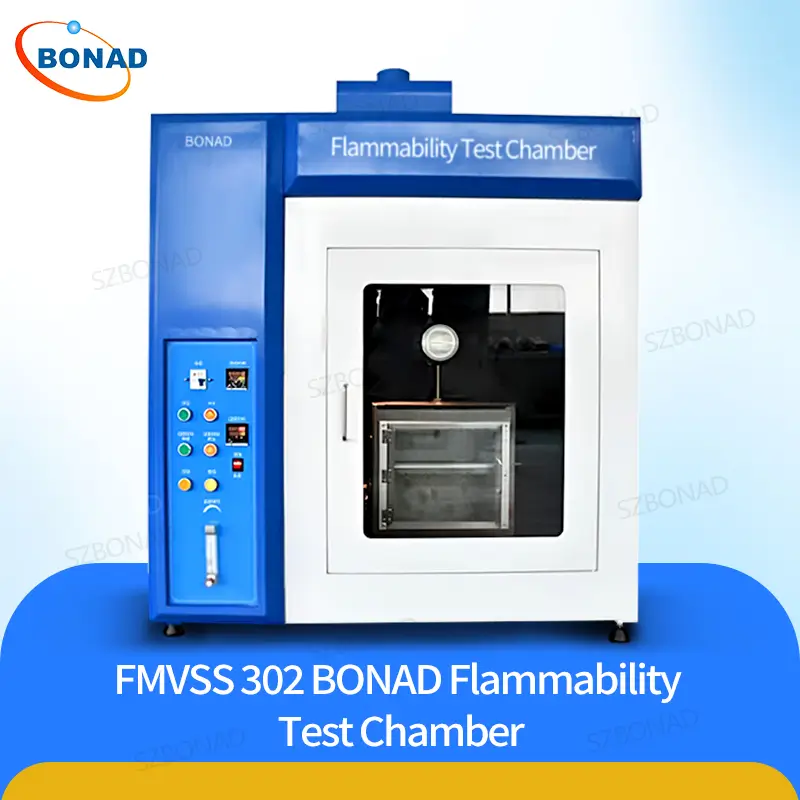
FMVSS 302 Automotive Interior Flammability Tester
A professional FMVSS 302 flammability tester is designed to provide controlled flame application, accurate timing, and repeatable measurement under standardized conditions.
Typical equipment capabilities include:
- Compliance with FMVSS 302, ISO 3795, ASTM D5132, DIN 75200
- Adjustable and stable flame source
- Digital timing and burn rate calculation
- Enclosed chamber design for operator safety
- Observation window and molten drip tray
Such systems are widely used by automotive OEMs, Tier-1 suppliers, material manufacturers, and accredited testing laboratories.
7. Testing Best Practices for Reliable Results
Proper Sample Conditioning
Specimens should be conditioned according to the relevant standard before testing to ensure reproducibility.
Flame Calibration and Stability
Flame height and gas flow must be verified regularly to avoid false pass or fail results.
Consistent Sample Mounting
Standardized fixtures and horizontal alignment are essential for comparable measurements.
Accurate Time and Distance Recording
Digital timers and clear reference marks improve data accuracy and audit credibility.
8. Common Mistakes in Automotive Flammability Testing
- Ignoring molten drip behavior and focusing only on burn rate
- Testing non-representative samples that differ from production materials
- Infrequent equipment calibration
- Assuming one test result applies to all interior components
Avoiding these errors improves compliance reliability and testing credibility.
9. Who Uses FMVSS 302 Flammability Testing Systems
- Automotive OEMs: Vehicle development and homologation
- Tier-1 / Tier-2 Suppliers: Interior component qualification
- Material R&D Centers: Flame-retardant formulation development
- Independent Laboratories: Third-party compliance and certification
10. Regulatory Compliance and Market Access
Passing FMVSS 302 and equivalent standards is often mandatory for vehicle sales in major markets. Reliable test data supports:
- Vehicle type approval
- Supplier audits and quality inspections
- Export and regulatory documentation
- Long-term compliance management
Why BONAD Is Trusted for Automotive Flammability Testing
- Professional Manufacturer & Factory
BONAD is a manufacturer and factory providing automotive safety and flammability testing equipment among other precision testing solutions for multiple industries. - Compliance-Oriented Engineering
Equipment is designed to meet internationally recognized automotive standards. - Suitable for Laboratories and Production Environments
Systems support R&D testing, supplier qualification, and routine quality control. - Used Throughout the Automotive Supply Chain
Applied by OEMs, Tier suppliers, and independent laboratories worldwide. - Focused on Data Reliability and Compliance Confidence
Supporting traceable, repeatable, and regulation-ready testing processes.
FAQ
1. Is FMVSS 302 flammability testing mandatory for automotive interiors?
Yes. FMVSS 302 is a mandatory safety requirement for materials used in the occupant compartment of vehicles sold or exported to the United States. Interior materials must meet the specified flammability limits before vehicle homologation and market approval.
2. What interior materials are required to comply with FMVSS 302?
FMVSS 302 applies to seat upholstery and foams, carpets, headliners, door trims, dashboards, interior plastics, sun visors, armrests, and other materials located within the passenger compartment.
3. What is the pass/fail criterion under FMVSS 302?
A material passes FMVSS 302 if the horizontal burning rate does not exceed 102 mm per minute, or if the flame self-extinguishes before reaching the designated measurement mark.
4. Can FMVSS 302 testing also satisfy international standards?
In many cases, yes. FMVSS 302 shares similar test principles with ISO 3795, ASTM D5132, DIN 75200, and GB 8410, allowing one test setup to support multiple regulatory requirements.
5. How many samples are typically required for testing?
The number of specimens depends on the standard and internal quality requirements. In practice, multiple samples are tested to ensure repeatability and representative performance of the material.
6. Should automotive manufacturers perform FMVSS 302 testing in-house or outsource it?
Both approaches are commonly used.
- In-house testing supports R&D, material screening, and supplier qualification.
- Third-party laboratories provide independent, accredited test reports for regulatory submission and audits.
7. What documentation is required for FMVSS 302 compliance?
A standard test report typically includes material identification, test standard reference, conditioning environment, flame application time, burn distance, burn time, calculated burning rate, and pass/fail results.
8. What should procurement teams consider when selecting an FMVSS 302 test equipment manufacturer?
Key considerations include:
- Manufacturer or factory-based production capability
- Compliance with multiple automotive standards
- Measurement repeatability and safety design
- Technical support and after-sales service
- Long-term equipment reliability and documentation support
Conclusion
Automotive interior flammability testing under FMVSS 302 is a critical safety assessment that supports occupant protection, regulatory compliance, and global market access. By applying standardized test methods, following best practices, and using professional testing equipment from qualified manufacturers, organizations can confidently evaluate interior material fire performance and reduce compliance risks throughout the vehicle lifecycle.