Electrostatic Discharge (ESD) remains one of the most unpredictable yet critical disturbance phenomena in electronic design and compliance testing. Because ESD events occur on the order of nanoseconds with high peak voltages and rich high-frequency content, replicating them reliably in the lab is essential to ensure products meet safety and performance standards.
In this article, we explore the core challenges of ESD testing, why consistent waveform stability matters, and how high‑precision ESD simulators significantly improve test quality, repeatability, and trustworthiness of results.
Understanding Electrostatic Discharge Testing and Its Challenges
ESD events are inherently discontinuous, meaning they are sudden, brief, and highly variable. These characteristics make them difficult to reproduce consistently in a controlled test environment. Key ESD testing challenges include:
1. Waveform Repeatability
ESD pulses must match specific waveform parameters — such as rise time, peak voltage, and timing at checkpoints (e.g., 30 ns and 60 ns) — defined by the IEC 61000‑4‑2 standard. Without precise control, repeated discharges can vary, leading to unreliable test data.
2. Voltage Stability Over Time
Internal high-voltage components like capacitors and resistors change characteristics with age, temperature, and usage. These small drifts can alter discharge energy, making it harder to evaluate product performance accurately.
3. Environmental Influence
Temperature and humidity have a major impact on air breakdown voltage and discharge behavior. Without controlled environmental monitoring, differing room conditions lead to inconsistent test results.
4. Test Setup Variables
Grounding quality, coupling plane placement, cable routing, and operator technique all influence the actual discharge path — and thus the outcome of the test.
How High‑Precision ESD Simulators Address These Challenges
Modern ESD test systems are engineered to minimize uncertainties and maximize repeatability, compliance, and reliability.
Active Voltage Conditioning and Feedback Control
Advanced ESD simulators use real-time feedback loops to track actual charging energy and automatically regulate the high-voltage output. This approach counteracts voltage drift due to power supply fluctuation or component heating.
Precision Spark Gap and Electrode Geometry
The physical distance and shape of the spark gap directly impact the discharge threshold and waveform shape. High‑precision machined electrodes ensure geometric tolerances are minimal, preserving waveform integrity across thousands of pulses.
Environmental Monitoring Support
Some simulators embed humidity and environmental monitoring systems that help operators understand when conditions may affect test results — prompting environmental adjustments for accurate testing.
Standardized Setup Guidance
Conforming to standardized test bench layouts (coupling planes, reference ground, insulating mats) ensures setup-dependent variables are minimized — crucial for comparability across labs and test sessions.
Featured ESD Testing Equipment for Reliable Compliance
To achieve accurate, repeatable, and standards-compliant ESD immunity testing, laboratories and manufacturers rely on professionally designed ESD simulators that deliver stable discharge waveforms under controlled conditions.
A typical IEC 61000-4-2 compliant ESD simulator integrates high-voltage charging control, precision discharge networks, and multiple test modes to replicate real-world electrostatic events encountered during product use, handling, or installation.
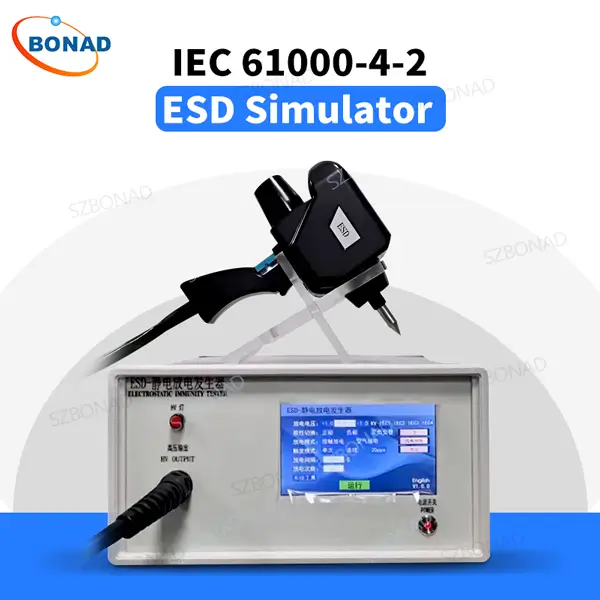
ESD Simulator – Electrostatic Discharge Test Generator (IEC 61000-4-2)
The ESD Simulator Electrostatic Discharge Test Generator from BONAD is engineered to support reliable ESD immunity testing across R&D, quality assurance, and regulatory compliance environments.
This ESD test system is designed to generate highly repeatable contact and air discharges, helping engineers evaluate product robustness against electrostatic stress with confidence. Its stable high-voltage output minimizes waveform drift caused by component aging, temperature variation, or repeated discharge cycles—one of the most common challenges in ESD testing.
Key advantages include:
- Full compliance with IEC 61000-4-2 requirements for ESD immunity testing
- Wide output voltage range suitable for low-level sensitivity testing and high-severity stress tests
- Contact discharge and air discharge modes, simulating different real-world ESD scenarios
- Positive and negative polarity selection for comprehensive immunity evaluation
- Stable and repeatable discharge waveforms, supporting accurate comparison and documentation
- Ergonomic ESD gun design for consistent operation and improved test efficiency
This ESD simulator is widely applicable to consumer electronics, industrial control equipment, automotive electronics, household appliances, medical devices, and communication products, where electrostatic discharge can cause functional disturbance or long-term reliability issues.
Why Choosing the Right ESD Simulator Matters
Using a well-designed ESD simulator helps ensure that test results are repeatable, traceable, and credible, which is essential for:
- Product certification and market access
- Design verification during development
- Failure analysis and reliability improvement
- Long-term quality assurance programs
By combining stable voltage control, standard-compliant discharge networks, and robust mechanical design, modern ESD simulators provide engineers with a dependable tool to overcome the inherent variability of electrostatic discharge testing.
Conclusion: Why Accurate ESD Testing Matters
Electrostatic discharge may be a transient event lasting only nanoseconds, but its impact on sensitive electronics can lead to functional failures, latent damage, or reduced reliability. Reliable ESD testing — grounded in stable discharge waveforms, repeatable results, and standardized setups — enables engineers to develop products with confidence and meet stringent global compliance requirements.
Investing in high‑precision, IEC 61000‑4‑2 compliant ESD simulators is not just about ticking a checkbox — it’s about designing products that survive the realities of electrostatic stress in the real world.
FAQ:
1. What is ESD testing and why is it important?
Electrostatic Discharge (ESD) testing evaluates a product’s immunity to sudden electrical discharges. It’s essential to prevent functional failures, damage, and ensure product reliability in real-world conditions.
2. What are the main challenges in ESD testing?
Key challenges include waveform repeatability, voltage stability over time, environmental influence (humidity, temperature), and test setup variables like grounding and electrode placement.
3. What is an IEC 61000‑4‑2 compliant ESD simulator?
It is a test instrument designed to generate reproducible ESD pulses that meet the IEC 61000‑4‑2 standard. These simulators control voltage, discharge timing, and polarity to ensure accurate immunity testing.
4. How does a high-precision ESD simulator improve test reliability?
By stabilizing voltage output, providing repeatable discharge waveforms, supporting multiple modes (contact and air), and reducing environmental and setup variability, these simulators produce consistent, traceable test results.
5. Which industries benefit from ESD simulators?
Industries include consumer electronics, automotive, industrial controls, medical devices, telecommunications, and any sector where electronic components must resist electrostatic stress.