As global manufacturing standards continue to rise, mechanical testing technology has become a cornerstone of product quality assurance, regulatory compliance, and long-term reliability. Industries such as electronics, apparel, automotive, hardware, and consumer goods increasingly rely on precise material testing data to validate product performance before market release.
Among the most essential testing systems are Universal Tensile Testing Machines and Pull Test Machines—two closely related technologies that address both comprehensive material evaluation and application-specific safety verification.
Universal Tensile Testing Machines: A Foundation of Mechanical Testing
A Universal Tensile Testing Machine (UTM) is designed to measure fundamental mechanical properties such as tensile strength, compressive strength, elongation, bending resistance, and shear performance. By applying controlled force to test specimens, UTMs provide engineers and quality managers with quantitative data that supports product design, material selection, and compliance with international testing standards.
Modern UTMs are no longer limited to basic tensile tests. Today’s systems emphasize:
- High measurement accuracy and repeatability
- Digital control and intelligent data processing
- Modular fixtures for multi-test applications
- Compliance with ISO, ASTM, EN, and other global standards
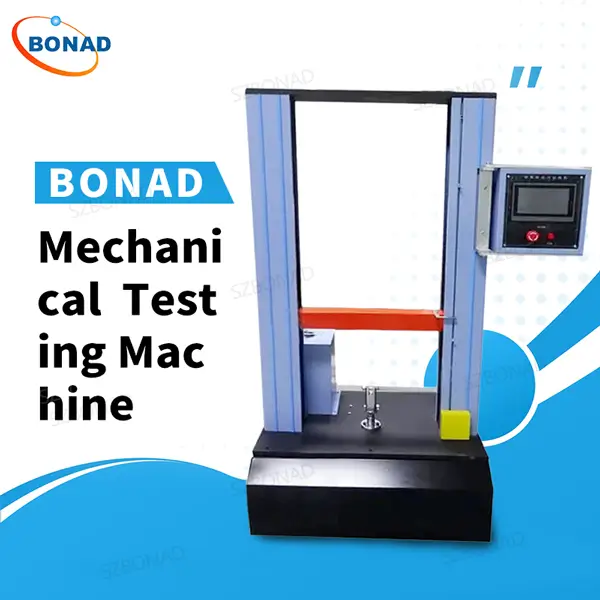
The Touch Screen Controlled Universal Tensile Testing Machine by BONAD represents this evolution. Featuring an intuitive touch-screen interface, flexible load capacity options, and support for multiple test modes, this system is suitable for laboratories, R&D centers, and industrial quality control environments. Its adaptable configuration allows users to perform tensile, compression, bending, and shear tests on a wide range of materials, including metals, plastics, rubber, textiles, and cables.
Product reference:
Touch Screen Controlled Universal Tensile Testing Machine
Pull Test Machines: Focused Testing for Safety-Critical Components
While UTMs offer broad testing capabilities, Pull Test Machines are designed for more specialized applications where pull-out force and attachment strength are critical performance indicators. These machines are commonly used to evaluate the mechanical integrity of:
- Buttons and snaps
- Rivets and fasteners
- Connectors and terminals
- Bonded or assembled components
Pull testing plays a particularly important role in consumer product safety, where insufficient fastening strength can lead to product failure, recalls, or safety hazards. As regulations become stricter, manufacturers increasingly integrate pull testing into both production inspection and final quality verification.
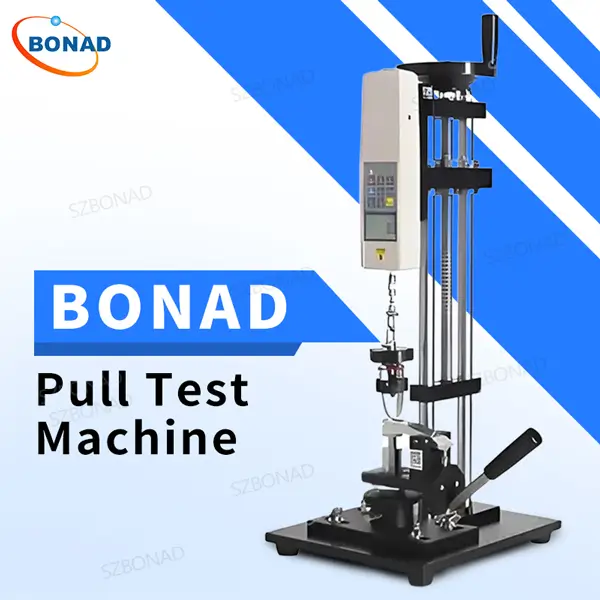
The Button Snap Pull Test Machine from BONAD is engineered specifically for these applications. It provides precise and repeatable pull force measurement for garment accessories and small components, helping manufacturers meet safety requirements such as ASTM, EN 71-1, and CPS-related standards. Its compact design and straightforward operation make it suitable for both laboratory testing and factory quality control.
Product reference:
Button Snap Pull Test Machine
Pull Test vs. Universal Tensile Testing: Understanding the Relationship
From a technical standpoint, a pull test machine can be regarded as a specialized application or configuration of tensile testing technology. The primary difference lies in test scope and flexibility:
- Universal Tensile Testing Machines focus on multi-purpose mechanical evaluation across diverse materials and test methods.
- Pull Test Machines concentrate on targeted pull-out or attachment strength testing, often with simplified operation and dedicated fixtures.
In practice, many manufacturers use both systems together—UTMs for material characterization and design validation, and pull test machines for process control and product safety checks. This complementary approach improves testing efficiency while reducing equipment redundancy.
Technology Trends Shaping Mechanical Testing Equipment
The material testing industry is currently shaped by several key trends:
- Digitalization: Touch-screen operation, automated data capture, and software-based analysis improve usability and traceability.
- Customization: Modular designs and tailored fixtures allow equipment to meet specific industry and application requirements.
- Standardization: Growing emphasis on global testing standards ensures consistent and comparable test results across markets.
- Production Integration: Compact and application-focused test systems support in-line or near-line quality inspection.
These trends reflect the industry’s shift toward intelligent, efficient, and compliance-driven testing solutions.
BONAD: Supporting Reliable Testing Solutions
As a manufacturer of testing equipment, BONAD provides both universal tensile testing machines and application-specific pull test machines to support diverse quality assurance needs. By offering configurable systems designed to meet international standards, BONAD helps manufacturers improve testing accuracy, operational efficiency, and regulatory compliance across multiple industries.
Conclusion
In an era where product reliability and safety directly influence brand reputation and market success, mechanical testing technology is more critical than ever. Universal Tensile Testing Machines and Pull Test Machines serve distinct but complementary roles in modern quality assurance systems, enabling manufacturers to validate materials, secure component integrity, and meet evolving global standards.
FAQ:
1. What is the difference between a pull test machine and a universal tensile testing machine?
A pull test machine is designed for specific pull-out or attachment strength tests, such as buttons, snaps, connectors, and fasteners. A universal tensile testing machine is a multi-purpose system capable of tensile, compression, bending, and shear tests across a wide range of materials. In many cases, pull testing is considered a specialized application of tensile testing technology.
2. When should a pull test machine be used instead of a universal tensile testing machine?
A pull test machine is preferred when testing requirements are focused on small components or fasteners and when simplicity, speed, and repeatability are critical. It is commonly used in garment manufacturing, consumer goods inspection, and production quality control environments.
3. Can a universal tensile testing machine perform pull tests?
Yes. With appropriate fixtures and test methods, a universal tensile testing machine can perform pull tests. However, dedicated pull test machines often provide optimized operation and fixtures for specific applications, making them more efficient for routine pull force testing.
4. What industries commonly use tensile and pull test machines?
These machines are widely used in electronics, automotive, textiles, footwear, hardware, cable and wire manufacturing, and consumer goods industries, where material strength and component reliability are critical.
5. What standards are commonly applied to pull and tensile testing?
Universal tensile testing machines and pull test machines typically support international standards such as ISO, ASTM, EN, IEC, and CPS-related safety requirements, depending on the application and industry.
6. How does digital control improve mechanical testing accuracy?
Digital control systems, including touch-screen interfaces, improve test repeatability, reduce operator error, enable real-time data visualization, and support standardized test procedures and result traceability.