During logistics and distribution, products are exposed to continuous vibration caused by road conditions, vehicle movement, loading impacts, and handling processes. A Transport Vibration Test is a laboratory simulation designed to evaluate how products and packaging perform under these real-world transportation stresses. Using professional Vibration Tables, manufacturers can identify potential damage, loosening, fatigue, or functional failure before products reach customers.
Transport vibration testing is widely applied across electronics, automotive, medical devices, industrial equipment, and export packaging to ensure product reliability and compliance with international standards.
What Is a Transport Vibration Test?
A Transport Vibration Test reproduces the vibration environment encountered during shipping by truck, rail, sea, or air. By applying controlled vibration profiles to products or packaged loads, the test verifies:
- Structural integrity of the product
- Effectiveness of packaging design
- Resistance to loosening, cracking, or fatigue
- Reliability throughout the distribution cycle
Professional Vibration Tables allow engineers to simulate long-term transport conditions in a short time, making them essential for quality control and packaging optimization.
Why Transport Vibration Testing Matters
Transport vibration testing provides measurable benefits across manufacturing and logistics:
Reduce shipping damage and product returns
Optimize packaging structure and material usage
Verify compliance with international transport standards
Improve product reliability and brand reputation
Lower logistics, warranty, and after-sales costs
For exporters and e-commerce suppliers, vibration testing is a critical step to prevent hidden transport risks.
Common Transport Vibration Test Methods
Sinusoidal Vibration Test
- Uses single-frequency vibration
- Identifies resonance frequencies and structural weaknesses
Random Vibration Test
- Simulates real transport vibration more accurately
- Commonly used for electronics, automotive, and aerospace products
Fixed Displacement / Fixed Frequency Test
- Basic packaging validation method
- Often used for routine transport checks
Sweep Frequency Test
- Gradually changes frequency
- Detects resonance points and potential failure modes
Typical Transport Vibration Test Standards
Transport vibration tests are commonly conducted in accordance with international standards, including:
- ISTA 1A / 1B / 2A / 3A – Packaging and distribution simulation
- ASTM D999 / ASTM D4728 – Vibration testing of shipping containers
- ISO 2247 – Mechanical vibration of packaged products
- IEC 60068-2-64 / IEC 60068-2-6 – Environmental and vibration testing
Compliance with these standards helps ensure global market acceptance.
Transport Vibration Test Equipment: Vibration Tables
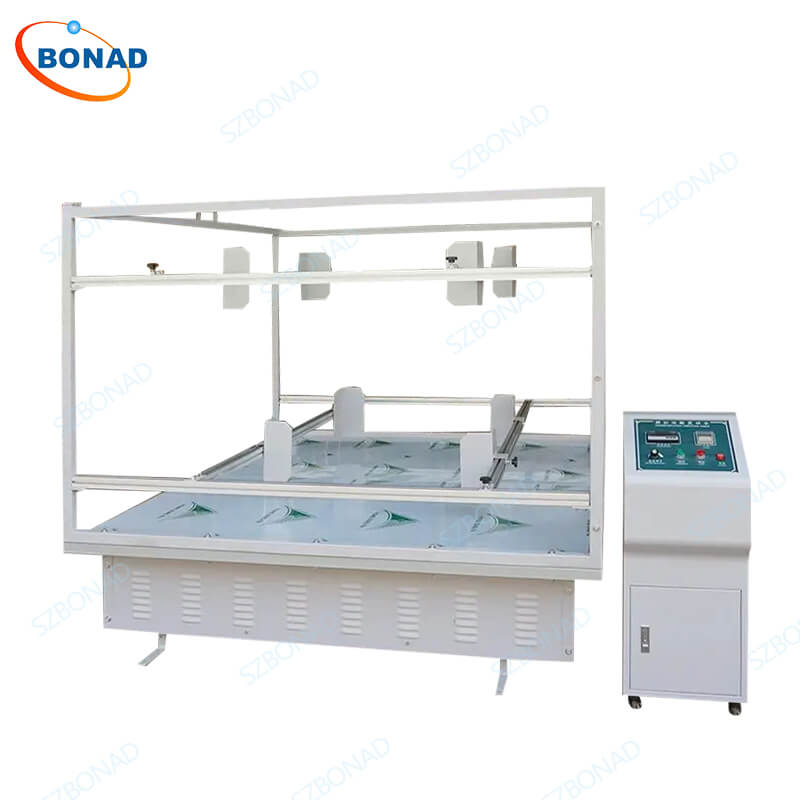
Simulating Automobile Transport Vibration Table
Brand: SZBONAD
Model: BND-ATVT Series
The Simulating Automobile Transport Vibration Table is designed to reproduce vibration and collision conditions encountered during automobile transportation. It simulates product impacts inside vehicle cargo spaces, mutual squeezing of goods, and vibration damage caused by uneven road conditions such as bumps, slopes, and turns.
This Transport Vibration Test solution complies with major international standards, including ASTM, ISTA, EN, ANSI, and UL, making it ideal for export-oriented manufacturers.
Key Applications
The BONAD transport vibration table is widely used for:
- Consumer electronics and home appliances
- Automotive parts and batteries
- Medical devices
- Industrial and electromechanical equipment
- Toys, furniture, ceramics, and gifts
- Packaging validation for e-commerce and export logistics
Product Features
- Digital display for vibration speed (RPM), clear and intuitive operation
- Guide-rail clamping system for safe and easy specimen installation
- Heavy-duty channel steel base with shock-absorbing rubber pads
- AC/DC motor with variable frequency control for stable performance
- Rotational vibration mode, compliant with US and European transport standards
- Independent timing and frequency control system
- Silent chain transmission for smoother and quieter operation
- Stainless steel worktable with aluminum profile fixing frame
- High load capacity and long-term durability
Technical Parameters
| Item | Specification |
|---|---|
| Model | BND-ATVT01 (Push Button) / BND-ATVT02 (Touch Screen) |
| Test Capacity | 100 kg (Customizable up to 5000 kg) |
| Table Dimensions | 1200 × 1000 mm (Customizable) |
| Guardrail Height | 600 / 800 / 1000 / 1200 mm |
| Control Motor | AC Variable Frequency Motor |
| Frequency Range | 100–300 RPM |
| Amplitude | 25.4 mm (1 inch) |
| Simulated Vehicle Speed | 25–40 km/h |
| Vibration Type | Rotational |
Typical Test Outcomes
After a standard Transport Vibration Test, qualified products should demonstrate:
- No functional failure
- No structural damage or loosening
- Packaging maintains protective performance
- Compliance with relevant transport vibration standards
Conclusion
Transport vibration testing using professional Vibration Tables is essential for manufacturers aiming to reduce transport risks, improve packaging performance, and meet global compliance requirements. The BONAD Simulating Automobile Transport Vibration Table (BND-ATVT) provides a reliable, standards-compliant solution for realistic transport simulation and long-term product quality assurance.
FAQ
What is a transport vibration test?
A transport vibration test simulates vibration stresses encountered during shipping by truck, rail, sea, or air to evaluate product durability and packaging performance using professional vibration tables.
Why is transport vibration testing important?
Transport vibration testing helps reduce shipping damage, optimize packaging design, verify compliance with ASTM and ISTA standards, and lower return and warranty costs.
What vibration tables are used for transport vibration tests?
Common vibration tables include simulated automobile transport vibration tables, electrodynamic vibration systems, and vibration shakers with slip tables, selected based on load capacity and test standards.
Which standards apply to transport vibration testing?
Transport vibration tests are typically performed according to ISTA 1A/2A/3A, ASTM D999, ASTM D4728, ISO 2247, and IEC 60068-2-6 / 2-64 standards.
What indicates a successful transport vibration test?
A successful test shows no functional failure, no structural damage or loosening, and packaging maintains protective performance in compliance with transport standards.