Comprehensive ESD Compliance Testing Solutions
Electrostatic Discharge (ESD) Compliance Testing is essential for ensuring that electronic devices can resist sudden electrostatic events without malfunction or damage. ESD occurs when electrical charges transfer between two objects, often causing electromagnetic interference or catastrophic component failure. Reliable ESD testing ensures the safety, durability, and compliance of modern electronics.
Understanding Electrostatic Discharge Testing
ESD testing evaluates the ability of electrical and electronic products to withstand electrostatic discharges that may occur during handling, operation, or transportation. These discharges can impact product performance, cause permanent circuit damage, and reduce long-term reliability.
Common standards for ESD testing include:
- IEC 61000-4-2: Defines test methods for immunity of electronic devices to ESD events.
- ISO 10605: Specifies ESD testing procedures for automotive electronics.
- ANSI/ESD S20.20: Establishes ESD control requirements for manufacturing and assembly environments.
Applications of ESD Compliance Testing
ESD testing is critical across multiple sectors:
- Consumer electronics – ensuring phones, laptops, and wearables remain reliable.
- Automotive electronics – validating ECUs, sensors, and control units.
- Aerospace and defense – protecting mission-critical systems.
- Telecommunication equipment – preventing signal interference.
- Medical devices – ensuring stable operation of life-support electronics.
- Industrial control systems – maintaining stable production and automation performance.
By complying with ESD testing standards, manufacturers guarantee that their products meet international EMC requirements and operate safely under real-world conditions.
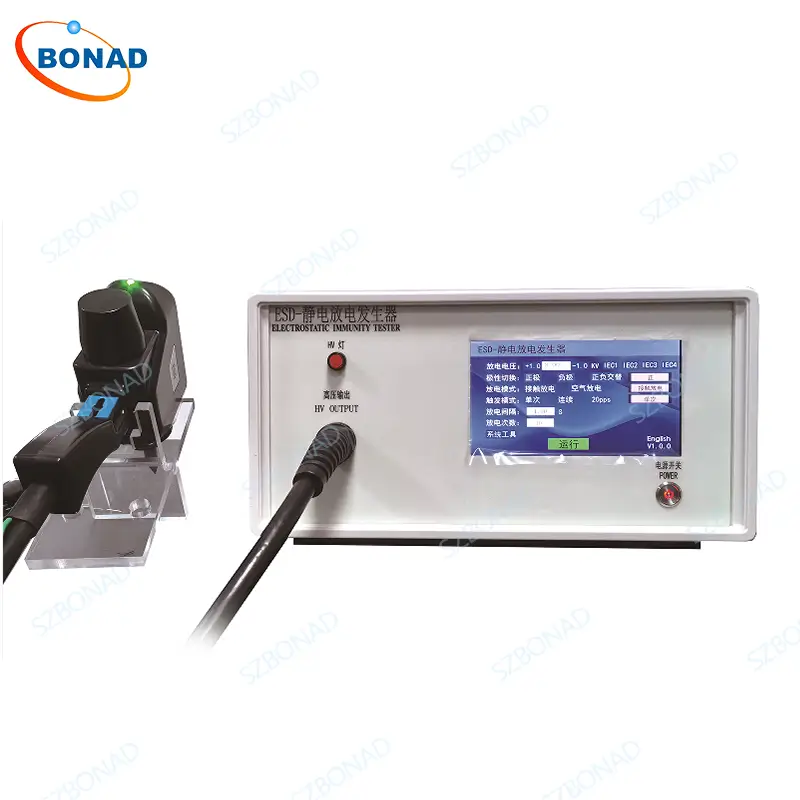
Recommended Testing Equipment: BONAD BND-ESD30 Electrostatic Discharge Test Generator
The BND-ESD30 Electrostatic Discharge (ESD) Test Generator from SZBONAD is a high-precision, fully compliant testing instrument designed for evaluating ESD immunity in accordance with IEC 61000-4-2 and GB/T 17626.2.
Key features include:
- Discharge voltage up to 30 kV, exceeding Level 4 ESD test requirements.
- Interchangeable RC modules supporting IEC, HBM, and MM models.
- Automatic trigger, voltage ramp, polarity switching, and programmable modes.
- Stable discharge performance and minimal humidity influence.
- Compact, lightweight design (~4 kg) for lab and field testing.
- Operator safety through low-radiation ESD gun design.
- High reliability with imported core components and low failure rate.
The ESD Testing Process
- Setup: Mount the device under test (DUT) on grounded test planes.
- Configuration: Adjust the ESD simulator and discharge network per standard.
- Execution: Apply controlled ESD events at designated points and polarities.
- Monitoring: Record any malfunctions or damage.
- Evaluation: If failure occurs, refine design—adding ESD suppressors or improving grounding.
Improving ESD Robustness
Common failure causes include insufficient ESD protection, improper component selection, and poor PCB layout.
To enhance ESD immunity:
- Add transient voltage suppressors (TVS diodes) for surge protection.
- Use high ESD-tolerant components with better EMC ratings.
- Optimize PCB layout and grounding to minimize current loops and noise coupling.
Case Study: Medical Device ESD Compliance
A leading medical manufacturer faced ESD test failures (IEC 61000-4-2) with a portable heart monitor. After redesigning its PCB grounding and adding TVS diodes, the device passed ESD compliance testing using the BND-ESD30 Simulator, achieving full EMC certification and safe operation in hospital environments.
Conclusion
Effective ESD compliance testing is critical to ensuring electronic reliability and global certification. With the BONAD BND-ESD30 Electrostatic Discharge Test Generator, laboratories and manufacturers can perform precise, repeatable, and standard-compliant ESD tests—enhancing product quality, safety, and customer trust.