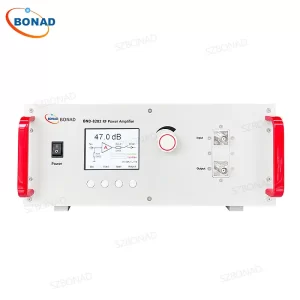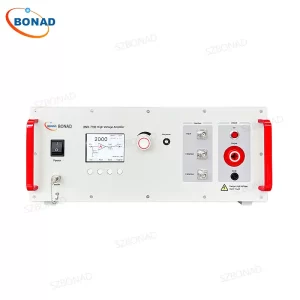
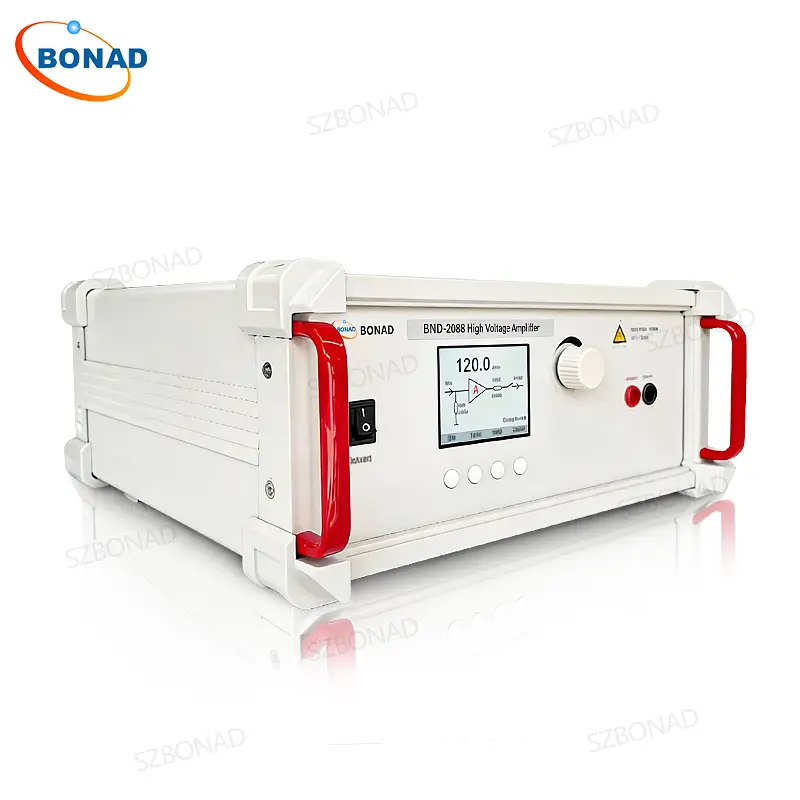
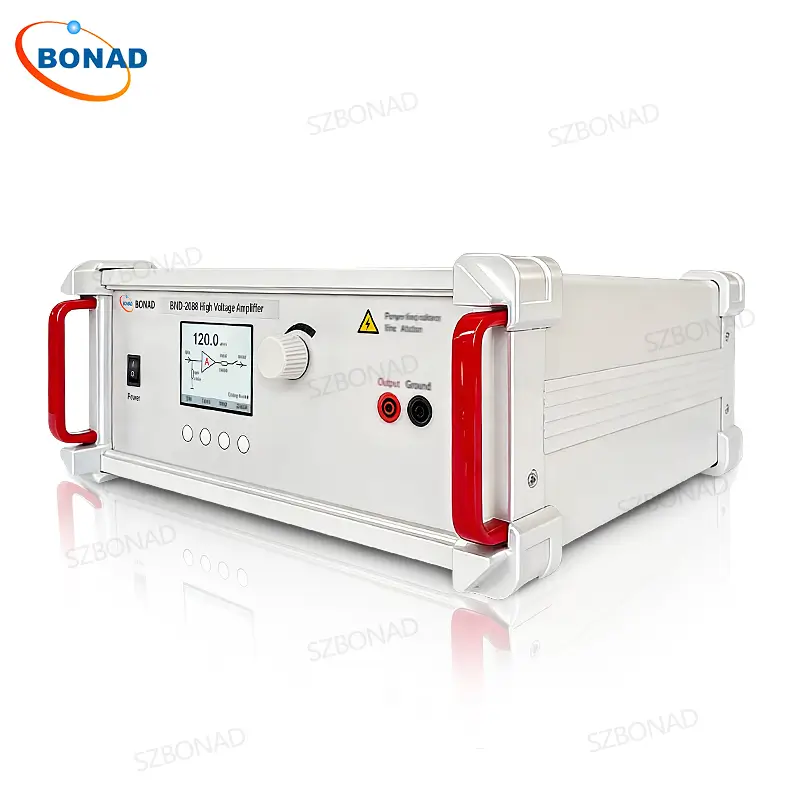
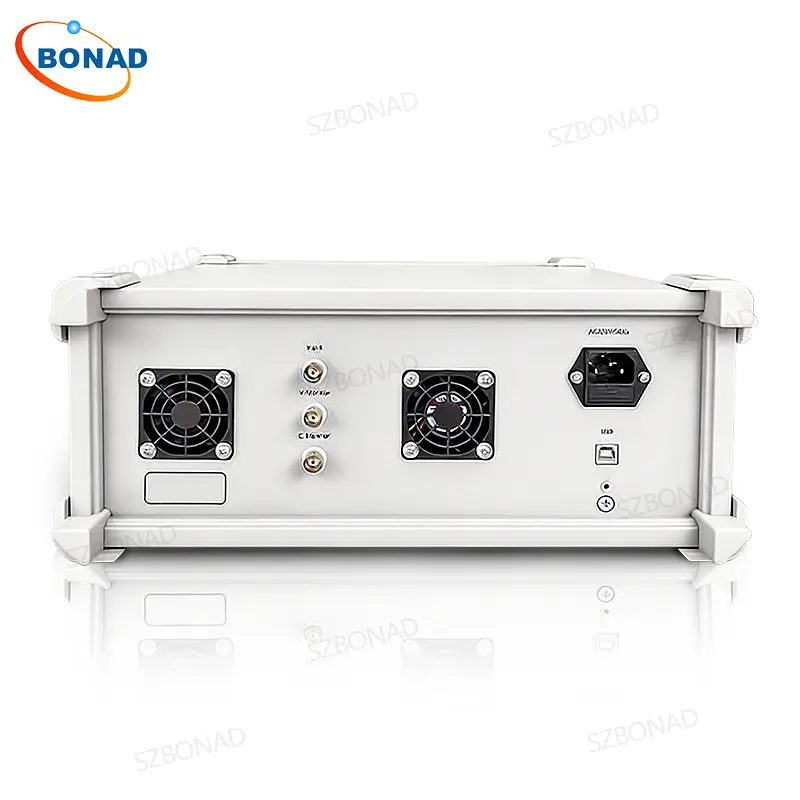
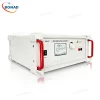
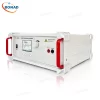
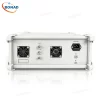
High Voltage Amplifier Manufacturer for Test Systems – BONAD
Applications
-
- Auxiliary high‑voltage source in environmental/aging test sequences.
- External signal amplification for electrical compliance & reliability tests.
- Piezoelectric ceramic drivers.
- Electro-optic modulator (EOM) drivers.
- Electromagnetic field experiments and drivers.
- MEMS (Micro-Electro-Mechanical Systems) testing.
- Microfluidics testing.
This high voltage amplifier is widely used in research laboratories, industrial testing, and precision instrument applications where high voltage, wide bandwidth, and precise control are required.
Features
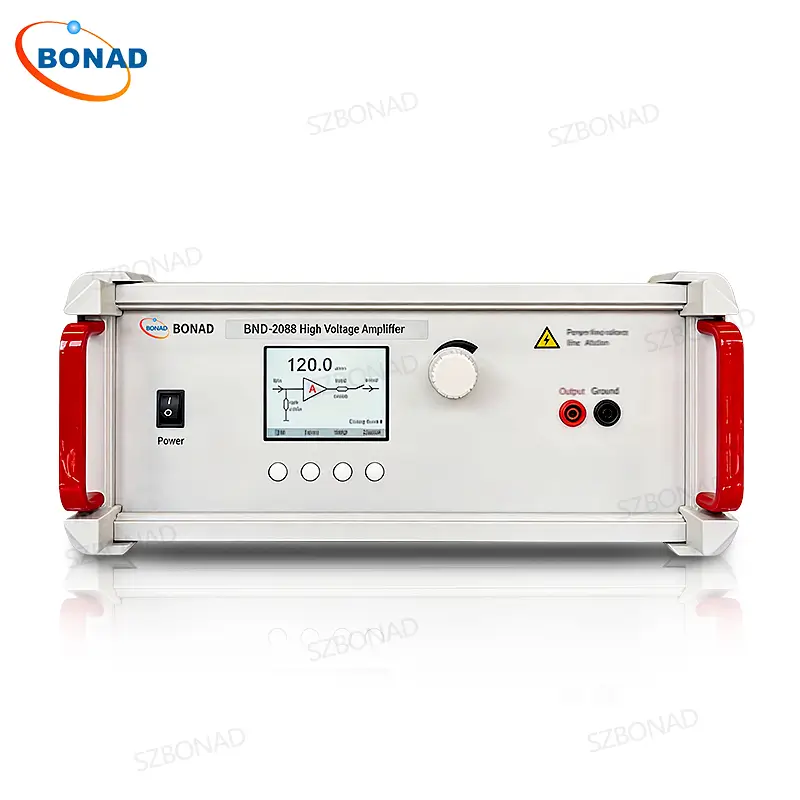
- High Bandwidth & Precision: Supports -3dB bandwidth up to 500 kHz with maximum output voltage of 800 Vp‑p (±400 V) for high-speed, high-voltage signal amplification.
- Adjustable Voltage Gain: Digitally controlled gain from 0–120×, with coarse (1 step) and fine (0.1 step) adjustment for fast voltage setup.
- Versatile Input/Output Interfaces:
- Input: BNC connector, selectable 50 Ω / 10 kΩ.
- Output: 4 mm Banana Jack, maximum 50 mA (>50 Hz).
- Real-Time Monitoring:
- Voltage Monitor: 10 mV/V, BNC connector for oscilloscope connection.
- Current Monitor: 20 V/A, BNC connector for real-time current monitoring.
- Intuitive LCD Interface: Clear display of device status and parameters, one-button saving of frequently used settings.
- Programmable Control: Supports external or computer control for automated testing, suitable for labs and production lines.
- Reliable Operation: Overcurrent protection, stable performance in 0°C–45°C operating temperature, and 3-year warranty.
Technical Specifications
| Parameter | Specification |
|---|---|
| Model | BND-2088 |
| Channels | 1 |
| Output Type | Single-ended |
| Bandwidth (-3dB) | DC ~ 500 kHz |
| Maximum Output Voltage | 800 Vp-p (±400 V) |
| Maximum Output Current | 25 mA (DC ~ 50 Hz) 50 mA (>50 Hz) |
| Maximum Output Power | 20 Wp |
| Fuse | 2 A / 250 V |
| Voltage Gain | ×0 ~ 120 (0.1 step / 1 step) |
| Load Resistance (RL) Limit | ≥15.9 kΩ (DC ~ 50 Hz) ≥7.9 kΩ (>50 Hz) |
| Output Resistance | 100 Ω / 5 kΩ (customizable) |
| Input Resistance | 50 Ω / 10 kΩ |
| Input Amplitude | 0 ~ 10 Vp-p MAX |
| Output Voltage Error | ≤ ±3% FS @ 1 kHz |
| Voltage Monitoring | 10 mV/V (±5% @ Output, FS) |
| Current Monitoring | 20 V/A (±5% @ Output, FS) |
| Slew Rate | ≥ 888.4 V/μs |
| Total Harmonic Distortion (THD) | ≤ 0.1% @ 1 kHz, 100 Vp-p |
| Output Voltage Zero Drift | ≤ ±0.3 V |
| Signal-to-Noise Ratio | ≥ 80 dB |
| Output Interface | 4 mm Banana Jack |
| Protection | Overcurrent Protection |
| Power Supply | AC 220 V ± 10%, 50 Hz |
| Operating Temperature | 0°C ~ 45°C |
| Storage Temperature | -20°C ~ 50°C |
| Operating Humidity | ≤ 80% RH, non-condensing |
| Warranty | 3 years |
| Dimensions (W×H×D) | 366 × 164 × 369 mm |
| Description | DC ~ 500 kHz (-3dB) Single-channel High Voltage Amplifier |
| Accessories | Power Cable ×1, BNC Cables ×3, Red/Black Output Cable Set ×1, USB Cable ×1, Fuse ×1, User Manual ×1, Usage Guide ×1, Product Certificate ×1, Calibration Certificate ×1, Packing List ×1 |
FAQ
What is the BONAD BND-2088 designed for?
The BND-2088 is a single-channel high voltage amplifier optimized for test and measurement applications, such as reliability testing, laboratory experiments, and driving piezoelectric or electro-optic devices. It can also be adapted for general-purpose high voltage applications, offering flexibility for diverse operational needs.
Can the amplifier be customized?
Yes. The BND-2088 supports custom voltage, current, gain, and interface configurations, making it suitable for standard test systems, specialized experiments, or proprietary industrial setups. This ensures both procurement and engineering teams can match the device to their exact requirements.
What makes the BND-2088’s performance reliable for testing applications?
The BND-2088 delivers high-precision, low-noise, and fast-response high voltage amplification, with a maximum output of 800 Vp‑p (±400 V) and bandwidth up to 500 kHz. Its adjustable gain (0–120×) and stable current output ensure consistent and repeatable results, critical for both automated test systems and laboratory experiments.
How does it integrate with automated test systems?
The amplifier offers external control and monitoring interfaces, enabling seamless integration into automated test environments (ATE), laboratory systems, or combined test setups. This reduces setup complexity, improves operational efficiency, and allows engineers to control and monitor high voltage signals accurately.
What applications and benefits does it provide for technical teams and decision-makers?
- High-voltage amplification for test and measurement systems.
- Driving piezoelectric, electro-optic, and MEMS devices.
- Custom or general-purpose use, enhancing flexibility and ROI.
- Reliable, precise, and low-noise operation, reducing errors and improving test efficiency.
- Ideal for engineering, procurement, and management teams seeking configurable, high-value test solutions.