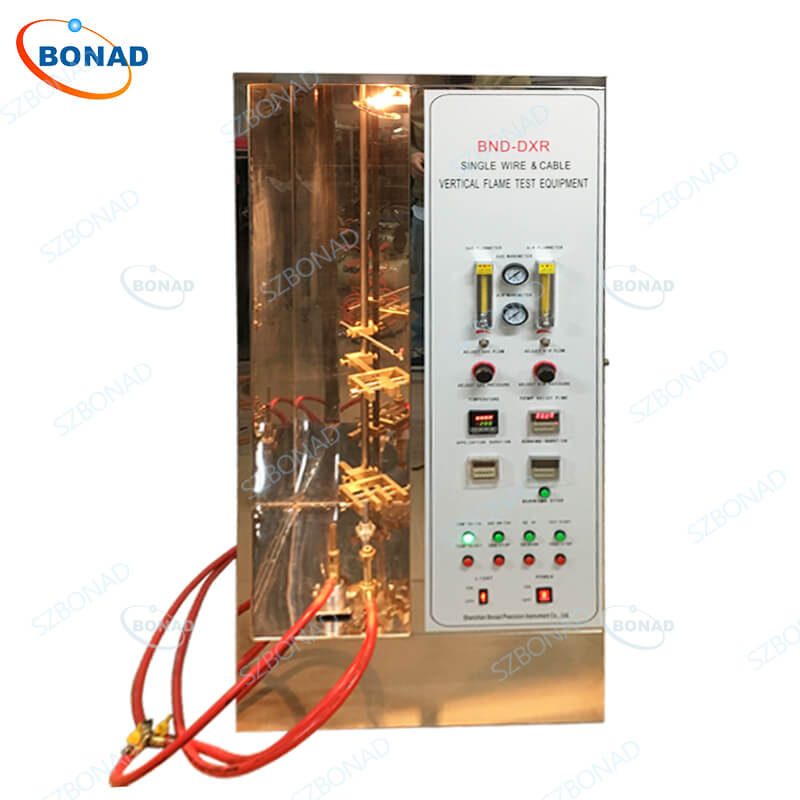
The Single Wire and Cable Burning Tester (Model BND-DDR, Brand SZBONAD) is an advanced Flammability Test Chamber designed to evaluate the flame-retardant performance of single wires and cables under simulated real-fire conditions.
Based on the core logic of stable flame generation, precise sample positioning, automated monitoring, and data visualization, the system ensures highly repeatable results and full compliance with global standards such as IEC60332-1, GB/T18380, and GB/T5169.14.
This article explains the working principle, testing methods, and industrial applications, helping users understand how this wire tester supports fire-safety assessments in electrical, appliance, and certification industries.
1. Working Principle of the Single Wire and Cable Burning Tester
The BND-DDR tester operates based on four integrated functional modules that work together to simulate a standardized vertical flame test.
1.1 Stable Flame Generation and Control
The system uses a 1 kW pre-mixed flame burner to produce a controlled and stable test flame.
- Gas: High-purity propane or LPG
- Gas flow rate: 0.1–1 L/min
- Air flow rate: 3–30 L/min
- Imported flame-control module ensures stability despite gas pressure fluctuations
- Flame temperature meets IEC and GB/T testing standards
This ensures each test is conducted under strictly identical flame conditions.
1.2 Sample Positioning and Combustion Action
The prepared test sample is:
- Cut to 600 ± 25 mm
- Vertically mounted in the combustion chamber
- Lower end aligned precisely with the flame center
The chamber uses anti-corrosion sprayed steel plates resistant to both high temperature and acidic smoke, creating a closed combustion environment free from airflow interference.
1.3 Automated Monitoring of Combustion Parameters
The system integrates high-precision sensors and a programmable control unit to monitor:
Combustion timing
- Adjustable: 0.1–999.9 s
- Burner retracts automatically after the set duration
- Auto-recording of afterburning time and glowing time
Flame propagation
- Visual + scale-based monitoring
- Measures upward and downward spread distances
Droplet behavior
- Absorbent cotton positioned 100 mm below sample
- System records:
- Droplet frequency
- Whether droplets ignite the cotton
- Combustion characteristics
1.4 Data Recording and Visual Display
Through the self-developed LCD touch screen, the system displays and stores:
- Combustion duration
- Afterburning time
- Glowing time
- Flame spread distance
- Droplet ignition results
Data can be exported for traceability and eliminates human recording errors.
2. Standardized Flammability Testing Method (Based on IEC60332 & GB/T Standards)
The flame-retardance evaluation process consists of three stages: Preparation → Execution → Determination
2.1 Test Preparation
Sample preparation
- Length: 600 ± 25 mm
- Conductor diameter > 0.8 mm or cross-section area > 0.5 mm²
- For fine wires (<1 mm), use BND-DDR1 model
Equipment setup
- Air compressor pressure: 0.7 MPa
- Burner calibrated to a 1 kW premixed flame
- Set ignition time (e.g., 30 s or 60 s based on standards)
Sample installation
- Vertical mounting
- Align sample bottom with flame center
- Place cotton 100 mm below for droplet-ignition detection
2.2 Test Execution
- Burner applies flame at a 45° angle
- System records ignition time, afterburning, and glowing durations
- Monitors flame spread and carbonization zone
- Records droplet generation and ignition behavior
2.3 Result Determination (Qualification Criteria)
| Evaluation | Standard | Requirement |
|---|---|---|
| Flame spread | GB/T 18380.11 | Charred distance > 50 mm; spread ≤ 540 mm |
| Afterburning & glowing | GB/T 18380.12 | Afterburning ≤ 60 s; glowing ≤ 120 s |
| Droplet behavior | GB/T 18380.13 | Droplets must not ignite cotton |
| Fine wire test | IEC 60332-2-2 | Afterburning ≤ 30 s; no flaming droplets |
3. Standards Supported by the BND-DDR Tester
The equipment fully complies with international and domestic standards:
International
- IEC 60332-1-1 / 1-2 / 1-3
- IEC 60695-11-2
Ensuring global certification compatibility (CE, CCC, etc.).
4. Application Fields of the BND-DDR Burning Tester
4.1 Wire & Cable Manufacturing
Evaluates flame propagation and droplet characteristics of:
- BV, RVV, YJV, VV cables
- Industrial wiring products
Ensures safety and compliance before market release.
4.2 Household Appliance Industry
Used for fire-safety assessment of:
- Internal wiring of refrigerators, air-conditioners, washing machines
- Power cords of small appliances (rice cookers, kettles, etc.)
Prevents electrical fire hazards.
4.3 Testing & Certification Laboratories
Organizations such as:
- SGS
- CQC
- Third-party compliance labs
Use this equipment for CE/CCC certification testing and R&D optimization.
4.4 Fine Wire Testing
The BND-DDR1 version is optimized for:
- Electronics
- Communication equipment
- Precision instrument wiring
Ensures safe flame behavior of thin insulated wires.
5. Product Overview: IEC60332 Single Wire and Cable Vertical Combustion Test Equipment (BND-DDR)
Key Features
- 2 Bunsen burners (Ø2 mm & Ø9.5 mm)
- Adjustable flame height: 20–190 mm
- Ignition/combustion time: 0–999.9 s
- 98% propane gas
- Temperature: 100°C to 700°C rise in 45 ± 2 sec
- Chamber volume: 0.15 m³
- Power: AC 220V, 50 Hz
A highly stable, fully automated flammability test chamber for professional wire-burning assessment.
Conclusion
The BND-DDR Single Wire and Cable Burning Tester uses advanced flame control, precise sample positioning, multi-parameter monitoring, and automatic recording to deliver reliable and repeatable fire-performance data.
Its fully standardized testing workflow, combined with wide standard compatibility (IEC + GB/T), makes it an essential wire tester in cable manufacturing, household appliances, certification laboratories, and electronic component industries.
As flame-retardant technologies continue developing, this Flammability Test Chamber will continue to provide high-accuracy safety evaluation and contribute to the long-term improvement of electrical fire prevention.