Waterproof and dustproof protection has become essential for smartphones, wearables, outdoor electronics, automotive components, industrial devices, and medical equipment. Among all protection levels, IP67 and IP68 are the most widely used high-grade ratings.
This guide explains what IP67 and IP68 mean, how the testing is performed, the standards involved, and how professional equipment—such as BONAD’s IPX7 and IPX8 test chambers—helps manufacturers achieve compliance efficiently.
1. What IP67 and IP68 Actually Mean
IP67 Rating
- 6 = Dust Tight
The enclosure must prevent any dust from entering. - 7 = Water Immersion Protection
The device must withstand 1 m of water depth for 30 minutes.
Suitable for phones, smart watches, consumer electronics, and lighting products.
IP68 Rating
- 6 = Dust Tight (same as above)
- 8 = Continuous Water Immersion
Devices must survive continuous submersion beyond 1 meter.
The exact depth and duration—e.g., 1.5 m, 3 m, 10 m—are defined by the manufacturer.
IP68 is used for premium electronics, automotive sensors, outdoor equipment, industrial controls, and underwater devices.
2. IP67 Test Procedures (Dust + 1 m Water Immersion)
(A) Dust Test – the “6”
- Performed inside a sealed dust chamber with fine talcum powder.
- Negative pressure or circulating dust airflow simulates harsh real-world environments.
- The device must show zero dust ingress after testing.
(B) Water Immersion Test – the “7”
- The device is submerged 1 meter deep for 30 minutes.
- No harmful quantity of water may enter the enclosure.
- Minimal moisture may be acceptable if it does not affect functionality.
(C) Modern Non-Destructive Test Methods
Laboratories increasingly use faster, high-precision alternatives:
- Pressure Decay / Volumetric Fill – monitors pressure drop to detect leaks
- Vacuum Leak Testing – evaluates sealing performance under low pressure
- Tracer Gas (Helium) Testing – identifies extremely fine leaks that water cannot detect
These methods are ideal for rugged electronics, connectors, cameras, and sealed modules.
3. IP68 Test Procedures (Dust + Deep Immersion)
While the dust test is identical to IP67, the water test is significantly more demanding.
(A) Deep-Water Immersion – the “8”
- Immersion depth typically ranges from 1.5 m to 10 m or more.
- Duration is ≥30 minutes, often longer.
- Pressure-controlled systems simulate real water depth precisely.
- Post-test inspection includes PCBs, batteries, connectors, seals, and adhesives.
Standards
- IEC 60529 – defines all IP ratings
- ISO 20653 – commonly applied in automotive waterproof testing
- Manufacturer must specify exact IPX8 test conditions
4. Recommended Professional IP67 / IP68 Waterproof Test Equipment (BONAD)
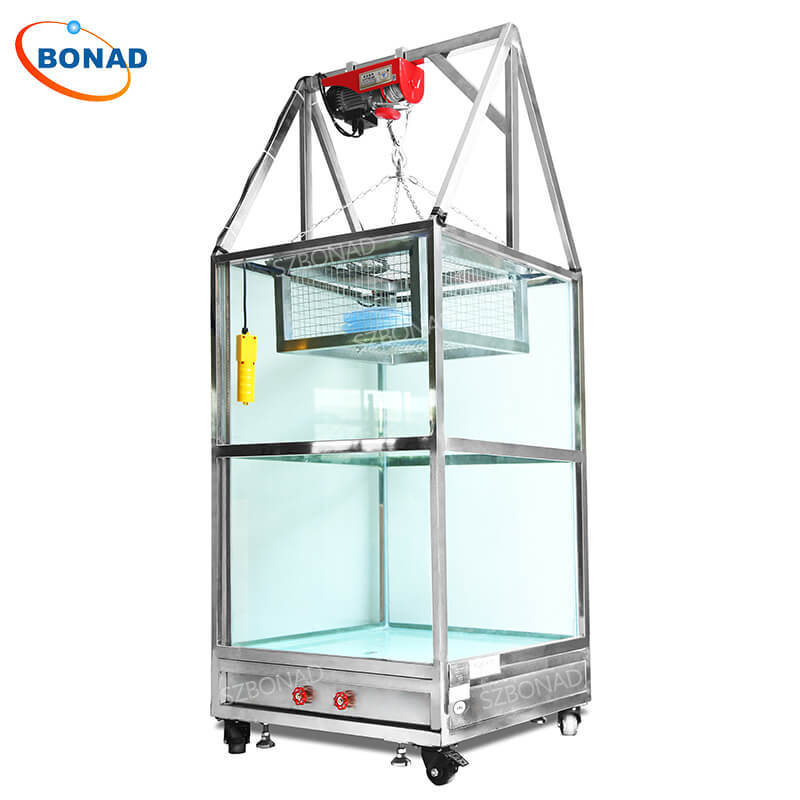
(1) BND-IPX7AS – IEC 60529 IPX7 Electric Lifting Water Immersion Tester
A specialized device designed for IP67 waterproof testing.
Key features:
- Thickened tempered glass transparent tank
- Maximum water depth: 1200 mm (customizable)
- Full 304 stainless steel frame and chassis
- Electric lifting mechanism for fully automated immersion
- Customizable stainless-steel specimen basket
- Fully complies with IEC 60529, GB4208, GB7000 (IPX7)
Ideal for smartphones, wearables, small electronics, LED lighting, and sealed components.
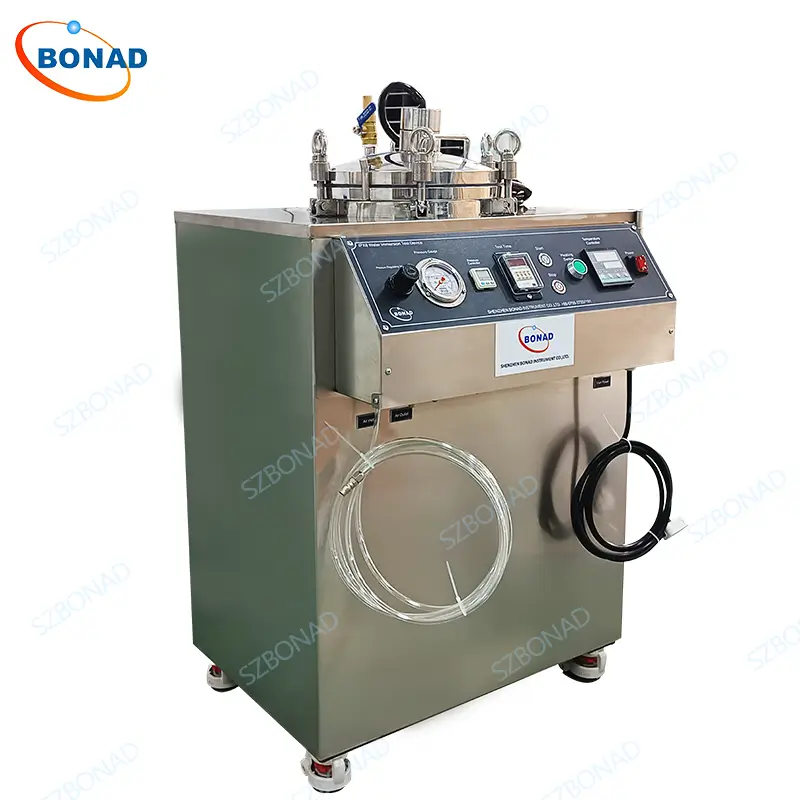
(2) BND-IPX8-H – IEC 60529 IPX8 Heated Immersion Pressure Test Chamber
A professional waterproof testing chamber for IP68 deep immersion and pressure testing.
Key features:
- High-strength 304 stainless steel pressure tank
- Simulates water pressure from several meters to tens of meters
- Optional heating function for temperature-controlled tests
- Digital pressure control with real-time monitoring
- Silicone sealing ring + 8-bolt locking for excellent airtightness
- Safety features: manual exhaust + automatic pressure relief
- Viewing window available (optional)
- Tank size fully customizable
Applications:
- Smartphones, wearables, audio devices
- Automotive sensors, lamps, connectors
- Industrial outdoor equipment
- Medical electronics
- Aerospace and defense components
5. Why IP67 and IP68 Testing Matters
- Ensures device reliability in rain, dust, humidity, and immersion environments
- Reduces warranty claims and field failures
- Provides compliance for global markets
- Strengthens brand trust and product competitiveness
- Essential for consumer electronics and industrial-grade equipment
6. Conclusion
IP67 and IP68 ratings are the most important global standards for waterproof and dustproof performance.
IP67 covers temporary immersion at 1 m, while IP68 addresses deep, continuous immersion with higher pressure requirements.
Using professional test equipment—such as BONAD’s IPX7 and IPX8 waterproof test chambers—manufacturers can achieve accurate, repeatable, and fully compliant testing for a wide range of products.
FAQ for IP67 & IP68 Waterproof Testing
1. What is the difference between IP67 and IP68?
IP67 protects against complete dust ingress and temporary water immersion at 1 meter for 30 minutes, while IP68 offers the same dust protection but allows continuous immersion beyond 1 meter, with depth and duration defined by the manufacturer.
2. Is IP68 always better than IP67?
Yes. IP68 is considered a higher protection level because it supports longer and deeper submersion. However, the exact performance depends on the manufacturer’s specified test conditions—for example, 1.5 m, 3 m, or 10 m.
3. Can IP67 devices be used underwater?
IP67 devices can only withstand short-term, accidental immersion. They are not suitable for swimming or continuous underwater use. If you need prolonged water exposure, look for IP68-rated products.
4. What tests are required to certify a device as IP67?
IP67 requires:
- A dust-tight test using a sealed chamber
- A 1-meter, 30-minute immersion test
Both tests follow the IEC 60529 standard.
5. What tests are required for IP68 certification?
IP68 includes:
- Complete dust-tight testing
- Deep water immersion with controlled pressure
Since IPX8 depth and time are not fixed, the manufacturer must specify conditions such as 1.5 m for 30 minutes or 10 m for 1 hour.
6. Does IP68 mean waterproof?
IP68 means the device is water-resistant, not 100% waterproof. It can handle deep immersion under defined conditions but may still fail in high-pressure jets, saltwater, hot water, or chemicals.
7. Can IP67 or IP68 devices be used in saltwater?
No. IP ratings only test freshwater immersion. Saltwater, chlorine, detergents, or chemicals require additional tests such as:
- ASTM B117 (salt spray)
- ISO 20653 IPX9K (high-pressure hot water)
8. How long can an IP68 device stay underwater?
It depends. IEC 60529 does not define a fixed duration. Manufacturers specify their own conditions, such as:
- 1.5 m for 30 minutes
- 3 m for 1 hour
- 10 m for 2 hours
Always follow manufacturer specifications.
9. What equipment is used for IP67 water immersion testing?
IP67 devices are usually tested in transparent immersion tanks with:
- 1 m water depth
- Timed immersion (30 minutes)
BONAD’s IPX7 Electric Lifting Water Immersion Tester (BND-IPX7AS) is a common solution.
10. What equipment is required for IP68 testing?
IP68 testing requires pressure-controlled immersion chambers that simulate deep-water pressure.
BONAD’s IPX8 Heated Immersion Pressure Test Chamber (BND-IPX8-H) is engineered for:
- Deep immersion
- High pressure
- Optional water heating
all compliant with IEC 60529 and ISO 20653.
11. Do IP67 and IP68 protect against dust?
Yes. Both ratings include a 6-level dust-tight certification, meaning zero dust particles may enter the enclosure.
12. Can IP67/IP68 prevent damage from rain or splashes?
Absolutely. IP67 and IP68 exceed splash protection. Both ratings protect against:
- Rain
- Splashes
- Accidental submersion
IP65/IP66 are splash- or jet-protection ratings, but IP67/IP68 cover more severe conditions.
13. Is an IP67 or IP68 rating required for outdoor electronics?
For outdoor use:
- IP67 is normally sufficient for weather and accidental immersion.
- IP68 is recommended for devices exposed to heavy rain, flooding, or underwater operation.
14. How do manufacturers verify IP67 or IP68 compliance?
Compliance is verified through:
- IEC 60529 dust and water immersion tests
- Automated pressure-simulation testing
- Visual and functional inspection after testing
Certified laboratories may use advanced methods like helium leak detection.
15. Are IP67 and IP68 required for product certifications in Europe or the US?
IP ratings are not mandatory but are widely accepted for product quality and safety.
Many industries—automotive, LED lighting, telecom, medical devices—use IP67/IP68 as a benchmark for reliability.