Material testing is fundamental to evaluating the strength, durability, and long-term performance of metals, alloys, polymers, composites and advanced engineering materials. Among all mechanical tests, tensile testing and creep testing are the most widely used in aerospace, automotive, energy, manufacturing and scientific research. This guide explains how each method works and highlights advanced solutions such as the SZBONAD Tensile Testing Machine (BND-TSUT) and the Creep Testing Machine for High-Temperature Materials (BND-TCTM).
1. What Is a Tensile Testing Machine?
A tensile testing machine measures material behavior when subjected to a controlled pulling force until fracture. It reveals essential mechanical properties that impact product design, quality control and safety compliance.
How Tensile Testing Works
- A prepared specimen is mounted between upper and lower grips.
- The machine applies an increasing tensile load along the sample’s longitudinal axis.
- Sensors measure force and elongation in real time.
- A stress-strain curve is generated, showing elastic and plastic behavior.
- Testing continues until the specimen breaks.
Key Properties Measured
- Ultimate Tensile Strength (UTS)
- Yield Strength
- Young’s Modulus (Elastic Modulus)
- Ductility (elongation and reduction of area)
Where Tensile Testing Is Used
- Quality inspection of metals, plastics, cables, rubber, textiles
- Material selection & R&D
- Medical device testing (needles, sutures, implants)
- Product certification and compliance
- Educational and laboratory research
2. What Is a Creep Testing Machine?
A creep testing machine measures how a material deforms slowly over time under a constant load—typically at high temperatures. This is essential for applications where components must endure long-term stress such as turbines, jet engines, boilers, reactors and pipelines.
How Creep Testing Works
- A constant tensile or compressive load is applied to the specimen.
- Temperature is maintained at a controlled high level.
- Deformation (strain) is measured over hours, days, or even months.
- Results produce a creep curve showing strain vs. time.
Why Creep Testing Matters
- Predicts long-term material life
- Ensures reliability at elevated temperatures
- Supports design of safe industrial components
- Evaluates creep rate & failure characteristics
Three Stages of Creep
- Primary (Stage I): decreasing creep rate
- Secondary (Stage II): steady-state creep
- Tertiary (Stage III): rapid deformation leading to rupture
3. SZBONAD Creep Testing Machine for High-Temperature Materials (BND-TCTM)
The BND-TCTM is a fully automated, servo-controlled creep testing system designed for long-duration high-temperature tests up to 200–1200°C.
Key Applications
- Uniaxial creep testing
- Stress-rupture evaluation
- Stress relaxation testing
- Long-term deformation monitoring
- High-temperature tensile tests
- Low-cycle fatigue & creep-fatigue interaction
Core Features
1. Fully Automated Workflow
Automatic heating → soaking → loading → data recording → cooling → unloading
Power-off protection ensures ongoing testing without data loss.
2. High-Precision Servo Load System
- Smooth force/deformation control
- 12-segment programmable loading curves
- Suitable for long-duration, high-temperature conditions
3. Multi-Machine Management
- Simultaneous control of multiple stations
- Real-time monitoring & automatic curve plotting
- Intelligent fault diagnosis
4. Advanced Data Acquisition
- Continuous recording of temperature, load, deformation, time
- Historical data indexing & Excel export
- Automatic report generation
5. High-Stability Temperature Control
- Multi-sensor intelligent protection
- Compatible with split or cylindrical furnaces
- Temperature curve drawing & segmented control
6. Independent Operation Capability
If the main PC fails, testing continues without interruption.
Compliance with International Standards
- GB / ISO / EN / JIS / ASTM
- ASTM E139, ASTM E328, ASTM E2714
- GB/T 2039, GB/T 10120, GB/T 15248
- JJG276-2009 and aerospace specifications (HB5151, MSRR9968)

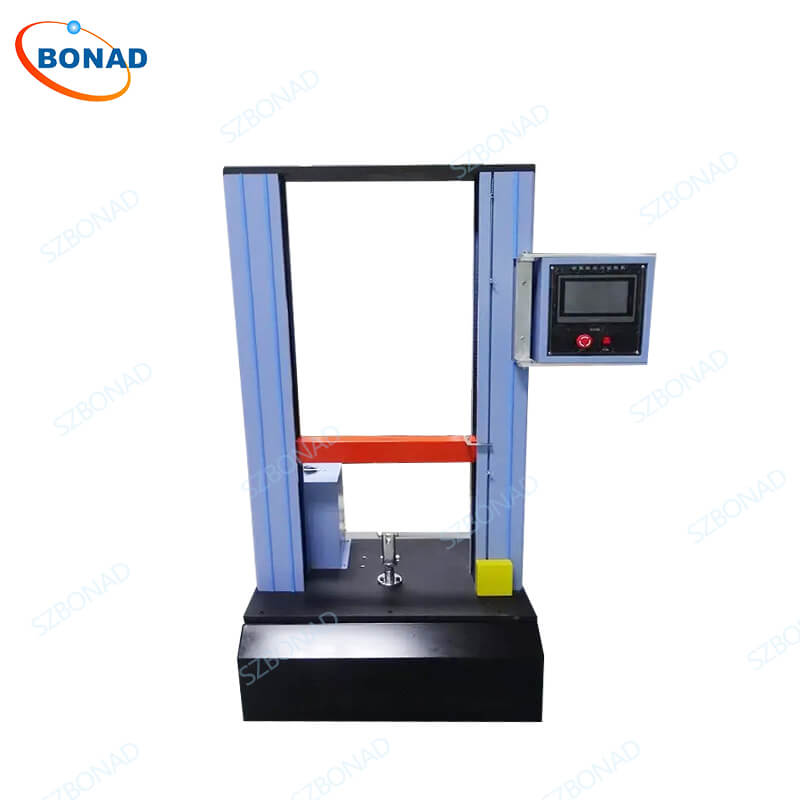
4. SZBONAD Touch Screen Controlled Universal Tensile Testing Machine (BND-TSUT)
A versatile tensile/compression/bending/shear testing solution ideal for metals, cables, plastics, textiles, rubber and composites.
Standards Compliance
- ASTMA370, ASTM E4, E8, E9
- ISO 6892, ISO 7438, ISO 7500-1
- EN 10002-4
Machine Features
- Panasonic servo motor + high-precision ball screw
- Automatic origin return & flexible data storage
- Dynamic force-elongation curve display
- High displacement resolution: 0.001 mm
- Multilingual interface: CN/EN
- RS232 stable data transmission
5. Why Choose SZBONAD Testing Machines?
- Professional B2B high-end testing solutions
- Reliable, long-term stability for research & industrial use
- Full compliance with global testing standards
- Comprehensive automation and precise data acquisition
- Support for high-temperature, low-temperature, tensile, creep and fatigue evaluations
Conclusion: Selecting the Right Testing Equipment
A Tensile Testing Machine is essential for understanding mechanical strength and ductility, while a Creep Testing Machine is indispensable for predicting long-term stability in high-temperature and high-stress environments. With industry-leading servo control, intelligent temperature regulation and fully automated workflows, SZBONAD provides reliable equipment for aerospace, energy, automotive, research institutions and advanced materials labs.
If you need high-precision material testing solutions, tensile testing machines and creep testing machines from SZBONAD offer accuracy, stability and compliance with industry standards.
Frequently Asked Questions (FAQ)
1. What is the difference between a tensile testing machine and a creep testing machine?
A tensile testing machine measures a material’s response to a short-term, increasing tensile load until fracture.
A creep testing machine, however, evaluates long-term deformation under constant load—often at high temperatures—to predict material life under sustained stress.
2. How do I choose between electronic and mechanical creep testing machines?
- Electronic (servo) creep testers
- Higher accuracy
- Automated control & data acquisition
- Suitable for aerospace, energy, R&D labs
- Mechanical (lever-type) creep testers
- Lower cost
- Ideal for universities, training labs and basic QC
- Simple and stable force application
If you require 24/7 long-duration tests, multi-station testing, or precise temperature control, the servo electronic model (BND-TCTM) is recommended.
3. What materials can be tested with a creep testing machine?
Creep testers are suitable for:
- Nickel-based superalloys
- Titanium alloys
- Stainless steels
- Non-ferrous metals (Al, Cu)
- High-temperature alloys
- Engineering ceramics
- Heat-resistant composite materials
If the test temperature is 200–1200°C, SZBONAD’s high-temperature creep tester is optimized for these materials.
4. How long does a typical creep test take?
Creep tests may run:
- Short-term: Several hours
- Medium-term: Days to weeks
- Long-term: Months or even 10,000+ hours
The BND-TCTM supports multi-month continuous operation with automatic power-loss protection.
5. What standards should a creep testing machine comply with?
A high-quality creep tester should meet:
- ASTM E139 – Creep and Stress-Rupture
- ASTM E328 – Stress Relaxation
- ASTM E2714 – Creep-Fatigue
- GB/T 2039 – Uniaxial Creep
- GB/T 10120 – Stress Relaxation
- GB/T 15248 – Low-Cycle Fatigue
- JJG276-2009 – Verification for Creep UTM
SZBONAD BND-TCTM meets GB/ISO/ASTM/JIS/EN global compliance.
6. Do tensile testing machines support compression and bending tests?
Yes.
The Touch Screen Controlled Universal Tensile Testing Machine (BND-TSUT) supports:
- Tension
- Compression
- Bending
- Shearing
- Peeling
- Tear strength
- Customized fixtures
It is suitable for metals, plastics, rubber, textiles, wires, cables and composite materials.
7. What accuracy can I expect from a SZBONAD tensile testing machine?
- Load accuracy: ±0.5% or better
- Displacement resolution: 0.001 mm
- High precision servo motor + ball screw ensures stable, repeatable performance
8. Can the creep testing machine run multiple stations simultaneously?
Yes.
The system supports multi-station parallel testing with:
- Independent control
- No cross-interference
- Separate temperature control & load paths
- Automatic data management and reporting
Ideal for mass sample evaluation in research institutions and factories.
9. What happens if the computer crashes during testing?
SZBONAD’s BND-TCTM features independent operation capability:
- Testing continues even if the PC fails
- Data is stored locally inside the machine
- Automatic recovery when the PC reconnects
This is crucial for long-term creep tests lasting thousands of hours.
10. Do you offer customized fixtures or temperature furnaces?
Yes.
Customization options include:
- Grips for round/flat specimens
- High-temperature extensometers
- Split-type or cylindrical furnaces
- Low-temperature chambers (–40°C to 250°C)
- Transverse strain measurement accessories
- Special jigs for wires, films, brittle materials, etc.
11. Can the machine export data and generate reports automatically?
Absolutely.
Both tensile and creep testers support:
- Automatic Excel export
- PDF report generation
- Data curve plotting (stress-strain, creep curves, temperature vs time)
- Historical sample ID search
- Regression analysis and creep life prediction
12. Do your testing machines support English-language software?
Yes.
The system supports:
- English
- Simplified Chinese
- Traditional Chinese
Additional languages are available upon request.