What Is Thermal Shock Testing?
Thermal shock testing is an environmental testing method used to evaluate how materials, components, and finished products respond to sudden and extreme temperature changes.
Unlike gradual temperature variation, thermal shock testing exposes a sample to rapid transitions between high and low temperatures, creating intense thermal stress within a short time.
This method is widely used by:
- Manufacturers validating product durability
- Testing laboratories conducting reliability assessments
- Certification bodies verifying compliance with international standards
Typical real-world scenarios include:
- Outdoor equipment exposed to day–night temperature swings
- Electronic devices during power cycling
- Automotive components operating in harsh climates
Why Thermal Shock Testing Is Critical
1. Detecting Hidden Material Failures
Rapid temperature changes can cause:
- Cracking due to thermal expansion mismatch
- Seal degradation and leakage
- Solder joint fatigue in electronics
- Structural deformation in polymers and metals
Thermal shock testing helps identify these issues early in the development or production stage.
2. Supporting Global Compliance
Thermal shock testing is essential for meeting international standards such as:
- IEC 60068-2-14
- MIL-STD-810
- JEDEC JESD22
- ASTM and ISO testing standards
These standards define test parameters including temperature limits, dwell time, and cycle counts to ensure consistent evaluation.
3. Accelerating Reliability Validation
Instead of waiting for long-term environmental exposure, thermal shock testing simulates years of stress within hours or days—making it a key tool for accelerated life testing.
How Thermal Shock Testing Works
A standard thermal shock testing process typically includes the following steps:
Step 1: Sample Preparation
Samples are selected to represent real production conditions.
Step 2: Extreme Temperature Exposure
Typical ranges include:
- Low temperature: -40°C to -70°C
- High temperature: +85°C to +150°C
Step 3: Rapid Transition
The sample is quickly transferred between hot and cold environments, creating thermal stress.
Step 4: Dwell Time
The sample remains at each temperature until thermal equilibrium is reached.
Step 5: Cycling
The process is repeated for multiple cycles depending on the test standard.
Step 6: Evaluation
After testing, samples are inspected for:
- Mechanical damage
- Electrical failure
- Performance degradation
Thermal Shock Testing vs Thermal Cycling
Although often confused, these two methods serve different purposes:
| Feature | Thermal Shock Testing | Thermal Cycling |
|---|---|---|
| Temperature change | Rapid | Gradual |
| Stress level | High | Moderate |
| Purpose | Detect sudden failure | Evaluate long-term fatigue |
| Application | Harsh condition simulation | Durability testing |
In practice:
Thermal shock is used for extreme stress validation, while thermal cycling evaluates long-term reliability.
Types of Thermal Shock Chambers
A thermal shock chamber is the core equipment used to perform these tests. Selecting the right configuration depends on the application and required precision.
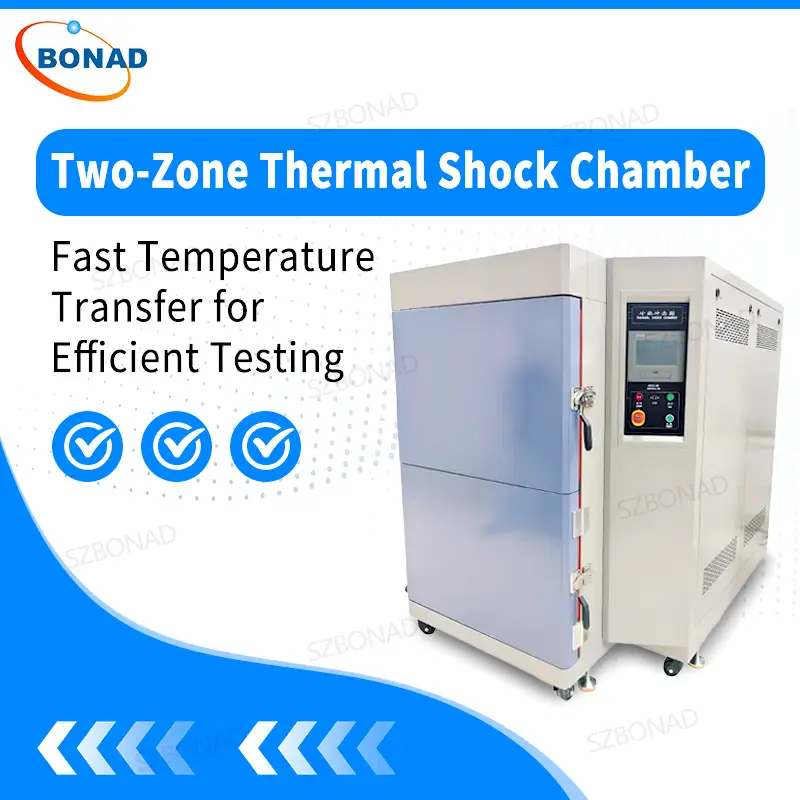
Two-Zone Thermal Shock Chamber
Two-zone systems consist of separate hot and cold chambers. The test sample is transferred between them to create rapid temperature changes.
Key advantages:
- Fast temperature transition
- Cost-effective solution
- Suitable for general industrial applications
Recommended solution:
Typical applications:
- Electronics and PCB testing
- Automotive components
- Industrial product validation
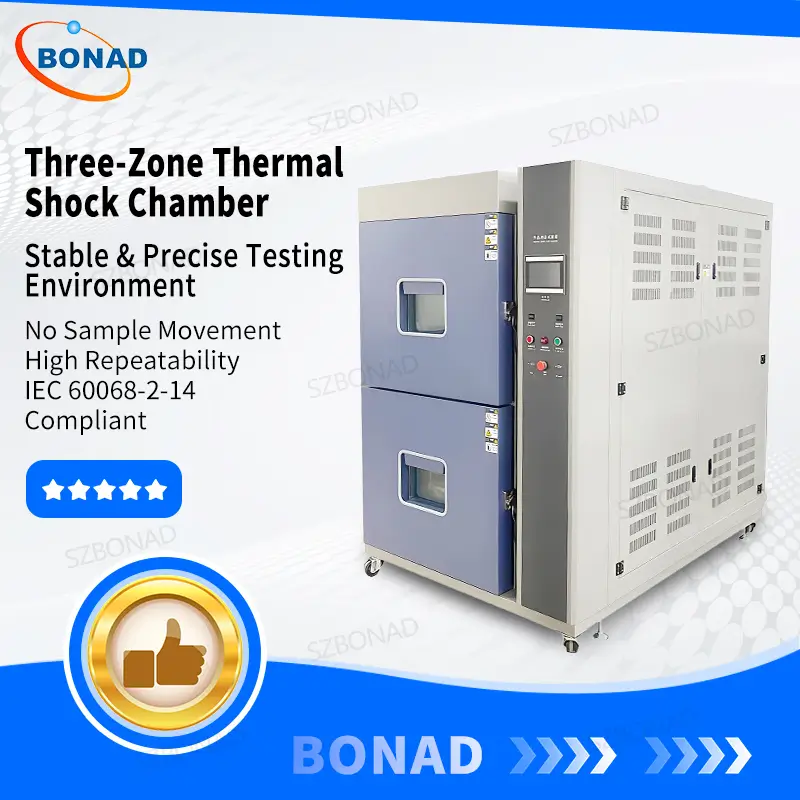
Three-Zone Thermal Shock Chamber
Three-zone systems include independent hot, cold, and test zones. The sample remains stationary while temperature conditions change around it.
Key advantages:
- Higher testing accuracy
- Improved repeatability
- Reduced mechanical stress from movement
Recommended solution:
Typical applications:
- Semiconductor testing
- Aerospace components
- High-reliability certification environments
Key Standards for Thermal Shock Testing
IEC 60068-2-14
This is the most widely recognized international standard for thermal shock testing. It defines:
- Test methods for abrupt temperature changes
- Recommended temperature ranges
- Duration and number of cycles
- Evaluation criteria
Additional Standards
- MIL-STD-810 – widely used in defense and aerospace
- JEDEC JESD22 – semiconductor reliability testing
- ASTM / ISO standards – materials and industrial applications
Compliance with these standards ensures consistency across global markets, including Europe, North America, and Southeast Asia.
Industrial Applications
Electronics & Semiconductor
- PCB and circuit reliability
- IC packaging validation
- Solder joint durability
Automotive & New Energy
- EV battery testing
- Sensor and control unit validation
- Engine component durability
Aerospace
- Extreme environment simulation
- Flight component reliability testing
Materials Testing
- Glass thermal resistance
- Polymer stability
- Metal fatigue behavior
How to Select the Right Thermal Shock Chamber
When choosing a thermal shock chamber, consider the following factors:
Temperature Range
Ensure compatibility with your testing requirements.
Transition Time
Faster transitions produce more realistic stress conditions.
Chamber Type
- Two-zone: cost-effective and widely used
- Three-zone: higher precision and consistency
Standards Compliance
Verify support for IEC, MIL, JEDEC, or other required standards.
Control System
Programmable systems improve repeatability and data accuracy.
Common Mistakes to Avoid
- Confusing thermal shock with thermal cycling
- Ignoring recovery time between cycles
- Selecting inadequate chamber capacity
- Overlooking compliance requirements
Conclusion
Thermal shock testing plays a vital role in ensuring product reliability under extreme environmental conditions. It allows manufacturers, laboratories, and certification organizations to detect failures early, improve product quality, and meet international compliance standards.
Choosing the right thermal shock chamber—whether a flexible two-zone system or a high-precision three-zone solution—directly impacts testing accuracy, efficiency, and long-term performance validation.
Get Expert Support
Looking for a reliable thermal shock testing solution?
- Custom configurations available
- Designed for IEC and global standards
- Suitable for laboratories and industrial applications
Explore the recommended systems above or reach out for tailored guidance based on your testing requirements.
FAQ:
What is the purpose of thermal shock testing?
To evaluate how products respond to rapid temperature changes and identify potential failure points.
What is a typical temperature range?
Most tests range from -40°C to +150°C, depending on the application and standard.
What is the difference between two-zone and three-zone systems?
Two-zone systems move samples between chambers, while three-zone systems keep samples stationary for better consistency.
How many cycles are required?
This depends on the test standard and product requirements, typically ranging from 10 to several hundred cycles.
Which industries require thermal shock testing?
Electronics, automotive, aerospace, materials, and energy sectors.