Industrial Methods, Applications, and Test Selection Guide
Corrosion is a major factor affecting the service life, safety, and reliability of industrial products. From metal components and surface coatings to electronic assemblies, corrosion-related failures can result in significant economic loss and compliance risks.
To address this challenge, manufacturers and laboratories rely on accelerated corrosion testing to simulate environmental exposure under controlled and repeatable conditions. Among the most widely used methods are salt spray (salt fog) testing and sulfur dioxide (SO₂) corrosion testing, each targeting different corrosion mechanisms and service environments.
The Role of Accelerated Corrosion Testing in Industry
Accelerated corrosion testing supports key industrial objectives:
- Verifying corrosion resistance during material and coating selection
- Comparing different surface treatments and protection systems
- Reducing field failure risk before mass production
- Supporting compliance with international and customer-specific standards
Unlike natural exposure testing, laboratory corrosion tests allow faster decision-making while maintaining consistency and traceability.
Salt Spray (Salt Fog) Corrosion Testing
Salt spray testing simulates marine, coastal, and salt-contaminated environments by exposing specimens to a fine mist of sodium chloride solution under controlled temperature conditions. It is primarily used to evaluate resistance to chloride-induced corrosion, which is common in coastal regions and winter road environments.
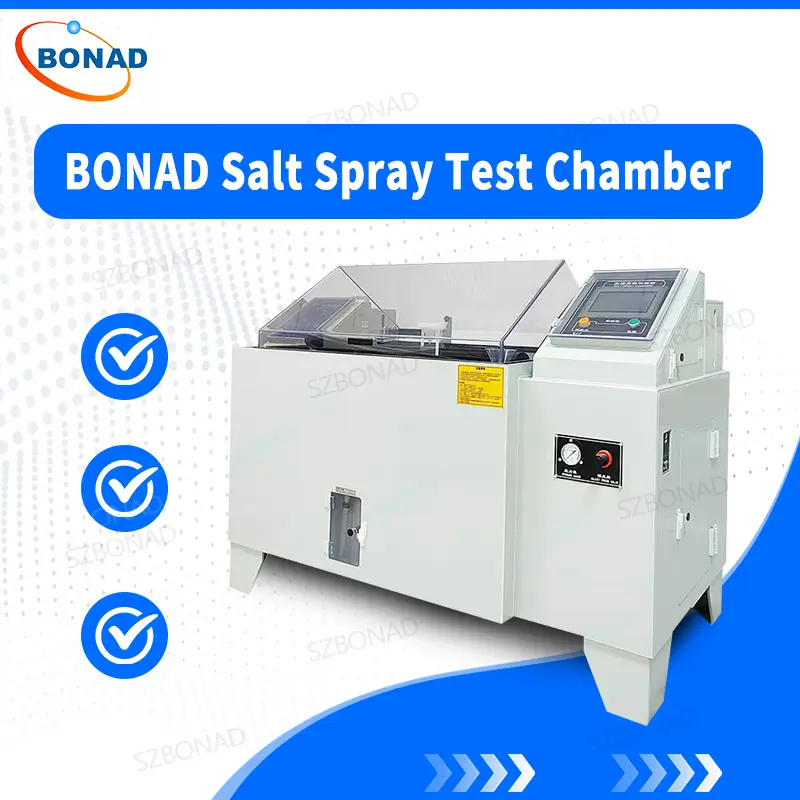
In practice, salt spray testing is typically conducted in standardized corrosion chambers designed to maintain stable spray distribution, temperature, and solution chemistry, such as professional salt spray corrosion test chambers used in industrial laboratories.
Common Salt Spray Test Methods
- Neutral Salt Spray (NSS)
Uses a 5% NaCl solution at approximately 35°C. It is the most widely adopted method for general corrosion resistance evaluation. - Acetic Acid Salt Spray (AASS)
Acidified salt solution accelerates corrosion, making it suitable for coated and electroplated materials. - Copper-Accelerated Acetic Acid Salt Spray (CASS)
Introduces copper ions to significantly increase test severity, mainly applied to decorative coatings and chromium-plated components. - Cyclic / Prohesion Testing
Alternates between wet and dry phases to better represent natural environmental exposure, improving correlation with field performance.
Corrosion Mechanism
Salt spray testing is dominated by electrochemical corrosion. Chloride ions penetrate protective layers, disrupt passive films, and accelerate oxidation reactions, leading to pitting, rust formation, and coating delamination.
Applicable Standards
- ASTM B117
- ISO 9227
- JIS Z 2371
Sulfur Dioxide (SO₂) Corrosion Testing
SO₂ corrosion testing simulates industrial and urban atmospheres where sulfur dioxide pollution is present due to fossil fuel combustion and industrial emissions. When combined with humidity, SO₂ forms acidic compounds that aggressively attack metals, coatings, and electronic components.
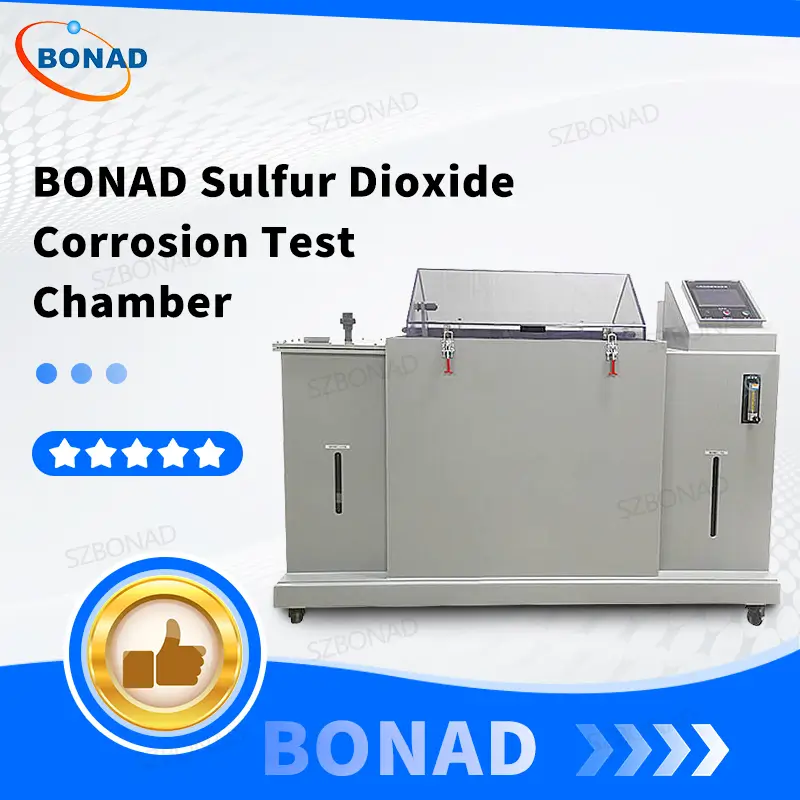
SO₂ testing is commonly performed using sealed corrosion chambers with precise control of gas concentration, temperature, and humidity, such as industrial SO₂ corrosion test chambers used for pollution resistance evaluation.
Typical SO₂ Test Modes
- Continuous SO₂ Exposure
Constant SO₂ concentration under controlled humidity to accelerate acid corrosion. - Cyclic SO₂ Testing
Alternates SO₂ exposure and recovery phases, reflecting real industrial environmental fluctuations. - Wet SO₂ Testing
Combines condensation with SO₂ exposure to simulate acid rain conditions.
Corrosion Mechanism
SO₂ corrosion testing is driven by chemical (acidic) corrosion. Sulfur dioxide reacts with moisture to form sulfurous acid (H₂SO₃), which attacks metal surfaces, weakens protective coatings, and may cause functional degradation of electronic assemblies.
Applicable Standards
- ISO 6988
- DIN 50018
- IEC 60068-2-42 / IEC 60068-2-43
Cyclic Corrosion Testing (CCT): Bridging the Gap
While salt spray and SO₂ testing focus on specific environments, cyclic corrosion testing (CCT) combines multiple stress factors—salt spray, drying, humidity, and sometimes SO₂ exposure—into a single test sequence.
CCT is increasingly used in automotive and infrastructure industries because it offers better correlation with real-world corrosion behavior, especially for coated and assembled products.
Salt Spray vs SO₂ Corrosion Testing: Key Technical Differences
| Aspect | Salt Spray Testing | SO₂ Corrosion Testing |
|---|---|---|
| Simulated Environment | Marine / saline | Industrial / acidic |
| Main Corrosive Agent | Chloride ions | Sulfur dioxide |
| Corrosion Type | Electrochemical | Chemical (acidic) |
| Typical Applications | Automotive, hardware, coatings | Electronics, industrial equipment |
| Test Severity | Rapid, visually apparent | Progressive, chemically aggressive |
| Field Correlation | Moderate | High for polluted environments |
Corrosion Evaluation and Result Interpretation
Accurate interpretation of corrosion test results is critical. Common evaluation methods include:
- Visual rating according to standard-defined criteria
- Mass loss and coating thickness reduction
- Microscopic surface analysis (optical microscopy, SEM)
- Chemical analysis (EDS, XPS) for corrosion products
It is important to note that test duration does not directly equate to service life. Accelerated tests are comparative tools, not absolute lifetime predictors.
Common Misunderstandings in Corrosion Testing
- Salt spray hours do not equal years of outdoor exposure
- One test method cannot represent all service environments
- Higher test severity does not always mean better real-world correlation
Selecting the appropriate test method requires understanding both the corrosion mechanism and the actual service conditions.
How to Select the Right Corrosion Test Method
- Choose salt spray testing for marine, coastal, or salt-exposed applications
- Choose SO₂ corrosion testing for industrial, urban, or acid rain–prone environments
- Combine methods or use CCT for complex exposure conditions
Standardized environmental test chambers ensure repeatability, safety, and compliance with international testing requirements.
FAQ
What is accelerated corrosion testing used for?
It is used to evaluate and compare corrosion resistance of materials and coatings under controlled, intensified conditions.
Is salt spray testing enough for industrial products?
Not always. Products used in polluted or urban environments often require SO₂ or cyclic corrosion testing.
Why is SO₂ testing especially important for electronics?
Acidic corrosion can affect contacts, solder joints, and conductive paths, leading to functional failure.
Can multiple corrosion tests be combined?
Yes. Combining salt spray, SO₂, and cyclic tests provides a more comprehensive durability assessment.
Are these tests internationally recognized?
Yes. Both methods follow ISO, ASTM, DIN, and IEC standards and are widely accepted worldwide.