In modern product design, waterproof performance is no longer optional—it is a critical requirement for electronics, automotive components, lighting systems, and industrial equipment.
To ensure consistent and standardized evaluation, manufacturers rely on the internationally recognized standard IEC 60529, which defines ingress protection (IP) ratings.
Among these, IPX1 to IPX4 represent the most commonly used entry-level to mid-level waterproof tests, covering real-world exposure such as condensation, dripping water, rain, and splashing.
This guide provides a comprehensive technical breakdown of IPX1, IPX2, IPX3, IPX4, and IPX4K, along with testing methods and recommended equipment solutions.
What Is IPX Waterproof Testing?
The IP rating system classifies how well an enclosure protects against water ingress. The second digit (X1–X9K) specifically defines liquid protection levels.
For IPX1–IPX4:
- IPX1 → Vertical dripping water
- IPX2 → Tilted dripping water
- IPX3 → Spraying water
- IPX4 → Splashing water
These tests simulate progressively more complex water exposure conditions, from indoor condensation to outdoor rain and splashes.
IPX1 vs IPX2 vs IPX3 vs IPX4: Key Differences
| Rating | Water Exposure Type | Test Condition | Typical Application |
|---|---|---|---|
| IPX1 | Vertical drip | Water drops fall vertically | Indoor electronics |
| IPX2 | Tilted drip | Up to 15° tilt exposure | Appliances |
| IPX3 | Spray | Water sprayed up to 60° | Outdoor equipment |
| IPX4 | Splash | Water from all directions | Consumer & industrial products |
Key takeaway:
IPX1–IPX2 = drip simulation
IPX3–IPX4 = rain & splash simulation
IPX1 & IPX2 Testing: Dripping Water Simulation
IPX1 and IPX2 tests simulate condensation or light dripping water, commonly found in indoor environments.
- IPX1: Vertical dripping for 10 minutes
- IPX2: Same test with 15° tilt in 4 directions
Recommended Equipment
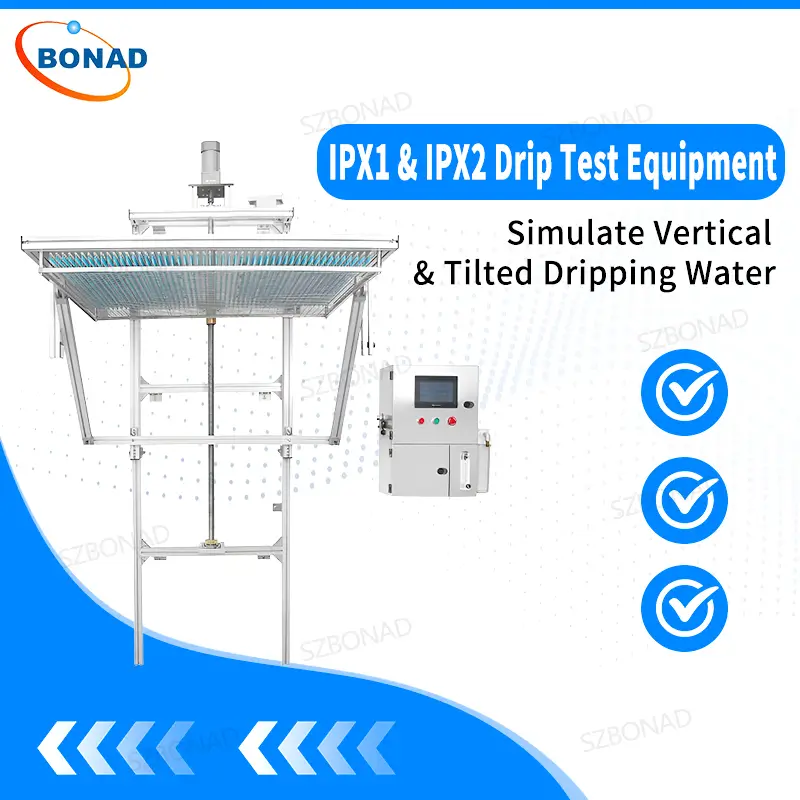
IEC 60529 IPX1 IPX2 Dripping Water Test Apparatus
Standard-compliant drip test system for IPX1 and IPX2 waterproof evaluation.
Why it matters:
- Ensures uniform droplet distribution
- Critical for basic enclosure sealing validation
- Widely used in appliances, lighting, and control panels
IPX3 & IPX4 Testing: Spray and Splash Simulation
These tests simulate real-world outdoor conditions, such as rain and water splashing.
- IPX3: Water sprayed at angles up to 60°
- IPX4: Water splashed from any direction
IPX4 is especially important because it reflects daily exposure scenarios, not immersion.
Recommended Equipment
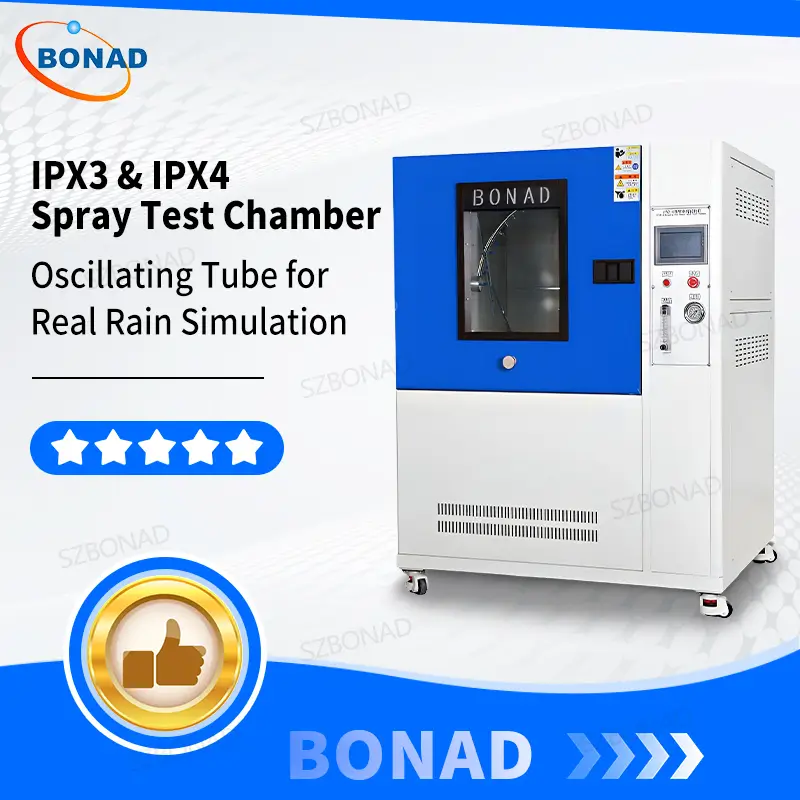
Oscillating Tube Test Chamber for IPX3 IPX4 Water Spray Test
Oscillating tube system for accurate spray and splash waterproof testing.
Key features:
- Oscillating tube mechanism for uniform spray
- Adjustable angles and flow rates
- Essential for IEC compliance testing labs
What Is IPX4K? (Automotive Standard Upgrade)
In automotive and industrial environments, standard IPX4 is often not sufficient.
This is where IPX4K comes in, defined under ISO 20653.
Key Differences from IPX4:
- Much higher water pressure (~400 kPa)
- Larger nozzle size and higher flow rate
- Simulates high-speed road splash conditions
In simple terms:
IPX4 = normal splash
IPX4K = high-pressure splash (automotive level)
Integrated IPX1–IPX4 Testing Solution
For manufacturers and laboratories, using separate devices for each test can be inefficient.
A more advanced solution is a fully integrated system covering all levels.
Recommended Equipment
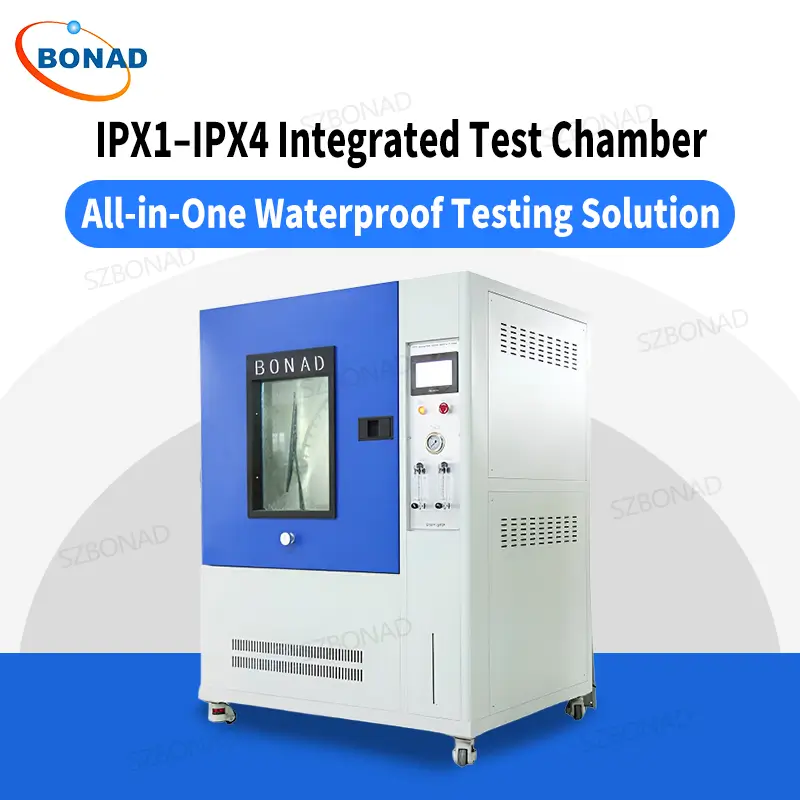
IPX1 to IPX4 Comprehensive Rain Test Equipment
All-in-one waterproof test chamber covering drip, spray, and splash testing.
Advantages:
- One system for all IPX1–IPX4 tests
- Saves space and cost
- Ideal for R&D labs, certification bodies, and manufacturers
How to Choose the Right IPX Testing Equipment
When selecting waterproof testing equipment, consider:
1. Test Scope
- Only drip? → IPX1/IPX2 system
- Outdoor simulation? → IPX3/IPX4
- Full compliance? → Integrated system
2. Sample Size
Ensure the chamber accommodates your product dimensions.
3. Automation Level
- Manual → lower cost
- Programmable → higher efficiency
4. Standards Compliance
- IEC 60529 (general electronics)
- ISO 20653 (automotive, IPX4K)
Applications of IPX1–IPX4 Testing
These tests are widely used across industries:
- Consumer electronics (phones, wearables)
- Lighting systems (outdoor lamps, LED fixtures)
- Automotive components
- Household appliances
- Industrial enclosures
They ensure products remain safe, reliable, and durable under water exposure conditions.
Conclusion
IPX1 to IPX4 waterproof testing forms the foundation of environmental durability validation.
- IPX1–IPX2 → Basic drip protection
- IPX3 → Spray resistance
- IPX4 → Full-direction splash protection
- IPX4K → High-pressure automotive splash
For manufacturers aiming at compliance and quality assurance, selecting the right testing method—and the right equipment—is essential.
Looking for reliable IP waterproof testing solutions?
Contact us today to get customized equipment recommendations for your application.