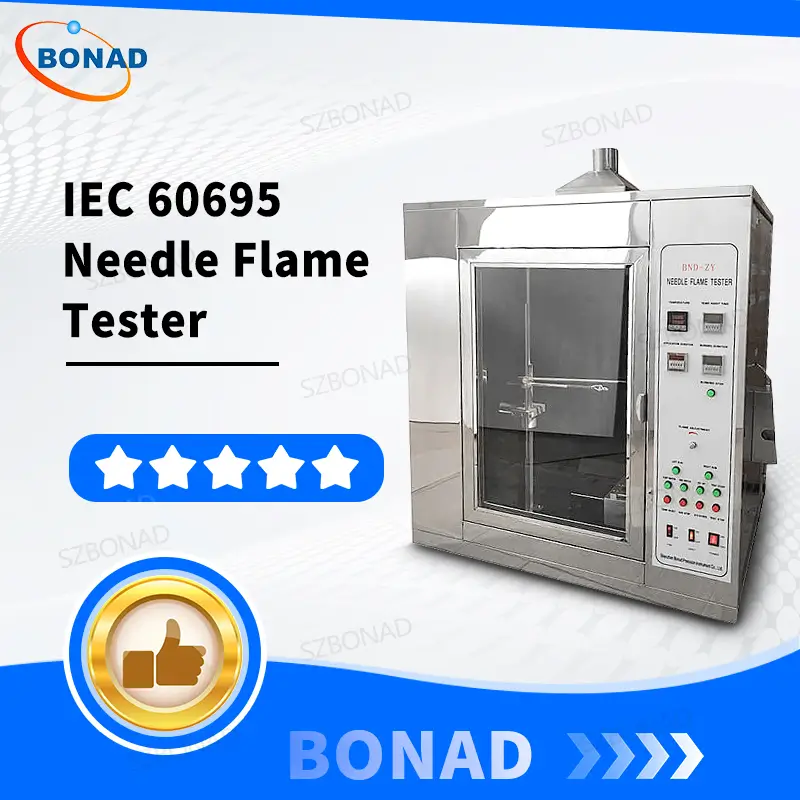
With the rapid advancement of industries such as electrical and electronic equipment, household appliances, lighting, and IT devices, fire safety has become a paramount concern. Faults like short circuits, component overheating, or insulation aging can generate small, localized flames capable of igniting surrounding materials, leading to serious accidents. Accurately simulating and testing these scenarios is vital for product development, quality control, and market certification. The BONAD Needle Flame Tester provides a reliable and precise solution for evaluating resistance to these ignition sources.
Core Principle and Value of Needle Flame Testing
The needle-flame test is a method specifically designed to assess the fire hazard presented by small flames that may result from fault conditions within equipment, such as overload, poor contact, or component failure. It utilizes a specified needle-shaped burner (e.g., Φ0.9mm) to simulate a small flame with an energy output of approximately 1W, applied to the surface or edge of a test specimen. By observing whether the material ignites, if flames spread, and the duration of afterflame, it quantifies the material’s ability to resist ignition by a small flame.
The core value of this test lies in its realistic simulation and targeted assessment of potential risks. Instead of simulating large-scale fires, it focuses on the most common and initial ignition sources within electronic products, providing critical data for the first line of fire prevention.
BONAD Needle Flame Tester: Design Philosophy and Core Features
Design Purpose
Engineered to precisely simulate small flame scenarios caused by circuit faults, component overheating, and contact arcing. Its optimized burner design and precise flame control ensure test conditions closely mirror real-world fault states, suitable for testing a wide range of materials and components in both horizontal and vertical orientations.
Key Features & Advantages
- High-Precision Flame Control: Adjustable flame height (12mm±1mm) and strict adherence to standard temperature rise curves (e.g., from 100℃±2℃ to 700℃±3℃ in 23.5s±1s), guaranteeing consistent test conditions.
- Intelligent Data Recording: Automatically or manually records flame application time (Ti), afterflame time (Te), and glow time (Tg) in a range of 0~999.9s with an accuracy of ±0.1s. Supports test pause for observation.
- Flexible Test Programming: Allows single or consecutive flame applications. Flame application time is customizable from 0~999.9s (standard recommendation is 30s), meeting diverse product testing sequences.
- Safe & User-Friendly Operation: Features a large LCD touch screen and supports remote control, minimizing operator exposure to high-temperature areas and enhancing safety.
- Comprehensive Data Analysis & Reporting: Built-in functions for statistical analysis, capable of generating trend graphs, statistical reports, and compliance documentation for standards like IEC 60695 and UL 94.
- Versatile Sample Support: Compatible with both horizontal (H) and vertical (V) sample holders, accommodating products of various shapes and sizes.
Detailed Application Fields
Electrical and Electronic Equipment
Critical for testing the flame resistance of low-voltage appliances, switches, sockets, relay housings, circuit breaker insulation, and terminal blocks. Simulates small flames from contact arcing to verify compliance with standards like GB/T 5169.5-2020 and IEC 60695-11-5:2016. Also applicable for assessing cable insulation under localized overheating conditions.
Information Technology and Audio-Visual Equipment
Tests enclosures and internal insulating materials of computers, printers, routers, and mobile devices. Simulates overheating scenarios in chips or power modules, ensuring products meet safety standards such as GB/T 4943.1-2022, IEC 62368-1:2023, and UL 94:2024. This is a key validation tool for fire safety design in high-density, miniaturized electronics.
Lighting Equipment
Evaluates flame resistance for LED driver housings, heat sinks, lampholder insulation, and potential high-temperature areas in stage and outdoor lighting. Essential for meeting the needle-flame test requirements of standards like GB 7000.1-2015 and IEC 60598-1:2020.
Automotive Electronics and On-board Equipment
Tests components in new energy and traditional vehicles, including navigators, onboard chargers, wiring harness insulation, central control panels, and Battery Management System (BMS) housings. Helps products comply with industry-specific standards like GB/T 2408-2021 and ISO 6722-1:2019.
Material R&D and Testing Laboratories
Widely used for evaluating and optimizing the flame resistance of engineering plastics (e.g., ABS, PC, PA), flame-retardant polymers, epoxy glass laminate boards, and polyimide films. Provides crucial data for material science research and development.
Key Considerations for Conducting Needle Flame Tests
- Sample Preparation and Conditioning: Specimens must be prepared to exact standard dimensions and quantities, and conditioned in a controlled atmosphere (typically 23±2°C, 50±5% RH for at least 24 hours) to ensure comparable results.
- Burner Calibration and Maintenance: Regularly calibrate the flame temperature curve using a standard thermocouple. Ensure the burner nozzle is unclogged and the gas (typically butane) purity and pressure are stable. This is fundamental for test accuracy.
- Safe Operating Procedures: Tests must be conducted in a well-ventilated combustion chamber or fume hood. Operators must wear personal protective equipment (PPE) like safety glasses and gloves and be familiar with emergency fire extinguishing procedures.
- Rigorous Result Interpretation: Beyond timing data, careful observation and documentation are required for phenomena such as flame spread to the holder, whether droplets ignite the tissue paper, and the charring extent of the sample. These are critical for assessing fire risk.
- Background Check Tests: To ensure laboratory consistency, standards require periodic background tests using specified calibration materials (e.g., polypropylene film) to verify the overall condition of the test system.
Industry Outlook
Globally tightening product safety regulations, combined with the trend of electronics toward higher power density, increased miniaturization, and more complex integration, make the assessment of fire risks from internal faults more critical than ever. The needle-flame test, as a classic method for simulating initial fault flames, will see sustained demand growth.
Future trends that will further drive the application of needle-flame testing include:
- New Energy Vehicles & Energy Storage Systems: Fire safety requirements for high-voltage electrical systems and internal components of battery packs will generate significant testing needs.
- IoT & Smart Home Devices: The multitude of connected devices operating continuously makes the flame resistance of internal power supplies and electronic modules crucial.
- Miniaturized Consumer Electronics: Products like TWS earbuds and smartwatches, with their extremely compact spaces, demand higher flame-retardant grades from materials.
- New Material Development: Research into flame-retardant modifications for bio-based materials and novel high-performance engineering plastics requires precise testing equipment for validation.
With its high accuracy and reliability, the BONAD Needle Flame Tester will be an invaluable tool for manufacturers, testing laboratories, and R&D institutions to address these challenges, meet global mainstream standards (IEC, UL, ISO, GB), and enhance the intrinsic safety of their products.
Why Choose the BONAD Needle Flame Tester?
- Modular & Flexible Design: Easily adaptable to various test scenarios based on sample size and orientation.
- Accurate & Reliable Data: Precise control of core parameters combined with high-accuracy K-type thermocouple measurement ensures repeatable and reproducible results, providing strong support for certification.
- Robust & User-Centric: Constructed with high-quality, heat-resistant materials like stainless steel for durability. Features an intuitive human-machine interface and a streamlined, safe operating procedure.
- Professional Support & Recognition: Backed by over a decade of industry experience and technical expertise, our equipment is widely market-approved. We offer comprehensive technical consultation, operational training, and after-sales support.
Conclusion
The BONAD Needle Flame Tester is a professional solution for the precise evaluation of small flame ignition risks in electrical/electronic products, components, and materials. Its strict compliance with international standards not only helps users effectively identify potential fire hazards but also provides a scientific basis for product safety design improvements, material selection, and quality certification. In today’s landscape of increasingly stringent safety regulations and intense market competition, investing in a reliable needle flame tester is a strategic step to ensure product safety and gain market trust.