Freezing load testing is a critical process in evaluating the real-world performance of refrigeration appliances. One key challenge for manufacturers, laboratories, and certification bodies is that there is no single global standard. Different regions—including Europe, North America, and Australia/New Zealand—adopt different testing standards, procedures, and test package specifications.
Understanding these differences is essential for:
- Global market access
- Product certification
- Accurate performance validation
This guide provides a deep technical breakdown of freezing load testing, with a strong focus on regional standards, test package variations, and featured snippet-ready explanations.
What is freezing load testing?
Freezing load testing is a standardized method used to evaluate a freezer’s ability to freeze a defined thermal load under controlled conditions. It uses calibrated test packages to simulate real food products, allowing accurate measurement of freezing capacity, temperature stability, and energy performance according to standards such as IEC 62552, DOE, and AS/NZS.
How is freezer performance tested?
Freezer performance testing typically includes the following steps:
- Place standardized test packages inside the freezer
- Set controlled ambient conditions using a test chamber
- Monitor temperature changes using calibrated sensors
- Measure the time required to reach target freezing temperature
- Record energy consumption during the testing process
- Compare results with applicable standards (IEC, DOE, AS/NZS)
What are the differences between IEC, DOE, and AS/NZS freezer testing standards?
| Standard | Region | Key Focus | Test Package Requirement |
|---|---|---|---|
| IEC 62552 | Europe / Global | Freezing performance + energy | Standardized thermal packages |
| DOE / AHAM | North America | Energy efficiency | Less standardized load methods |
| AS/NZS 4474 | Australia / NZ | Energy + performance | Modified IEC-based packages |
What are freezer test packages?
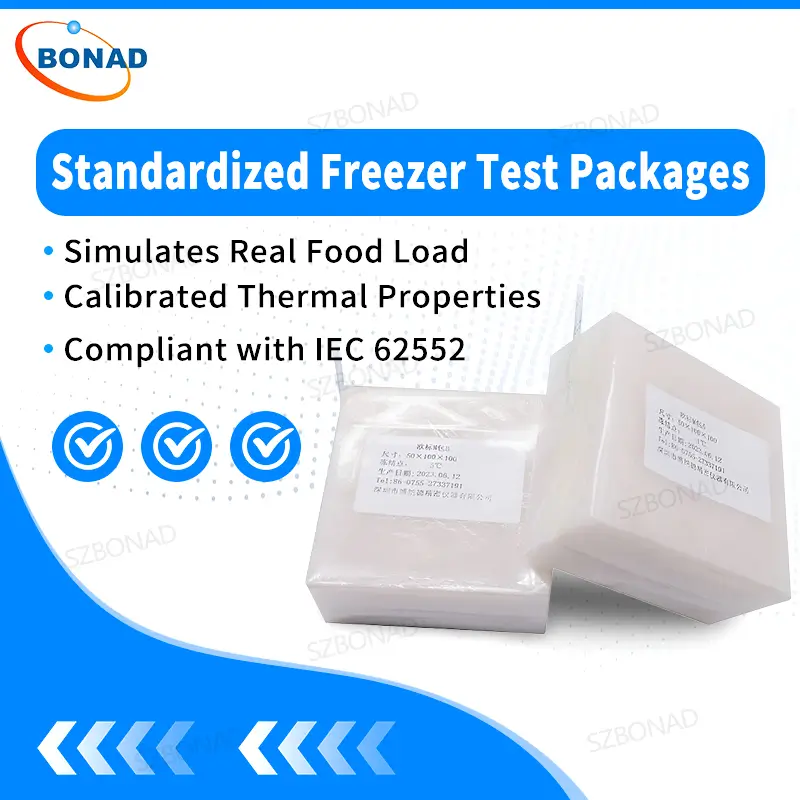
Freezer test packages are standardized thermal loads designed to simulate real food products during refrigeration testing. They are typically made to mimic the thermal properties of lean meat and are used to ensure repeatable and comparable test results across different standards and laboratories.
Why are test packages important in freezing load testing?
Test packages ensure accurate and repeatable testing by simulating real storage conditions inside a freezer. Without standardized loads, test results may vary significantly and may not be accepted for certification or compliance with international standards.
What Is Freezing Load Testing?
Freezing load testing evaluates a freezer’s ability to:
- Freeze a defined thermal mass
- Maintain stable internal temperatures
- Operate efficiently under realistic conditions
Instead of empty testing, standardized thermal test packages are used to simulate actual food loads.
Major Freezing Load Testing Standards by Region
🇪🇺 Europe – IEC / EN Standards
- Core Standard: IEC 62552 (EN 62552)
- Focus: Freezing capacity, energy consumption, temperature performance
- Test Packages: Standardized blocks (~500g), thermal properties mimicking lean meat, optional thermocouples
🇺🇸 North America – DOE / AHAM Standards
- Key Standards: DOE regulations, AHAM HRF-1
- Focus: Energy efficiency and performance rating
- Test Packages: Alternative load simulation, focus on energy performance rather than standardized thermal mass
🇦🇺 Australia & New Zealand – AS/NZS Standards
- Core Standard: AS/NZS 4474
- Focus: Hybrid approach: energy + performance
- Test Packages: Similar to IEC, with regional modifications in size, placement, or test conditions
Other Regions
- Southeast Asia, Middle East, South America often adopt IEC 62552 or modified local variants
Core Freezing Load Testing Methods
1. Freezing Capacity Test
- Measures how much load a freezer can process in a given time
- Evaluates performance against standard thresholds
2. Temperature Pull-Down Test
- Evaluates how quickly internal temperature reaches setpoint
- Monitors cooling curve stability and compressor efficiency
3. Energy Consumption Test
- Measures energy usage during freezing cycles
- Critical for compliance with energy labeling regulations
4. Temperature Stability Test
- Assesses internal temperature fluctuations under load
- Ensures food safety and storage reliability
Testing System & Equipment Configuration
A professional freezing load testing setup typically includes:
1. Environmental Test Chamber
- Controls ambient temperature and humidity
2. Data Acquisition System
- Multi-channel temperature monitoring
- Energy consumption tracking
3. Sensors & Calibration
- High-accuracy thermocouples
- Calibration traceability
4. Test Packages (Core Element)
- Simulate real food loads
- Ensure standard compliance
Recommended Solution
For compliant and repeatable testing, standardized test packages are essential:
Best Practices for Multi-Standard Testing
- Design systems for multiple standards (IEC + DOE + AS/NZS)
- Use interchangeable test packages for different regions
- Standardize procedures internally to reduce lab variability
- Work with experienced test solution providers for global compliance
Common Mistakes to Avoid
- Using non-standard test packages
- Ignoring regional compliance differences
- Incorrect sensor placement
- Inconsistent loading methods
Conclusion
Freezing load testing is a globally regulated, multi-standard process. Manufacturers must:
- Understand regional standards (IEC, DOE, AS/NZS)
- Use compliant test packages
- Implement accurate and repeatable testing systems
A well-designed testing strategy ensures:
- Faster certification
- Reliable product performance
- Stronger global competitiveness
FAQ:
Are freezing load testing standards the same worldwide?
No. Different regions use different standards and testing methods.
What is the most widely used freezer testing standard?
IEC 62552 is the most globally recognized standard, especially in Europe and many international markets.
Can one test system meet multiple standards?
Yes, with proper configuration and compatible test packages.
Why do test packages differ between standards?
Because each region defines its own testing objectives, such as energy efficiency, freezing capacity, or storage performance.
How can I ensure compliance for global markets?
By using standardized test packages and designing your testing system to support multiple international standards.