Introduction: Enclosure Protection and Standardization
In modern electrical and electronic product design and manufacturing, enclosure protection ratings are a core indicator for evaluating product reliability, safety, and environmental adaptability. Products are widely used in complex environments, from indoor household settings to outdoor industrial sites, where they are exposed to moisture, dripping water, or splashing.
To prevent water ingress from causing circuit shorts, component failures, or safety hazards, product enclosures must provide effective protection. The International Electrotechnical Commission (IEC) established the globally recognized IEC 60529 Ingress Protection (IP) Code system.
Within this framework, IEC 60529 waterproof testing for IPX1 and IPX2 drip test boxes plays a fundamental role. These tests simulate a product’s ability to resist condensation, vertical dripping, or slightly inclined dripping. Understanding this testing is the first step to ensuring minimum waterproof requirements, achieving compliance certification, and gaining market trust.
Analysis of IPX1 and IPX2 Ratings under IEC 60529
The IP code consists of the letters “IP” followed by two digits. The first digit indicates protection against solid foreign objects, and the second digit indicates protection against water ingress. IPX1 and IPX2 represent the first and second levels of liquid ingress protection.
Test Conditions and Requirements
- IPX1 (Vertical Drip Test): This level simulates vertical dripping, such as condensation. The sample is placed in its normal operating position and exposed to water droplets falling vertically from the top of the test chamber for 10 minutes. After the test, no harmful water accumulation should occur inside the enclosure.
- IPX2 (15° Inclined Drip Test): This test simulates conditions where the enclosure is tilted up to 15° while exposed to vertical dripping. Samples are sequentially exposed to four fixed tilt angles (or mounted on a slow-turning platform), with each angle lasting 2.5 minutes, totaling 10 minutes.
Testing Principles and Key Parameters
The core principle of IPX1 and IPX2 testing is generating uniform and stable water droplets using a standardized drip plate. Key technical parameters include:
- Drip hole diameter: 0.4 mm
- Hole spacing: 20 mm
- Droplet precipitation rate: 1.0 ± 0.5 mm/min
These precise specifications ensure that IPX1/X2 test results are consistent, repeatable, and comparable across laboratories worldwide, guaranteeing the authority and reliability of the testing process.
Expanded Knowledge on IPX1/IPX2
Beyond basic definitions, understanding IPX1 and IPX2 ratings requires attention to additional technical, design, and operational details.
Environmental Simulation
- IPX1 primarily simulates vertical condensation or light dripping in static conditions. This includes slow rain on a roof, ceiling leaks, or water vapor condensation in humid environments.
- IPX2 simulates light rain under slight tilt or small wind influence, such as devices installed at an angle, ceiling-mounted fixtures, or tilted enclosures in outdoor or industrial installations.
Design Implications for Products
- Proper sealing of openings, cable entries, and ventilation holes is critical. Even a small gap can compromise IPX1/IPX2 compliance.
- Gaskets, O-rings, and silicone seals are often used to achieve required protection.
- Designers should consider both vertical and inclined exposure for enclosures mounted at non-horizontal positions.
Common Testing Pitfalls
- Incorrect tilt or placement: Misalignment of samples can cause uneven exposure, resulting in unreliable results.
- Drip plate calibration errors: Water flow must meet standard requirements; too high or too low flow invalidates the test.
- Sample surface preparation: Dust, debris, or surface roughness may affect water behavior and lead to inconsistent results.
Safety Considerations
- Electrical devices under test must be isolated or de-energized, unless testing under live conditions is specifically required and safely managed.
- Overflow or leakage should be captured by drain systems to prevent laboratory hazards.
- Operators must ensure no splashing or dripping reaches unintended areas during tests.
Industry Applications
- Lighting fixtures: Ceiling lamps, LED panels, and emergency lights.
- Control cabinets: Electrical distribution panels in indoor and semi-outdoor environments.
- Consumer electronics: Smart home devices exposed to condensation or light rain.
- Small appliances: Devices with partial water exposure, such as bathroom or kitchen electronics.
Technical Implementation and Core Role of BONAD Drip Test Equipment
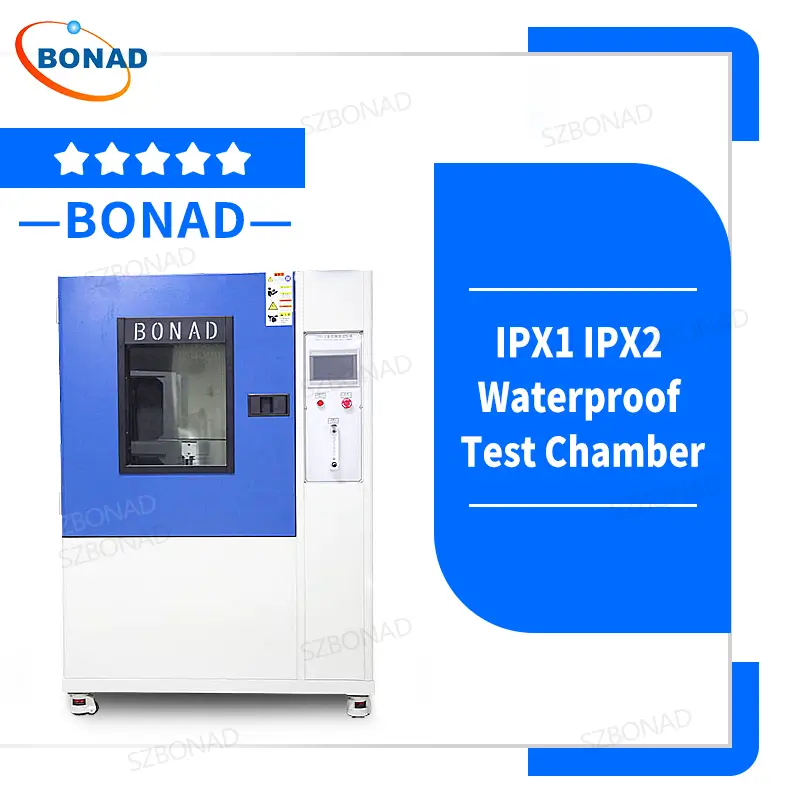
Professional drip test boxes that comply with standards are essential for accurately executing IEC 60529 IPX1 and IPX2 tests. BONAD IPX1/IPX2 waterproof testing equipment is widely used in R&D labs, production quality control, and third-party certification testing.
Precision Drip Plate and Water Supply System
BONAD devices feature precision-engineered drip plates aligned to standard specifications. The carefully arranged holes ensure uniform droplet distribution. A constant-pressure water supply system with flow regulation maintains a stable precipitation rate of 1.0 ± 0.5 mm/min throughout the test, which is critical for reliable results.
Sample Placement and Load Capacity
The BONAD IPX1/IPX2 test chambers provide sufficient space to accommodate various sample sizes. For IPX2 testing, equipment includes adjustable sample holders or slow-turning platforms to control tilt angles precisely. Most BONAD systems support samples weighing up to 150 kg, enabling tests on small controllers, LED lighting fixtures, and large electrical cabinets alike.
Foundational and Expandable Role
IEC 60529 IPX1 and IPX2 drip tests are entry-level but essential evaluations in the broader waterproof testing framework. BONAD drip test systems can integrate with higher-level spray, jet, and immersion testing devices to form a comprehensive IP protection verification solution, covering the full range of ingress protection ratings.
Application Scenarios and Testing Value
The role of BONAD IPX1/IPX2 drip test equipment is critical in several key industry applications:
- Product R&D and Design Verification: Evaluate enclosure sealing structures (gaskets, drainage holes, etc.) during design, preventing costly redesigns due to insufficient waterproofing.
- Production Line Quality Control: Serve as sampling or full inspection tools, ensuring consistent waterproof performance and preventing defective products from reaching customers.
- Third-Party Testing and Certification: Authoritative labs such as SGS, TÜV, and CQC use BONAD equipment to issue test reports, essential for CCC, CE, and UL market access certification.
- Standard Compliance Declaration: Testing allows manufacturers to confidently declare IPX1 or IPX2 protection, providing reliable technical support and increasing customer confidence.
Conclusion
IEC 60529 IPX1 and IPX2 drip testing is more than a simple drip experiment; it is a standardized, quantifiable, and essential assessment process. BONAD IPX1/IPX2 waterproof testing systems convert these standards into precise, repeatable, and efficient tests, providing manufacturers, testing labs, and R&D teams with essential tools to ensure product safety, achieve compliance, and enhance market competitiveness.
Understanding IPX1/IPX2 technical requirements, design implications, common pitfalls, and safety considerations is critical for all stakeholders in electrical and electronic product development. Effective use of BONAD drip test equipment ensures products meet both regulatory requirements and real-world environmental conditions.
Recommended BONAD IPX1/IPX2 Products
- BONAD IPX1/IPX2 Waterproof Test Equipment – Standard vertical and inclined drip testing.
- BONAD IEC 60529 IPX1 IP2X Dripping Water Test Apparatus – Precise angle control and certified for third-party testing.
- BONAD IPX1‑2 Waterproof Laboratory Test Equipment – Laboratory-grade system for research and production verification.